
Skip to content
The Encyclopedia of Horology

Pocket watch · Minute-repeating triple calendar chronograph

Le Phare Minute-Repeating Triple Calendar Chronograph

Partially verified

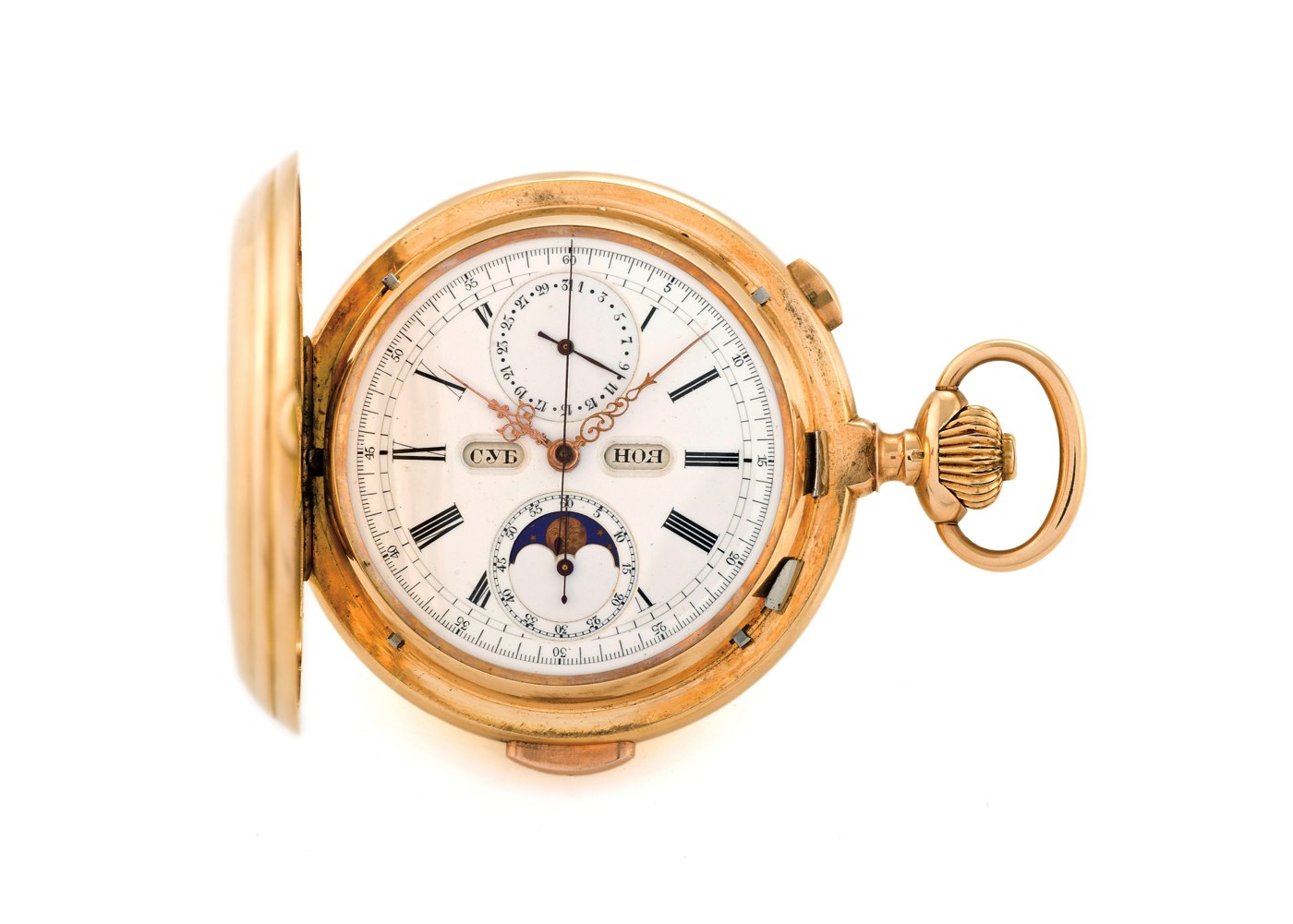
This Le Phare pocket watch, created by C. Barbezat-Baillot in Locle, Switzerland, is a complex timepiece designed for the Russian market and retailed by N.N. Boutte. Dating to approximately 1910, the watch features a large, four-body, hunting-style pink gold case measuring 57.5 mm in diameter. The engine-turned exterior is complemented by a white enamel dial with Roman numerals and a multi-functional layout including a triple-date calendar, chronograph, and moon phase display. The movement is a 20-ligne frosted gilt caliber, fitted with 19 jewels and a minute-repeater mechanism controlled by a push-button on the case band. Technical attributes include a straight-line lever escapement, cut bimetallic compensation balance, and a centrifugal governor. The hinged gold cuvette displays engraved prize medals and information regarding the watch's technical specifications, with a glazed cover allowing for observation of the movement mechanics.

Le Phare hunting-cased pocket watch with triple calendar and moon phase.
Le Phare hunting-cased pocket watch with triple calendar and moon phase. — Antiquorum. Rights pending — permission not yet requested. Original source

Catalogue identity

Source
catalog.antiquorum.swiss
Category
Pocket watch · Minute-repeating triple calendar chronograph
Maker / attribution
Le Phare (C. Barbezat-Baillot)
Reference
Not recorded
Catalogue / lot identifier
21
Source-reported date
circa 1910
Source-reported place
Switzerland
Source-reported serial
73699

Source-reported attribution and specifications are not independent authentication. A listing does not establish present ownership, current display, availability or permission to reproduce.

Object description

Case and Dial Construction

The watch is housed in a four-body, hunting-style case of the 'bassine et filets' design. The exterior is decorated with engine-turning and finished with polished borders. The internal structure includes a hinged gold cuvette that serves as a canvas for technical details and marks representing prize medals awarded to the maker. A glazed, gold-rimmed cover is provided to allow visual access to the movement.

The white enamel dial features radial Roman numerals and an outer minute track, supplemented by fifths-of-a-second divisions to support the chronograph function. Subsidiary dials track the seconds and date, while additional apertures are provided for the day of the week, the month in Cyrillic, and the lunar cycle. The time is displayed using gilt Louis XV style hands.

Evidence for this section
  • “Four-body, bassine et filets, engine-turned with polished borders.”
  • “Hinged gold cuvette engraved with prize medals and technical details, glazed gold-rimmed cover to view the movement.”
  • “apertures for the days of the week, months (in Cyrillic) and moon phases.”

Movement and Complications

The 20-ligne movement is finished in frosted gilt and utilizes 19 jewels. It operates using a straight-line lever escapement and includes a cut bimetallic compensation balance, paired with a blued steel Breguet balance spring for rate adjustment. An index regulator manages the timing.

The complex repeating mechanism is built to chime on gongs, which are activated via a push-button located on the case band. A centrifugal governor regulates the speed of the repeater striking. Additionally, the watch incorporates chronograph functionality and a triple-date calendar system.

Evidence for this section
  • “Cal. 20''', frosted gilt, 19 jewels, straight line lever escapement”
  • “cut bimetallic compensation balance, blued steel Breguet balance spring, centrifugal governor, index regulator”
  • “repeating on gongs activated by a push-button on the band.”

Condition and Attribution

The auction description reports the watch as being in 'Very good' condition for the dial and 'Good' condition for the case and movement. The source identifies the watch as being intended for the Russian market and produced by the firm of C. Barbezat-Baillot, operating under the name Le Phare, around 1910.

The case is numbered, and the cuvette is specifically signed by Le Phare to confirm its attribution.

Evidence for this section
  • “Made for the Russian market, circa 1910.”
  • “Case numbered, cuvette signed "Le Phare".”
  • “Overhaul recommended, at buyer's expense”

Open research questions

  • What specific prize medals are referenced in the engraving on the cuvette?
  • Is there further documentation regarding the retail activity of N.N. Boutte in the Russian market?

Source evidence

Recorded claims and source quotations for Le Phare Minute-Repeating Triple Calendar Chronograph
FieldSource-reported valueSource quotation
MakerLe Phare (C. Barbezat-Baillot, Locle)“Le Phare (C. Barbezat-Baillot, Locle)”
RetailerN.N. Boutte“retailed by N.N. Boutte”
Case material14K (56 Zolotniks) pink gold“14K (56 Zolotniks) pink gold”
Case number73699“case No. 73699”
Movement caliber20 lignes“Cal. 20'''”
Jewel count19“19 jewels”
Diameter57.5 mm“DIAM. 57.5 mm”

Visible details

  • White enamel dial with Cyrillic calendar displays.
  • Hunting case style with hinged cover.
  • Push-button on the side band for the minute repeater.
  • Gilt Louis XV style hour and minute hands.

Research qualifications

  • The auction house reports that an overhaul is recommended.
  • The specific retail arrangement with N.N. Boutte is based on the source's assertion.

Photograph identity and source facts were screened before import; rights clearance remains pending.