
Skip to content
The Encyclopedia of Horology

Pocket watch · Chronograph

L. Leroy & Cie. Ecran Paramagnetique Chronograph

Partially verified

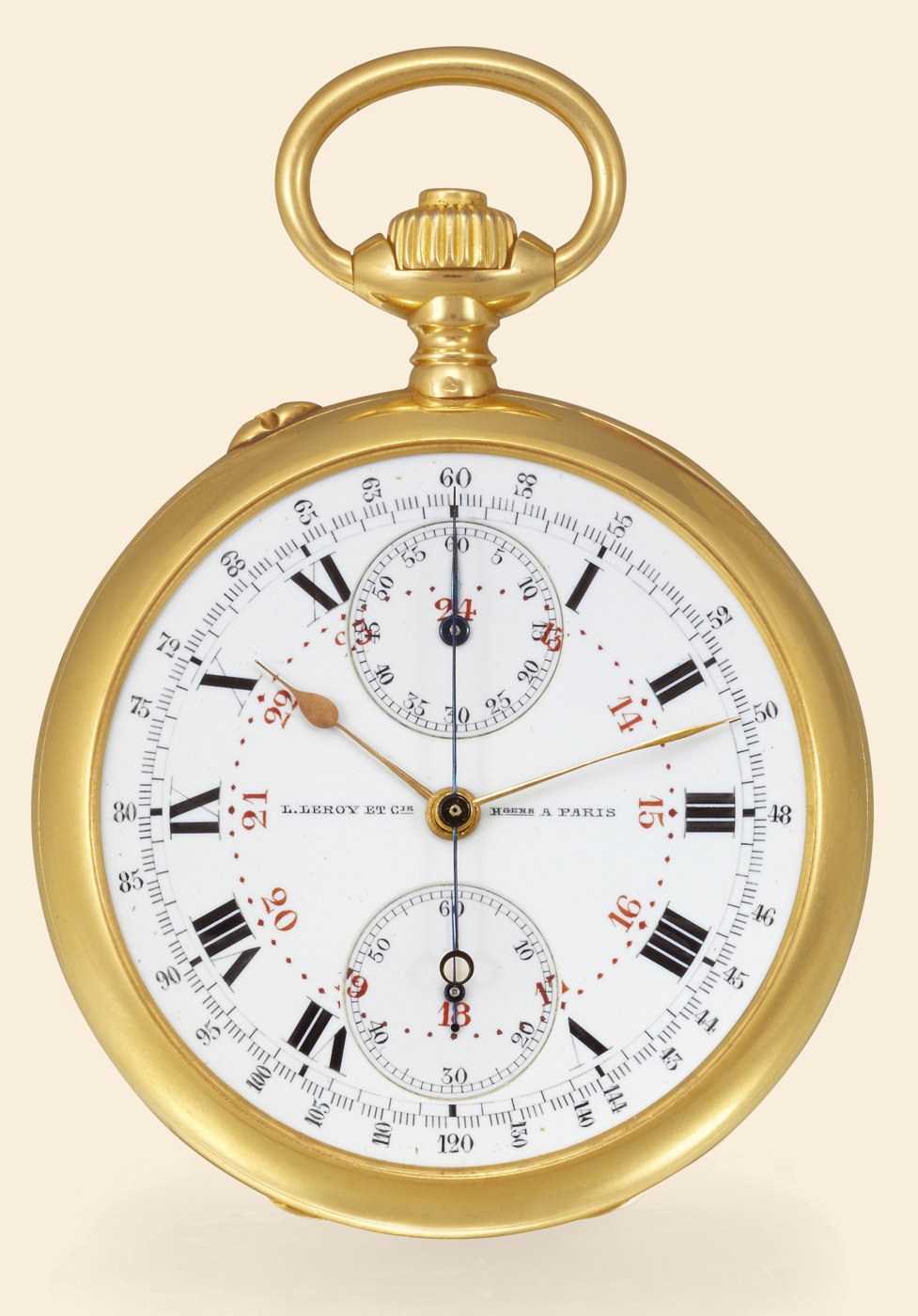
This L. Leroy & Cie. 'Ecran Paramagnetique' is an 18K gold keyless dress pocket watch manufactured in Paris circa 1900. It features an 18K gold three-body 'bassine' polished case that houses a specialized soft iron inner shield, designed to function as an antimagnetic enclosure for the movement. The timepiece is driven by a 19-ligne gilt brass movement with 23 jewels, utilizing a straight-line lever escapement and a bimetallic compensation balance with a blued steel Breguet balance spring. The watch includes a chronograph complication with an instantaneous 60-minute register, operated via a push-button integrated into the winding crown. The white enamel dial displays radial Roman numerals, an internal 13-24 hour track, an outer tachymeter, and subsidiary registers for seconds and minutes. This specimen is signed by the maker on the dial, cuvette, and movement, and measures 51 mm in diameter.

Front view of the L. Leroy & Cie. 18K gold pocket watch, showing the white enamel dial with Roman numerals and the chronograph registers.
Front view of the L. Leroy & Cie. 18K gold pocket watch, showing the white enamel dial with Roman numerals and the chronograph registers. — Antiquorum. Rights pending — permission not yet requested. Original source

Catalogue identity

Source
catalog.antiquorum.swiss
Category
Pocket watch · Chronograph
Maker / attribution
L. Leroy & Cie.
Reference
Not recorded
Catalogue / lot identifier
629
Source-reported date
circa 1900
Source-reported place
France
Source-reported serial
69774

Source-reported attribution and specifications are not independent authentication. A listing does not establish present ownership, current display, availability or permission to reproduce.

Object description

Case and Dial Design

The watch is housed in an 18K gold three-body case characterized by a polished 'bassine' profile. The exterior is notable for an engraved monogram on the case back, while the interior protects the mechanism with a soft iron casing.

The dial is executed in white enamel, presenting a complex layout with radial Roman numerals and an interior red-printed 13-24 hour track. Additional tracks include an outer minute and fifths-of-a-second divisions, along with an outermost tachymeter scale. Time is indicated by gold 'Spade' hands, and the functionality of the chronograph is managed through a button integrated into the winding crown, which operates the movement's visible chronograph work.

Evidence for this section
  • “Three body, "bassine", polished, the back engraved with a monogram, inner soft iron case forming an antimagnetic shield.”
  • “outermost tachymeter scale, subsidiary seconds at 6 and 60-minute register at 12.”
  • “The case of the present watch is an early example of the type later used by manufacturers such as Rolex, Omega and IWC”

Movement and Escapement

The movement is a 19-ligne gilt brass caliber containing 23 jewels. It employs a straight-line lever escapement and a bimetallic compensation balance, which is cut at the center of the rim to facilitate thermal adjustment. The timing regulation is controlled by an index regulator acting upon a blued steel Breguet balance spring.

The chronograph mechanism is visible and configured for an instantaneous 60-minute register positioned at the 12 o'clock mark. The entire assembly is signed, consistent with the signatures present on the dial and the cuvette, reflecting the manufacturer's authentication of the internal components.

Evidence for this section
  • “, gilt brass, 23 jewels, straight line lever escapement, bimetallic compensation balance cut in the middle of the rim, blued steel Breguet balance spring, index regulator, chronograph with visible work”
  • “instantaneous 60-minute register a”
  • “Dial, cuvette and movement signed.”

Condition and Attribution

The auction description provides a grade of AA, indicating a 'very good' status, though individual components show signs of age. The case is described as being in good condition but with visible patination and wear, while the movement is noted as requiring an overhaul to ensure optimal function.

The watch is attributed to L. Leroy & Cie. of 7 Boulevard de la Madeleine, Paris, with a serial number of 69774.

Evidence for this section
  • “Grading System Grade: AA Very good”
  • “Case: 3-10-12 Good Patinated Worn”
  • “Movement: 3* Good Overhaul recommended”
  • “L. Leroy & Cie. A Paris, 7 Boulevard de la Madeleine, No. 69774. Made circa 1900.”

Open research questions

  • What specific metal alloy was used for the 'Ecran Paramagnetique' soft iron shield?
  • Are there contemporary L. Leroy & Cie. patents or advertisements that further detail the intended performance of this early antimagnetic case?

Source evidence

Recorded claims and source quotations for L. Leroy & Cie. Ecran Paramagnetique Chronograph
FieldSource-reported valueSource quotation
MakerL. Leroy & Cie.“L. Leroy & Cie. A Paris”
ReferenceNo. 69774“No. 69774”
Datecirca 1900“Made circa 1900.”
Case material18K gold“18K gold, keyless dress watch”
Movement size19 lignes“M. 19”
Jewel count23“23 jewels”

Visible details

  • The winding crown incorporates a chronograph pusher.
  • The dial includes an outer tachymeter scale.
  • The case back features an engraved monogram.
  • The 12 o'clock register serves as the instantaneous 60-minute counter.

Research qualifications

  • The exact effectiveness of the early soft iron antimagnetic shield compared to later developments is not verified.
  • The extent of the reported 'patinated' condition of the case is subjective to the cataloguer.

Photograph identity and source facts were screened before import; rights clearance remains pending.

Terms in this record

Glossary explanations for terms named in this object’s record.