
Skip to content
The Encyclopedia of Horology

Marine chronometer · Two-day marine chronometer with constant-force escapement

Joseph Banister Marine Chronometer 'Patent No. 1'

Partially verified

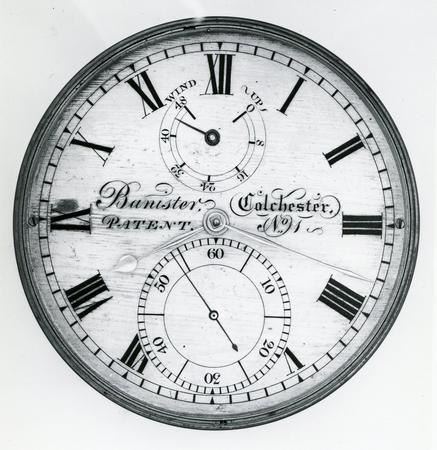
Source cataloguers describe this marine chronometer as produced by Joseph Banister of Colchester between 1830 and 1840. Contained within a standard brass drum with a leather travelling box, the movement features an experimental constant-force escapement where a spiral spring impulses the balance roller through a three-armed pivoted lever. The silvered brass dial is engraved and filled with black wax, displaying Roman numerals, subsidiary seconds, and an up-and-down reserve dial marked to 48 hours. The movement bears ebauche stamp 'J.M.' alongside internal numbers 5000 and 500, a fusee with maintaining power, and a bimetallic balance with a helical spring.

Front view of the silvered brass dial showing signature, subsidiary seconds, and reserve of going indicator
Front view of the silvered brass dial showing signature, subsidiary seconds, and reserve of going indicator — British Museum. Rights pending — permission not yet requested. Original source

Catalogue identity

Source
www.britishmuseum.org
Category
Marine chronometer · Two-day marine chronometer with constant-force escapement
Maker / attribution
Joseph Banister
Reference
Patent No. 1
Catalogue / lot identifier
Source URL identifies the listing
Source-reported date
1830-1840
Country
United Kingdom
Source-reported serial
5000

Source-reported attribution and specifications are not independent authentication. A listing does not establish present ownership, current display, availability or permission to reproduce.

Object description

Dial and Exterior Construction

The object features a silvered brass dial with engraved Roman numerals and an outer minute track, filled with black wax. It includes an upper subsidiary dial for the winding reserve and a lower subsidiary dial for running seconds. The hands are gold for the hours and minutes, and blued steel for the subsidiary indications.

The movement is housed in a brass drum with a threaded bezel and a flat glass. The drum displays filled-in holes previously used for gimbal mounting and a spring-loaded escutcheon plate in the base. The dial is held by two countersunk screws and a positioning peg, and is signed: 'Banister Colchester. Patent No. 1'.

Evidence for this section
  • “Silvered, engraved brass dial, the engraving filled with black wax”
  • “Signature: On the dial only 'Banister Colchester. Patent No. 1'.”
  • “The dial plate is recessed to take the dial flush with the edge, there is a positioning peg and the dial is held by two countersunk screws.”

Movement and Escapement

The movement features a full-plate construction with hand-spotted plates and a fusee with maintaining power. Ebauche marks 'J.M.' are punched on the dial side of the front plate. The movement is numbered '5000' under the maintaining detent and '500' on the inside of the front plate.

The constant-force escapement utilizes a three-armed pivoted lever to impulse the balance via a spiral spring. The system is designed for one-way impulse and incorporates a jewelled discharge roller. Observers note that the escapement components, particularly the two-part balance cock, exhibit comparatively crude workmanship, suggesting that a standard chronometer movement was modified and fitted with these parts by Joseph Banister.

Evidence for this section
  • “Ebauche marks punched on the dial side of the front plate 'J.M.' Numbered under the maintaining detent 5000, and on the front plate inside 500.”
  • “Escapement: A type of constant force escapement in which a spiral spring gives impulse to a roller on the balance staff via a pivoted lever.”
  • “It appears from the comparatively crude workmanship of the escapement parts, especially the two cocks, that a standard chronometer movement was modified and fitted with these extra parts by Joseph Banister”

Attribution and Context

The chronometer is dated by the source to 1830–1840. Joseph Banister (1778–1875) obtained patent No. 7083 on 7 May 1836, which covered a gravity escapement for a precision regulator and improvements applicable to watches and chronometers.

The source notes that while it is assumed this chronometer represents the improvement mentioned in the patent, it is not clear what the specific improvement referred to in the patent actually is.

Evidence for this section
  • “Production date 1830-1840”
  • “It is not clear what the improvement to watches and chronometers referred to in the patent actually is, but it is assumed that this chronometer is an example.”

Open research questions

  • Are there archival records documenting the 'J.M.' ebauche stamp in relation to specific chronometer makers of the period?
  • Can the modifications identified as 'comparatively crude' be distinguished from the primary construction by metallographic analysis?

Source evidence

Recorded claims and source quotations for Joseph Banister Marine Chronometer 'Patent No. 1'
FieldSource-reported valueSource quotation
Museum number1958,1006.1949“Museum number 1958,1006.1949”
Dial inscriptionBanister Colchester. Patent No. 1“Signature: On the dial only 'Banister Colchester. Patent No. 1'.”
Ebauche markJ.M.“Ebauche marks punched on the dial side of the front plate 'J.M.'”
Movement number5000“Numbered under the maintaining detent 5000”
Production placeColchester“Made in: Colchester”
Escapement typeConstant-force escapement“Escapement: A type of constant force escapement in which a spiral spring gives impulse to a roller on the balance staff via a pivoted lever.”
Museum number1958,1006.1949“Museum number 1958,1006.1949”
Escapement typeConstant-force escapement“Escapement: A type of constant force escapement”

Visible details

  • Silvered dial with engraved Roman hour numerals and outer closed minute track
  • Upper subsidiary dial for state of winding marked WIND 48 to UP 0
  • Lower subsidiary dial for running seconds with Arabic numerals at ten-second intervals
  • Engraved signature across the dial centre reads 'Banister, Colchester. PATENT. No 1'
  • Dial plate secured by two countersunk screws visible near the III and IX hour numerals

Research qualifications

  • The leather travelling box, brass drum case, and key described by the source are not shown in this dial photograph
  • Movement details and constant-force escapement mechanisms are concealed behind the dial

Photograph identity and source facts were screened before import; rights clearance remains pending.

Consulted source

marine chronometer; clock-case; box; clock-key | British Museum

Reviewed 2026-10-25 · Record 179da797c6