
Skip to content
The Encyclopedia of Horology

Marine chronometer · Two-day marine chronometer

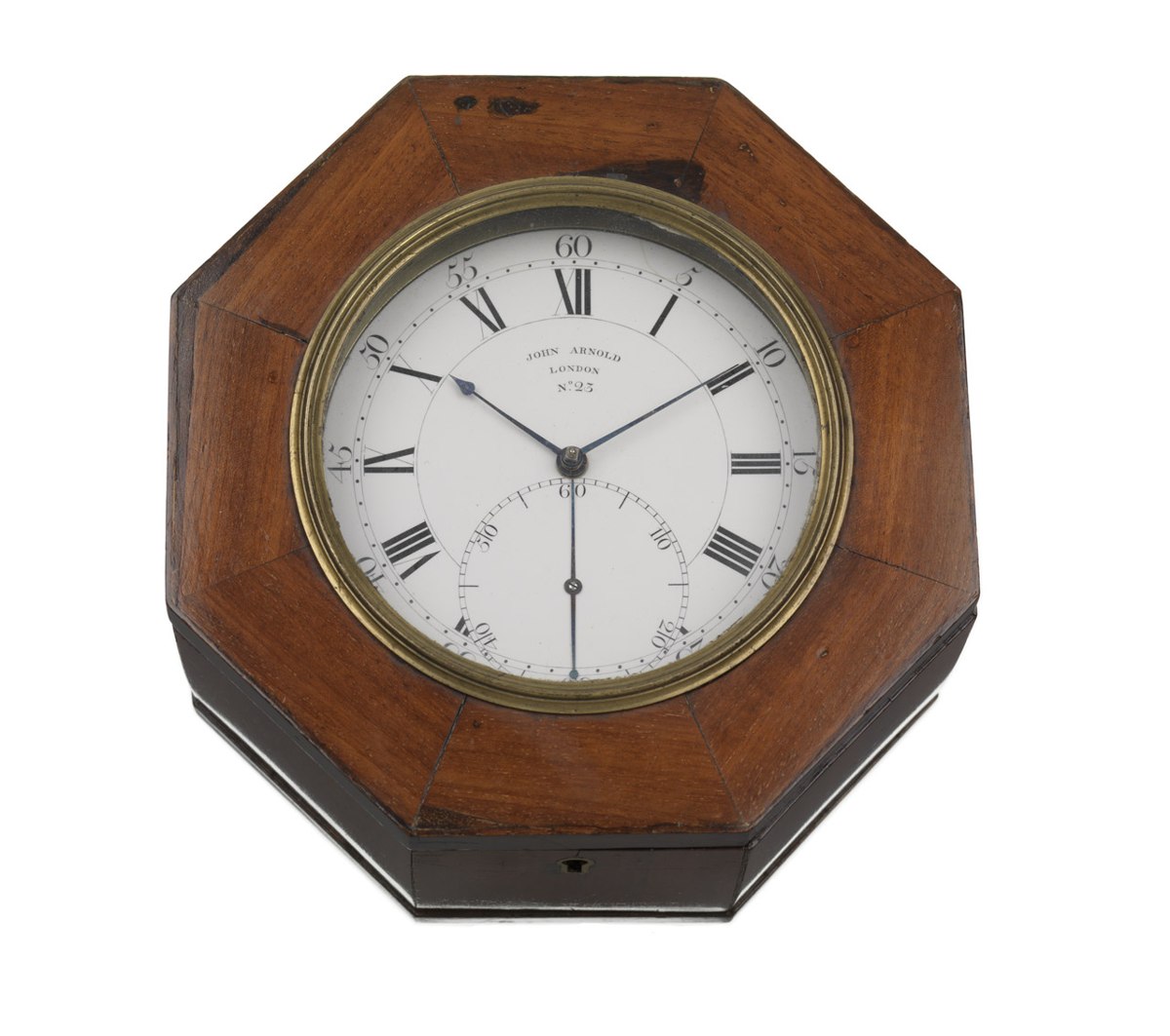
John Arnold & Son No. 23 two-day marine chronometer in octagonal mahogany box

Partially verified

This two-day marine chronometer was constructed by John Arnold & Son in London circa 1784. It is housed in an octagonal mahogany box featuring concealed joints and an eight-segment radially jointed lid with a glazed brass bezel. The white enamel dial is marked with Roman numerals, Arabic five-minute outer markers, and an expansive subsidiary seconds ring, signed 'JOHN ARNOLD / LONDON / No.23'. According to the source, the movement incorporates a full-plate fusee setup with Harrison's maintaining power, an early Arnold spring detent escapement, a blued-steel helical balance spring, and an early Arnold 'Z' balance with bimetallic segments.

Top-down view of the marine chronometer dial through the glazed aperture of the octagonal mahogany case
Top-down view of the marine chronometer dial through the glazed aperture of the octagonal mahogany case — National Maritime Museum, Greenwich, London, Caird Collection. Rights pending — permission not yet requested. Original source

Catalogue identity

Source
www.rmg.co.uk
Category
Marine chronometer · Two-day marine chronometer
Maker / attribution
John Arnold & Son
Reference
ZAA0012
Catalogue / lot identifier
Source URL identifies the listing
Source-reported date
circa 1784
Country
United Kingdom
Source-reported serial
23

Source-reported attribution and specifications are not independent authentication. A listing does not establish present ownership, current display, availability or permission to reproduce.

Object description

Case Construction

The chronometer is housed in an octagonal mahogany box measuring 93mm high, 167mm wide, and 167mm deep. The box is veneered in mahogany over a mahogany carcass with concealed joints and a slightly stepped base. The lid features eight radial segments and an 11cm glazed aperture with a moulded brass bezel; the glass is secured with a plaster fillet.

A brass escutcheon is flush-mounted on the front keyhole. The box lid utilizes brass hinges described as later additions, likely from the twentieth century. The base contains a swiveling brass dust shutter for winding, and the exterior sides feature pairs of holes which may indicate the original location of loop handles.

Evidence for this section
  • “Octagonal mahogany box, measuring 93mm high, 167mm wide, and 167mm deep.”
  • “The lid is on two later (probably twentieth century) brass hinges”
  • “There are pairs of holes on the left and right hand sides of the octagonal box, which were probably where a loop handle was fitted.”

Dial and Hands

The 106.1 mm diameter white enamel dial is attached to the pillar plate with three pinned feet and signed 'JOHN ARNOLD / LONDON / No.23'. The layout includes Roman hour numerals, Arabic five-minute markers, and a large subsidiary seconds dial. The seconds dial features Arabic ten-second numerals and radial batons.

The hands consist of a blued-steel spade and poker set, with a counterpoised seconds hand. The rear of the dial bears a red enamel 'N 23' marking, and there are traces of black paper tape noted on the back.

Evidence for this section
  • “The 106.1 mm Ø white enamel dial is attached to the pillar plate of the movement with three pinned feet”
  • “The dial is signed across the upper centre: JOHN ARNOLD / LONDON / No.23.”
  • “On the back of the dial, enameled over the counter-enamel, in red, is: N 23.”

Movement and Escapement

The movement is a full-plate fusee type with four tapered cannon-style pillars. The potence plate is engraved 'John Arnold & Son / London, and No.23 Inv. et Fecit.' The mechanism includes Harrison’s maintaining power and an early Arnold spring detent escapement.

The assembly features an early 'Z' balance with bimetallic rim segments and a blued-steel helical balance spring. The upper balance pivot includes a rose-cut diamond endstone. While the general finish is described as high, the brass wheel work exhibits some surface blistering, and the gold passing spring is considered a replacement.

Evidence for this section
  • “The potence plate is engraved: John Arnold & Son / London, and No.23 Inv. et Fecit.”
  • “The early Arnold “Z” balance has straight, bevelled steel arms”
  • “A brass plugged hole in the detent blade adjacent to the rivet for the current passing spring suggests this passing spring is a replacement.”

Open research questions

  • What is the origin of the penciled notation '25 [sic]' found inside the base of the box?
  • Could the pairs of holes on the box sides definitively confirm the historical attachment of loop handles?

Source evidence

Recorded claims and source quotations for John Arnold & Son No. 23 two-day marine chronometer in octagonal mahogany box
FieldSource-reported valueSource quotation
Box TypeOctagonal mahogany box“Octagonal mahogany box, measuring 93mm high, 167mm wide, and 167mm deep.”
Dial SignatureJOHN ARNOLD / LONDON / No.23“The dial is signed across the upper centre: JOHN ARNOLD / LONDON / No.23.”
EscapementEarly Arnold spring detent escapement“Early Arnold spring detent escapement with brass escape wheel and grained steel foot detent screwed directly on the potence plate”
BalanceEarly Arnold 'Z' balance“The early Arnold “Z” balance has straight, bevelled steel arms and the pivots on the staff are parallel with a straight sided cone behind.”
Plate EngravingJohn Arnold & Son / London, No.23 Inv. et Fecit“The potence plate is engraved: John Arnold & Son / London, and No.23 Inv. et Fecit.”
Dated Estimatecirca 1784“John Arnold & Son, London c.1784”
ProvenanceAcquired from Clowes and Jauncey in 1937“The first that is known of this chronometer is its purchase from Clowes and Jauncey on 21 October 1937”

Visible details

  • Eight-segment radially jointed mahogany lid surrounding a circular glazed aperture within a brass bezel.
  • White enamel dial featuring Roman numerals for the hours, outer Arabic numerals at five-minute intervals, and a large subsidiary seconds dial.
  • Central blued-steel spade hour hand, poker minute hand, and a long counterpoised seconds hand.
  • Octagonal mahogany case with a small keyhole escutcheon centered on the front facet.

Research qualifications

  • Internal movement features including the fusee, 'Z' balance, and spring detent escapement are cited from the museum documentation and not visible in the closed exterior view.
  • The source notes that the lid's brass hinges are later replacements, likely from the twentieth century.

Photograph identity and source facts were screened before import; rights clearance remains pending.

Consulted source

23 | Royal Museums Greenwich

Reviewed 2026-10-25 · Record 3ce7b9f99b

Terms in this record

Glossary explanations for terms named in this object’s record.