
Skip to content
The Encyclopedia of Horology

Pocket watch · Keyless lever chronometer

Golay Fils & Stahl Chronometer Pocket Watch

Partially verified

This Golay Fils & Stahl chronometer pocket watch, serial number 32095, is a precision timepiece designed for observatory trials. Produced around 1914, the 52 mm silver watch features a 20-ligne rhodium-plated movement finished with fausses côtes decoration. The movement includes a straight-line lever escapement, 21 blue sapphire jewels, and a Guillaume compensation balance equipped with gold temperature and meantime adjustment screws. The timepiece utilizes a blued steel Breguet balance spring with a terminal curve and an index regulator. The watch is distinguished by its history of observatory testing, having achieved a first-class bulletin de marche from the Observatoire de Genève in June 1914 and subsequently receiving a Kew A certificate from the National Physical Laboratory in Teddington in July 1914. It is accompanied by its original documentation from both testing facilities, which validates its performance accuracy during the early 20th century.

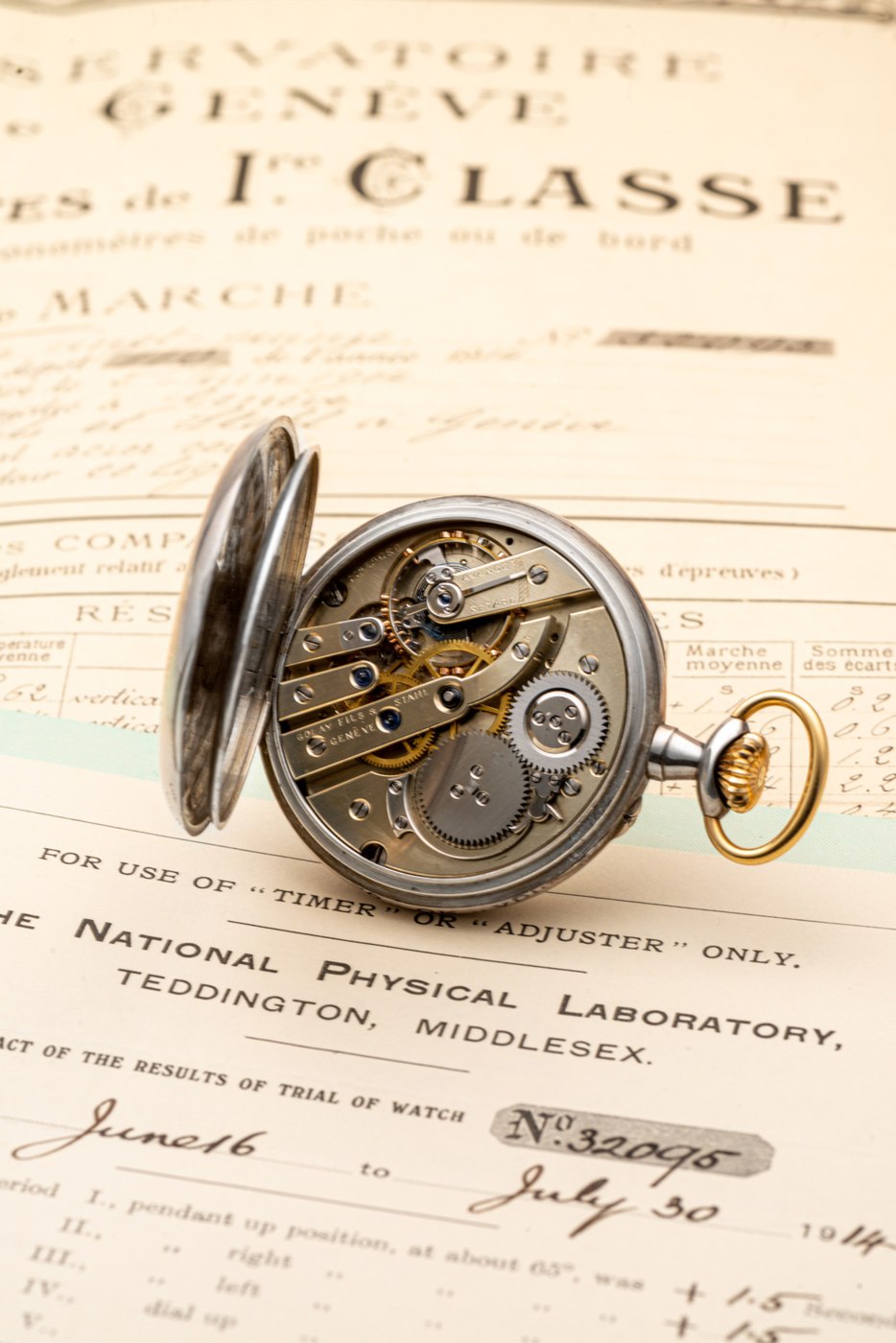
A 20-ligne Golay Fils & Stahl chronometer movement, shown alongside its original observatory testing certificates.
A 20-ligne Golay Fils & Stahl chronometer movement, shown alongside its original observatory testing certificates. — Antiquorum. Rights pending — permission not yet requested. Original source

Catalogue identity

Source
catalog.antiquorum.swiss
Category
Pocket watch · Keyless lever chronometer
Maker / attribution
Golay Fils & Stahl
Reference
Not recorded
Catalogue / lot identifier
84
Source-reported date
circa 1914
Source-reported place
Switzerland
Source-reported serial
32095

Source-reported attribution and specifications are not independent authentication. A listing does not establish present ownership, current display, availability or permission to reproduce.

Object description

Movement and Escapement

The timepiece is powered by a 20-ligne rhodium-plated movement, which incorporates high-grade finishing such as fausses côtes decoration. The mechanical assembly utilizes a straight-line lever escapement and is jeweled with 21 blue sapphire jewels. A prominent technical feature is the Guillaume compensation balance, fitted with gold screws for both temperature and meantime adjustment.

Precision is regulated by a blued steel Breguet balance spring featuring a terminal curve and an index regulator. The winding mechanism includes wolf’s tooth gearing, a detail visible on the winding wheels within the movement. According to the provided information, the watch was specifically engineered for the high-precision requirements of early 20th-century observatory chronometer trials.

Evidence for this section
  • “Calibre 20’’’, rhodium plated, fausses côtes decoration, 21 blue sapphire jewels”
  • “straight line lever escapement, Guillaume compensation balance with gold temperature and meantime adjustment screws”
  • “blued steel Breguet balance spring with terminal curve, index regulator, wolf’s tooth winding”

Observatory Provenance and Documentation

The historical significance of this chronometer is supported by its certification from two distinct testing bodies. In June 1914, the watch was evaluated by the Observatoire de Genève, where it secured a first-class bulletin de marche. This was immediately followed by a submission to the National Physical Laboratory in Teddington, which issued a Kew A certificate on July 30, 1914.

The presence of the original paperwork from both institutions verifies the chronometer's performance history.

Evidence for this section
  • “With original 1 ST class ‘ ’bulletin de marche’ ’ from the Observatoire de Genève on 5 June 1914 and the original National Physical laboratory in Teddington class Kew A certificate from 30 July 1914.”
  • “This Chronometer was submitted successively at the Geneva observatory where it obtained a bulletin de marche for first class category from June 1914 and then immediately submitted to the National Physical laboratory in Teddington where it obtained its Kew A certificate.”

Condition and Attribution

The auction description classifies the condition of the case and dial as 'good' with slight scratching noted. The case, measuring 52 mm in diameter, is constructed from silver.

The watch is signed by Golay Fils & Stahl on the dial, case, and movement. The serial numbers for both the case and the movement are recorded as 32095, confirming that these components are attributed as original to this specific timepiece.

Evidence for this section
  • “Case: 3-8 Good Slightly scratched”
  • “Movement: 3* Good Overhaul recommended”
  • “Signature Dial, Case and Movement”

Open research questions

  • What is the specific manufacturer of the ebauche used by Golay Fils & Stahl for this 20-ligne movement?
  • Do the specific rating results listed in the Kew A certificate indicate a high rank within the 1914 trial cohort?

Source evidence

Recorded claims and source quotations for Golay Fils & Stahl Chronometer Pocket Watch
FieldSource-reported valueSource quotation
MakerGolay Fils & Stahl“Brand Golay Fils & Stahl, Geneve”
Movement Number32095“Movement No. 32095”
Case Number32095“Case No. 32095”
Datecirca 1914“Year Circa 1914”
Diameter52 mm“Diameter 52 mm”
Jewels21 blue sapphire jewels“21 blue sapphire jewels”
Observatory TrialGeneva Observatory and Teddington National Physical Laboratory“CHRONOMETER PRECISION WATCH FOR GENEVA OBSERVATORY TRIAL AND TEDDINGTON OBSERVATORY TRIAL”
BalanceGuillaume compensation balance“Guillaume compensation balance”

Visible details

  • Silver case construction measuring 52 mm in diameter.
  • Movement displays fausses côtes decoration and wolf's tooth winding wheels.
  • Gold-colored crown and bow contrast with the silver case.
  • Engraved signature visible on the movement plate.

Research qualifications

  • The auction description reports the need for an overhaul.
  • The extent of the reported 'slightly scratched' condition on the case and dial is not fully visible in the photograph.

Photograph identity and source facts were screened before import; rights clearance remains pending.