
Skip to content
The Encyclopedia of Horology

Pocket watch · Keyless lever chronometer

L. Fernier & Frères 18K pink gold keyless lever chronometer

Partially verified

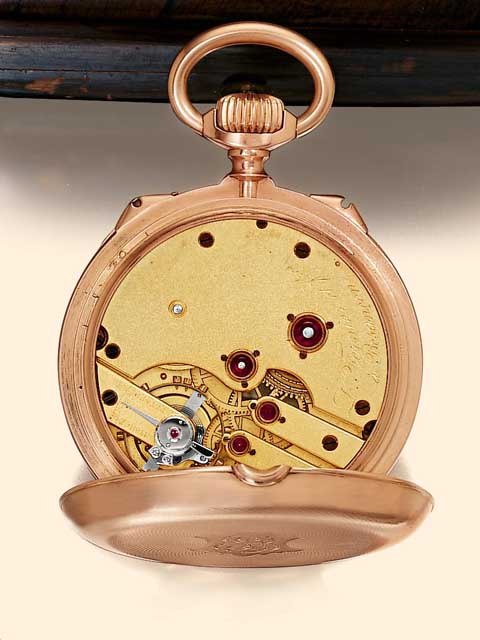
This 18K pink gold pocket watch is attributed to the maker L. Fernier & Frères, Besançon, circa 1890. It features a "bassine et filets" four-body case with an engine-turned back, accompanied by its original wooden fitted box. The watch includes a gold hinged cuvette that opens to reveal a glazed gold bezel, allowing for a clear view of the movement. A specific gold bolt is positioned at 11 o'clock to engage the winding mechanism. The watch is powered by a 44 mm (19 1/2''') frosted gilt half-plate movement containing 20 jewels, with top jewels secured in raised gold settings. A distinct technical feature of this timepiece is its specialized over-winding prevention mechanism, which automatically disengages the winding process upon full tension to protect the mainspring from potential breakage. The dial and case are both signed by the maker.

The frosted gilt half-plate movement and open gold cuvette of the L. Fernier & Frères pocket watch.
The frosted gilt half-plate movement and open gold cuvette of the L. Fernier & Frères pocket watch. — Antiquorum. Rights pending — permission not yet requested. Original source

Catalogue identity

Source
catalog.antiquorum.swiss
Category
Pocket watch · Keyless lever chronometer
Maker / attribution
L. Fernier & Frères
Reference
Not recorded
Catalogue / lot identifier
430
Source-reported date
circa 1890
Source-reported place
France

Source-reported attribution and specifications are not independent authentication. A listing does not establish present ownership, current display, availability or permission to reproduce.

Object description

Case and Dial

The pocket watch is housed in an 18K pink gold four-body case designed in the "bassine et filets" style. The reverse of the case is decorated with engine-turned patterns. A gold hinged cuvette provides protection for the internal movement while allowing access for viewing through a glazed gold bezel. Externally, the watch is fitted with a gold bolt at the 11 o'clock position intended to engage the winding mechanism.

The watch face consists of a white enamel dial featuring radial Roman numeral hour markers and an outer minute track punctuated by Arabic numerals at five-minute intervals. The time is displayed via gold spade-style hands, and a subsidiary sunk seconds dial is positioned on the main dial surface. Both the case and the dial bear the signature of the maker.

Evidence for this section
  • “C. Four-body, "bassine et filets", engine turned back, gold hinged cuvette over glazed gold bezel for viewing the movement, gold bolt at 11 o'clock to engage the winding.”
  • “White enamel, radial Roman numerals, outer minute track with five-minute Arabic markers, subsidiary sunk seconds.”

Movement and Escapement

The timepiece is powered by a 44 mm (19 1/2''') frosted gilt half-plate movement. It is equipped with 20 jewels, with those in the upper section housed in raised gold settings. The escapement is a straight line calibrated lever type, paired with a cut-bimetallic compensation balance and a blued steel Breguet balance spring.

The watch includes a technical system intended to prevent over-winding. This mechanism operates by disengaging the winding system once the mainspring reaches its full tension capacity.

Evidence for this section
  • “frosted gilt, half-plate, 20 jewels, top ones in raised gold settings, straight line calibrated lever escapement, cut-bimetallic compensation balance with blued steel Brguet balance spring”
  • “The overwinding prevention mechanism, which is very rarely found in regular watches by disengaging the winding prevents the mainspring from breaking.”

Condition and Attribution

The object is attributed to L. Fernier & Frères of Besançon, with an approximate production date of 1890. The watch is supplied in its original wooden fitted box.

The auction house lists the watch as a rare example due to the inclusion of the specialized over-winding prevention mechanism. The authenticity of the watch is supported by signatures found on both the dial and the case. All functional components are original as described in the catalogue entry.

Evidence for this section
  • “L. Fernier & Frères, Besançon, circa 1890.”
  • “Grading System Case: 3 Good Movement: 3* Good Overhaul recommended, at buyer's expense”
  • “The overwinding prevention mechanism, which is very rarely found in regular watches”

Open research questions

  • What is the specific patent or inventor associated with the over-winding prevention mechanism used by Fernier & Frères?
  • To what extent did L. Fernier & Frères incorporate this mechanism into other models during the late 19th century?

Source evidence

Recorded claims and source quotations for L. Fernier & Frères 18K pink gold keyless lever chronometer
FieldSource-reported valueSource quotation
MakerL. Fernier & Frères“L. Fernier & Frères, Besançon, circa 1890.”
Case Material18K pink gold“18K pink gold keyless lever chronometer”
Movement Diameter44 mm (19 1/2''')“M. 44 mm. (19 1/2''')”
Jewel Count20“20 jewels, top ones in raised gold settings”
Winding MechanismOver-winding prevention“mechanism disengaging the winding when fully wound.”
Case TypeFour-body bassine et filets“C. Four-body, "bassine et filets", engine turned back”
Dial FeaturesWhite enamel with subsidiary seconds“White enamel, radial Roman numerals, outer minute track with five-minute Arabic markers, subsidiary sunk seconds.”

Visible details

  • Frosted gilt half-plate movement finish
  • Glazed bezel visible beneath the gold cuvette
  • Visible bolt at 11 o'clock for winding
  • Engine-turned detailing on the case back

Research qualifications

  • The exact provenance history beyond the original box is not documented
  • The auction house recommends an overhaul for the movement

Photograph identity and source facts were screened before import; rights clearance remains pending.

Terms in this record

Glossary explanations for terms named in this object’s record.