
Skip to content
The Encyclopedia of Horology

Clock · Longcase clock

George Graham No. 679 George II Walnut Longcase Clock

Partially verified

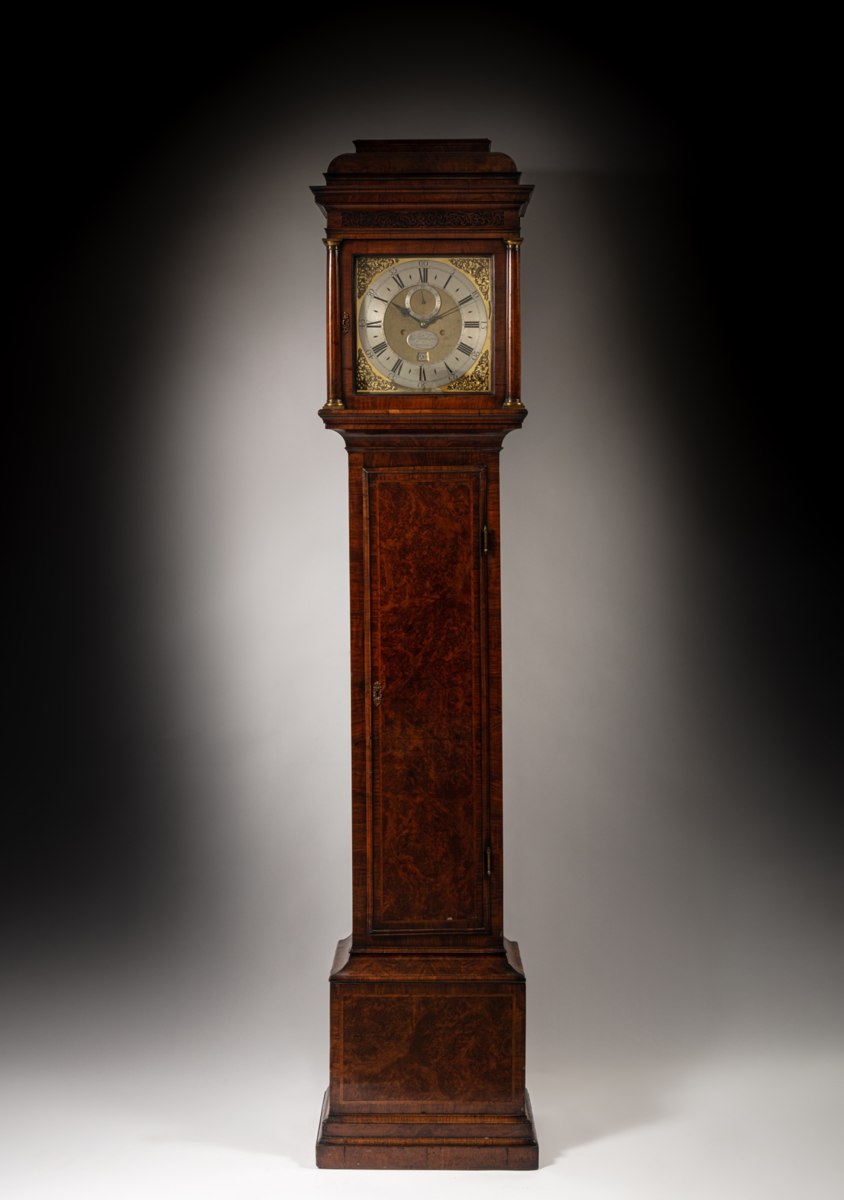
This George II walnut longcase clock was crafted in London circa 1730 and is attributed by Sotheby's to George Graham, marked with number 679. The walnut case stands approximately 225 cm tall, featuring a moulded caddy top, pierced frieze frets, brass-capped hood pilasters, a long rectangular trunk door, and a stepped plinth base. Its square brass dial displays Roman numerals, Indian mask and scroll spandrels, a subsidiary seconds dial, a date aperture, and maintaining power lever. According to the auction description, the movement incorporates five latched knopped pillars, anchor escapement, bolt and shutter maintaining power, and rack striking on a bell.

Full-length front view of the George Graham walnut longcase clock No. 679
Full-length front view of the George Graham walnut longcase clock No. 679 — Sotheby's. Rights pending — permission not yet requested. Original source

Catalogue identity

Source
www.sothebys.com
Category
Clock · Longcase clock
Maker / attribution
George Graham
Reference
Not recorded
Catalogue / lot identifier
38
Source-reported date
circa 1730
Country
United Kingdom
Source-reported serial
679

Source-reported attribution and specifications are not independent authentication. A listing does not establish present ownership, current display, availability or permission to reproduce.

Object description

Dial Composition and Inscriptions

The clock is catalogued with a 12-inch latched square brass dial fitted with double screwed Indian mask and scroll spandrels. It features a finely matted centre with a subsidiary seconds dial, a date aperture with pin hole adjustment, and a maintaining power lever positioned between II and III.

The dial bears multiple inscriptions. It is signed along the lower edge 'Geo: Graham, London' and signed again on a silvered oval plaque, which is also numbered 679.

Evidence for this section
  • “12-inch latched dial with double screwed Indian mask and scroll spandrels”
  • “maintain power lever between II and III, finely matted centre with subsidiary seconds dial and date aperture with pin hole adjustment”
  • “signed along the lower edge Geo: Graham, London”
  • “signed again on a silvered oval plaque, numbered 679”

Case Architecture and Construction

The walnut case measures 7 feet 4½ inches (225 cm) in height. The hood features a moulded top and caddy cresting above finely pierced frets to the frieze and sides, accompanied by brass-capped pilasters. Visual inspection confirms figured burr walnut veneer across the long rectangular trunk door and front plinth.

According to the cataloguing description, the rectangular trunk door is numbered 679 twice to its inner upper edge. The case terminates in a crossbanded plinth with a stepped base, and the sides are divided into panels with crossbanding.

Evidence for this section
  • “Height 7ft. 4½in.; Haut. 225cm”
  • “the case with moulded top and caddy cresting above finely pierced frets to the frieze and sides, brass-capped hood pilasters”
  • “the rectangular trunk door numbered 679 twice to the inner upper edge, crossbanded plinth with stepped base, the sides divided into panels with crossbanding”
  • “Figured burr walnut veneer across the long rectangular trunk door and front plinth.”

Provenance and Dating

The lot was offered in Sotheby's sale 'The Manny Davidson Collection: A Life in Treasures and Benevolence - Evening Sale' with an assigned date of circa 1730, London. The provenance listed in the catalogue records prior sale at Christie's London on 26 November 1996, lot 254, from 'The Vitale collection of Highly Important European clocks'.

The detailed condition report was restricted to logged-in users on the source website and is not reproduced in the public catalogue text. Independent verification of internal mechanism details remains unconfirmed by visible imagery.

Evidence for this section
  • “George Graham No.679. A George II walnut longcase clock, London, circa 1730”
  • “The Manny Davidson Collection: A Life in Treasures and Benevolence - Evening Sale”
  • “The Vitale collection of Highly Important European clocks , Christie's London, 26 November 1996, lot 254.”
  • “Condition report Please log in”

Open research questions

  • Does the restricted auction condition report note any replacements or restorations to the pierced fretwork, caddy cresting, or plinth base?
  • Does examination of the seatboard and movement cheek supports confirm the historic marriage or original pairing of movement No. 679 with this walnut case?
  • What markings or inscriptions appear on the bell, weights, or pulleys, which are not detailed in the catalogue text?

Source evidence

Recorded claims and source quotations for George Graham No. 679 George II Walnut Longcase Clock
FieldSource-reported valueSource quotation
Maker's signature on dialGeo: Graham, London“signed along the lower edge Geo: Graham, London”
Movement number679“numbered along the lower edge of the backplate 679”
EscapementAnchor escapement“the movement with five latched and knopped pillars, anchor escapement”
Dial size12-inch“12-inch latched dial with double screwed Indian mask and scroll spandrels”
Height7ft. 4½in. (225 cm)“Height 7ft. 4½in.; Haut. 225cm”
Striking mechanismRack striking on a bell“rack striking on a bell”
Maintaining power systemBolt and shutter maintaining power“bolt and shutter maintaining power”
Pendulum constructionBrass rod with lenticular bob and graduated rating nut“the pendulum with brass rod, lenticular bob and graduated rating nut”
Trunk door numberingNumbered 679 twice to the inner upper edge“the rectangular trunk door numbered 679 twice to the inner upper edge”
Prior provenanceThe Vitale collection of Highly Important European clocks, Christie's London, 26 November 1996, lot 254“The Vitale collection of Highly Important European clocks , Christie's London, 26 November 1996, lot 254.”

Visible details

  • Square brass dial framed by gilt corner spandrels, featuring an outer chapter ring and a subsidiary upper dial.
  • Figured burr walnut veneer across the long rectangular trunk door and front plinth.
  • Hood flanked by brass-mounted columns supporting a stepped caddy cresting.

Research qualifications

  • Internal movement, pendulum, weights, and rear plate markings are not visible in the provided image.
  • Latched dial mechanism and backplate numbering are reported by the source and cannot be independently confirmed from the photograph.

Photograph identity and source facts were screened before import; rights clearance remains pending.

Consulted source

George Graham No.679. A George II walnut longcase clock, London,

Reviewed 2026-10-21 · Record c32523d20b

Terms in this record

Glossary explanations for terms named in this object’s record.