
Skip to content
The Encyclopedia of Horology

Clock · Longcase clock

George Graham George I Burr Walnut Eight-Day Longcase Clock, No. 662

Partially verified

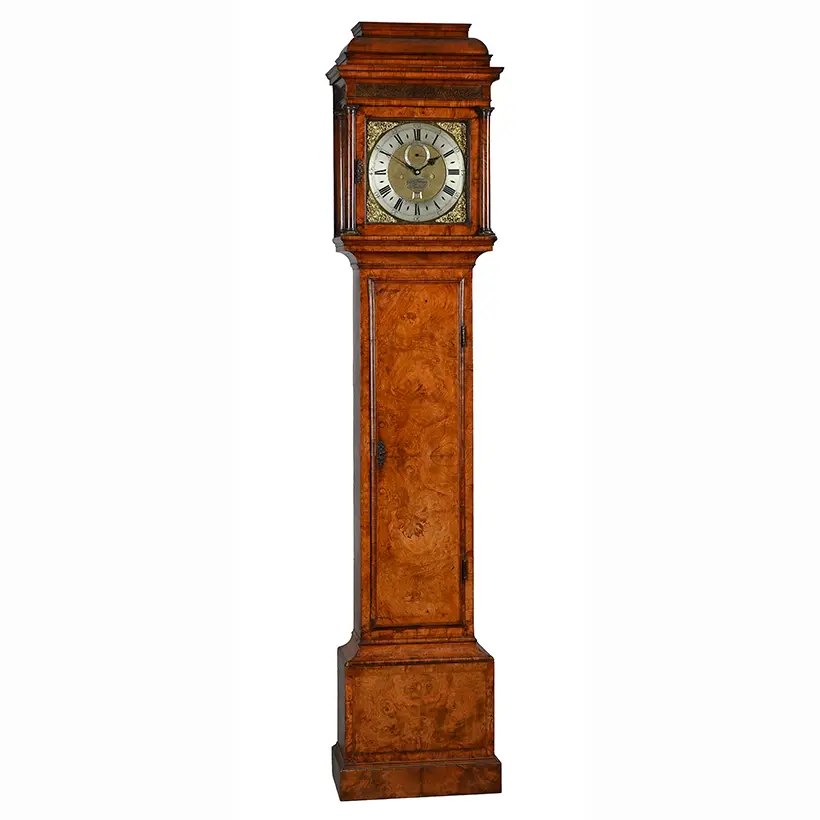
According to the auction catalogue, this George I burr walnut eight-day longcase clock by George Graham dates to circa 1725 and bears serial number 662. The source states it features a two-train bell-striking movement with five latched knopped pillars, deadbeat escapement with inverted Y-shaped pallets, bolt-and-shutter maintaining power, and a brass-rod seconds pendulum. Its 12-inch square brass dial presents a matted centre signed on an oval plate, applied silvered Roman numeral chapter ring, subsidiary seconds, and double-screwed gilt Indian mask spandrels. The burr walnut case incorporates a domed caddy surmount, fretwork frieze, three-quarter hood columns, and a book-matched figured rectangular trunk door stamped 662.

Full frontal view of the George Graham George I burr walnut longcase clock no. 662
Full frontal view of the George Graham George I burr walnut longcase clock no. 662 — Dreweatts. Rights pending — permission not yet requested. Original source

Catalogue identity

Source
www.dreweatts.com
Category
Clock · Longcase clock
Maker / attribution
George Graham
Reference
Not recorded
Catalogue / lot identifier
236
Source-reported date
circa 1725
Country
United Kingdom
Source-reported serial
662

Source-reported attribution and specifications are not independent authentication. A listing does not establish present ownership, current display, availability or permission to reproduce.

Object description

Dial and Mechanism

The movement is a five-latched, knopped pillar, two-train bell-striking mechanism. It is equipped with a deadbeat escapement featuring inverted Y-shaped pallets and bolt-and-shutter maintaining power within the going train. The clock is regulated by a brass-rod seconds pendulum with a calibrated rating nut and a nib-piece set against the lenticular bob.

The 12-inch square brass dial includes a matted center with an oval signature plate reading 'Geo: Graham, London'. Features include a silvered Roman numeral chapter ring, subsidiary seconds, and double-screwed gilt Indian mask and scroll spandrels with foliate strapwork engraving in the margins.

Evidence for this section
  • “five latched knopped pillar two train bell striking movement”
  • “deadbeat escapement with inverted Y-shaped pallets”
  • “12 inch square brass dial”
  • “oval plate signed Geo: Graham, London to the finely matted centre”

Case Construction

The burr walnut case features a domed caddy surmount on a shallow mounded box upstand. The hood includes an ogee-molded cornice, a fretwork frieze, and is flanked by three-quarter columns with gilt brass capitals. The sides of the hood contain scroll-pierced frets.

The trunk features a 40-inch rectangular door decorated with book-matched figured veneers, herringbone borders, and cavetto cross-grain edge moldings. The plinth base is finished with a cavetto top molding and matching veneered panels.

Evidence for this section
  • “domed caddy surmount”
  • “trunk with concave throat moulding over 40 inch rectangular door fronted with fine book-matched figured veneers”

Identification and Provenance

The clock is identified by serial number 662, which is punch-stamped on the left-hand top edge of the trunk door and stamped on the lower edge at the rear of the movement plates. The source attributes a date of circa 1725.

Internal elements noted in the source include an ivorine service label for 'CAMERER CUSS' and remnants of an original paper equation table on the interior of the door. The clock was previously the property of a central London financial institution.

Evidence for this section
  • “the left hand top edge of the door punch stamped 662”
  • “stamped 662 to the lower edge at the rear”
  • “interior of the door with remnants of the original paper equation table beneath ivorine service label for CAMERER CUSS”
  • “The property of a central London financial institution”

Open research questions

  • What is the current physical state of the paper equation table cited as being inside the trunk door?
  • Do the inventory numbers found alongside the Camerer Cuss label correlate to documented historical collections?

Source evidence

Recorded claims and source quotations for George Graham George I Burr Walnut Eight-Day Longcase Clock, No. 662
FieldSource-reported valueSource quotation
Serial Number662“stamped 662 to the lower edge at the rear”
EscapementDeadbeat escapement with inverted Y-shaped pallets“deadbeat escapement with inverted Y-shaped pallets”
Dial Dimensions12 inch square brass dial“12 inch square brass dial”
Overall Case Dimensions224cm high, 49.5cm wide, 26cm deep“224cm (88.25ins) high, 49.5cm (19.5ins) wide, 26cm (10.25ins) deep.”
Trunk Door StampPunch stamped 662 on left hand top edge“the left hand top edge of the door punch stamped 662”
Overall Dimensions224cm high, 49.5cm wide, 26cm deep“224cm (88.25ins) high, 49.5cm (19.5ins) wide, 26cm (10.25ins) deep.”

Visible details

  • Full-length standing view of a burr walnut longcase clock with a square hood and molded caddy surmount.
  • Glazed square dial aperture flanked by dark-finished or patinated brass columns displaying a silvered chapter ring and gilt spandrels.
  • Long, rectangular trunk door exhibiting book-matched walnut veneer with prominent grain figure.

Research qualifications

  • Movement plates, internal door equation table, and pendulum are described in the catalogue but not visible in the full exterior photograph.
  • Date is attributed as 'circa 1725' in the catalogue description.

Photograph identity and source facts were screened before import; rights clearance remains pending.

Terms in this record

Glossary explanations for terms named in this object’s record.