
Skip to content
The Encyclopedia of Horology

Pocket watch · Pair cased pocket watch

Estienne Huber Pair-Cased Pocket Watch

Partially verified

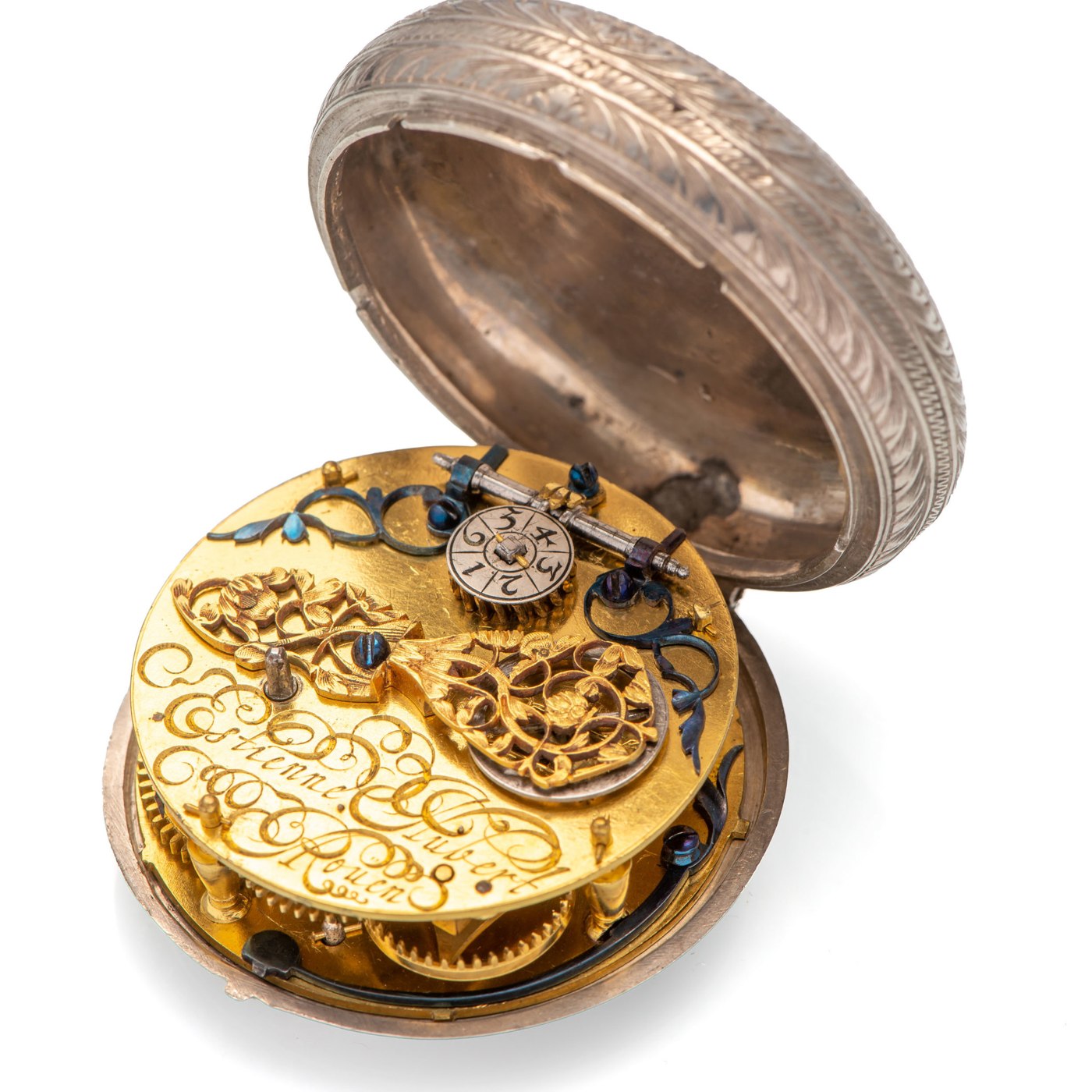
This pocket watch, attributed to Estienne Huber of Rouen and dated circa 1660, is housed in a silver pair case. The outer case is covered in leather featuring piquet pinwork decoration, while the silver inner case displays engraving on the split bezel and band in a foliage pattern, with the back featuring a floral panel in low relief. The movement is a gilt full-plate caliber with turned vase pillars and a fusee driven by gut. It utilizes a three-wheel train with a verge escapement and a plain two-arm steel balance without a spring. The watch includes an oval pierced and engraved cock secured by a screw, and a setup mechanism with blued-steel brackets and a silver indicator disc.

Movement of the Estienne Huber pair-cased watch, showing the engraved balance cock and setup disc.
Movement of the Estienne Huber pair-cased watch, showing the engraved balance cock and setup disc. — Antiquorum. Rights pending — permission not yet requested. Original source

Catalogue identity

Source
catalog.antiquorum.swiss
Category
Pocket watch · Pair cased pocket watch
Maker / attribution
Estienne Huber
Reference
Not recorded
Catalogue / lot identifier
81
Source-reported date
circa 1660
Source-reported place
France

Source-reported attribution and specifications are not independent authentication. A listing does not establish present ownership, current display, availability or permission to reproduce.

Object description

Case Construction and Decoration

The watch is enclosed in a pair case design. The inner silver case features a split bezel and band ornamented with engraved acanthus and leaf foliage. The case back is decorated with a low-relief panel of summer flowers set against a hatched ground. A functional winding shutter is integrated into the design, shaped as an engraved rose.

The outer protective element is covered in leather and decorated with piquet pinwork.

Evidence for this section
  • “Silver case with split bezel and band engraved with acanthes and leaf pattern foliage, the back with a finely executed panel of summer flowers in low relief on a hatched ground”
  • “Leather covered with piquet pinwork decoration.”

Movement and Escapement

The movement is a gilt full-plate caliber, 18''' in size, featuring turned vase-shaped pillars. The power source is a fusee driven by a gut line, which transmits energy through a three-wheel train to a verge escapement. The escapement incorporates a plain two-arm steel balance without a balance spring.

Regulation is managed by a worm and wheel setup mechanism. This system is fitted with pierced blued-steel brackets and a silver indicator disc. The balance is protected by an oval-pattern balance cock, which is pierced and engraved with floral motifs and secured to the plate by a single screw.

Evidence for this section
  • “gilt full plate with turned vase pillars, fusee with gut, three wheel train with verge escapement, plain two-arm steel balance without spring”
  • “oval pattern pierced and florally engraved cock secured by a screw, worm and wheel set up with pierced blued-steel brackets and silver indicator disc.”

Maker History and Literature

Estienne Huber was born in 1608 and was the son of a watchmaker. He attained his mastership in 1656 following the death of his father, with whom he had collaborated for years. He had three sons who followed in his profession, and he passed away in 1676.

This watch is documented in horological literature, specifically in the works of Clutton & Daniels and Cammerer Cuss. It was also included in the Antiquarian Horological Society's 10th Anniversary Exhibition held at the Science Museum in 1964, where it was catalogued as exhibit number 63.

Evidence for this section
  • “Literature: Illustrated Clutton & Daniels, Watches, figs. 92 A - C. Cammerer Cuss, Watches, plate 23.”

Open research questions

  • What is the specific material composition of the case back foliage panel?
  • Is the piquet pinwork on the leather case considered original to the 1660s construction?

Source evidence

Recorded claims and source quotations for Estienne Huber Pair-Cased Pocket Watch
FieldSource-reported valueSource quotation
MakerEstienne Huber“Estienne Huber a Rouen, France”
Datecirca 1660“Year Circa 1660”
Case MaterialSilver“Silver case with split bezel and band engraved with acanthes and leaf pattern foliage”
Movement TypeGilt full plate“gilt full plate with turned vase pillars, fusee with gut”
EscapementVerge“three wheel train with verge escapement”
Diameter48 mm“Diameter 48 mm”
ProvenanceAntiquarian Horological Society 10th Anniversary Exhibition, 1964“Exhibited: Antiquarian Horological Society 10th Anniversary Exhibition, Science Museum, May - August 1964, exhibit No. 63.”

Visible details

  • Engraved winding shutter on the case back
  • Turned vase pillars within the movement
  • Blued-steel setup brackets on the movement plate
  • Floral relief engraving on the silver case back

Research qualifications

  • The exact origin of the design for the case engraving is suggested based on a 1949 reproduction of anonymous designs
  • The movement is noted to require an overhaul

Photograph identity and source facts were screened before import; rights clearance remains pending.

Consulted source

EARLY POCKET WATCH, SILVER

Reviewed 2026-10-26 · Record 9164452eb2

Terms in this record

Glossary explanations for terms named in this object’s record.