
Skip to content
The Encyclopedia of Horology

Pocket watch · Manual wind open-face chronometer pocket watch

Ecole d'Horlogerie Genevoise Pièce École Pocket Watch

Partially verified

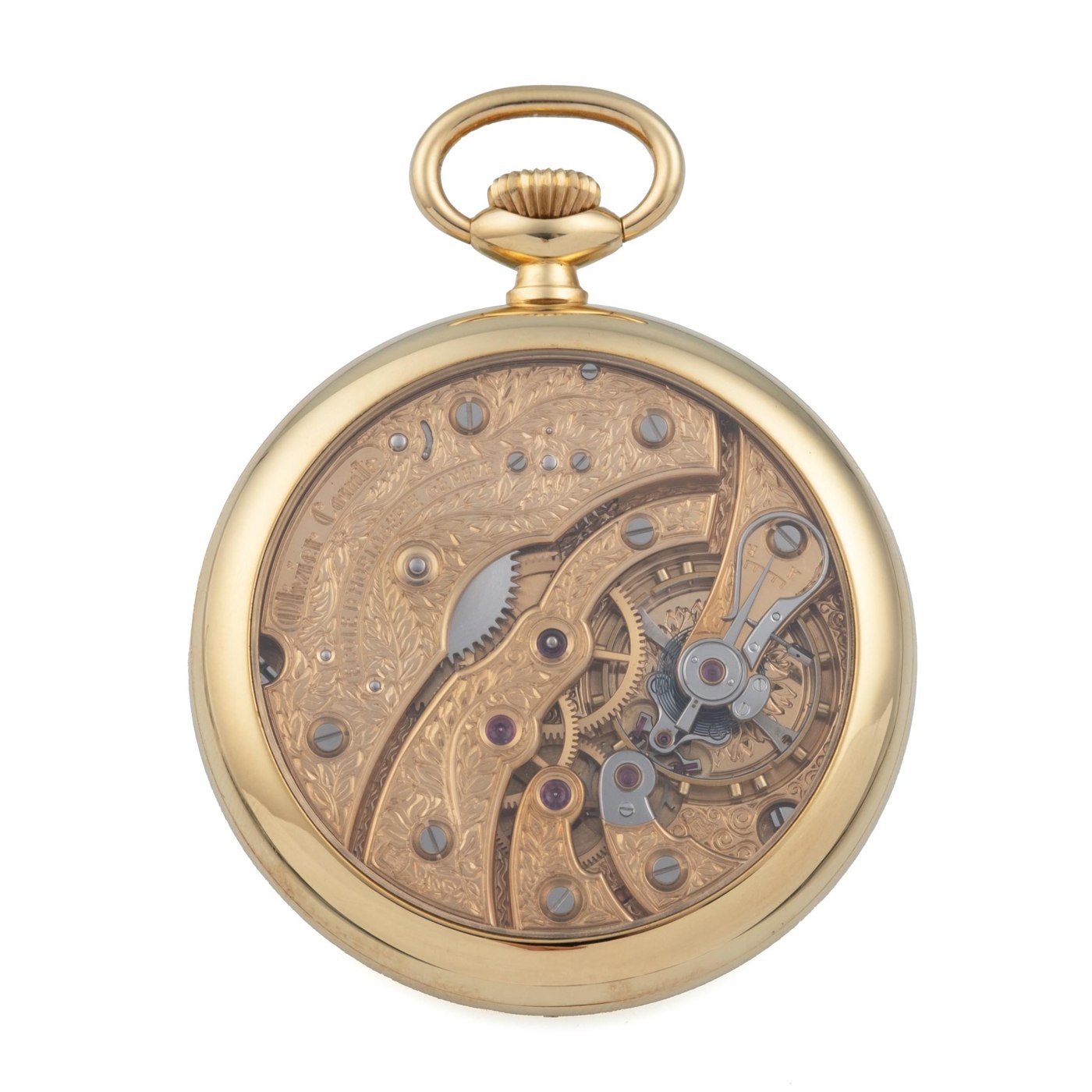
This manual wind open-face chronometer pocket watch is a 'Pièce École' created by Olivier Comte as part of his training at the Ecole d'Horlogerie Genevoise. The watch features an 18k yellow gold polished case with a glazed snap-on case back. The enamel dial displays Roman numerals, an outer minute track, and a subsidiary seconds dial at the six o'clock position, accompanied by blue steel Cathédrales hands. The watch is powered by a Patek Philippe caliber, which is a 19-jewel, 19''' gilt-brass movement. This movement is entirely hand-engraved with floral and scroll decoration and features the Geneva Seal stamped twice on the main plate and bridge. Technical specifications include a going barrel, a straight-line lever escapement, and a cut bimetallic compensated balance with gold poising screws. Regulation is achieved through a polished steel swan-neck micrometric regulator. The watch is accompanied by its original box and related documentation.

The pocket watch shown alongside its original wooden box, a bulletin de marche, and contemporary newspaper articles documenting the maker.
The pocket watch shown alongside its original wooden box, a bulletin de marche, and contemporary newspaper articles documenting the maker. — Antiquorum. Rights pending — permission not yet requested. Original source

Catalogue identity

Source
catalog.antiquorum.swiss
Category
Pocket watch · Manual wind open-face chronometer pocket watch
Maker / attribution
Olivier Comte
Reference
Not recorded
Catalogue / lot identifier
253
Source-reported date
29 May 1981
Source-reported place
Switzerland
Source-reported serial
589

Source-reported attribution and specifications are not independent authentication. A listing does not establish present ownership, current display, availability or permission to reproduce.

Object description

Case and Dial

The timepiece is housed in an 18k yellow gold polished case measuring 51 millimeters in diameter. It is designed as an open-face watch with a traditional crown at the twelve o'clock position. The case features a glazed snap-on case back, which provides visibility of the internal components without requiring the removal of the back.

The dial is crafted from enamel and features Roman numerals for the hour markers. An outer minute track surrounds the dial, and a subsidiary seconds dial is located at six o'clock. The time is indicated by a set of blue steel Cathédrales hands. The dial is signed with the name of the horological school.

Evidence for this section
  • “polished case. Glazed snap-on case back revealing the movement.”
  • “Enamel dial with Roman numerals, outer minute track, subsidiary seconds at six o’clock. Blue steel Cathédrales hands.”

Movement and Escapement

The watch is powered by a 19''' gilt-brass movement by Patek Philippe, which has been modified and finished by Olivier Comte. The movement contains 19 jewels and is entirely decorated with hand-engraved floral and scrollwork on the plates and bridges. It bears the Poinçon de Genève, stamped twice to certify the quality of its finish.

The technical assembly includes a going barrel and a straight-line lever escapement. Timekeeping accuracy is managed by a cut bimetallic compensated balance fitted with gold poising screws and a blued steel hairspring with a terminal curve. The rate is adjusted using a polished steel swan-neck micrometric regulator.

Evidence for this section
  • “Movement by Patek Philippe, stamped twice with the Geneva Seal”
  • “gilt-brass movement entirely hand-engraved with floral and scroll decoration.”
  • “cut bimetallic compensated balance with gold poising screws and blued steel hairspring with terminal curve. Polished steel index regulator with swan-neck spring and micrometric screw.”

Provenance and Documentation

This watch was created as a 'Pièce École' at the Ecole d'Horlogerie Genevoise. The project was completed by student Olivier Comte and is dated to 29 May 1981.

The auction description reports that the lot is sold with its original box and a bulletin de marche, registered as number 22621. Additional materials include copies of various articles related to the watch and the maker.

Evidence for this section
  • “ECOLE D'HORLOGERIE GENEVOISE, SWITZERLAND, “PIÈCE ÉCOLE”, MADE BY OLIVIER COMTE”
  • “Year 29 May 1981”
  • “Original box, bulletin de marche number 22621, and copies of various related articles.”

Open research questions

  • What is the specific history of Patek Philippe supplying movement blanks to the Ecole d'Horlogerie Genevoise for student projects?
  • Are there known archival records at the school detailing the specific engraving training curriculum for students like Olivier Comte?

Source evidence

Recorded claims and source quotations for Ecole d'Horlogerie Genevoise Pièce École Pocket Watch
FieldSource-reported valueSource quotation
MakerOlivier Comte“made by Olivier Comte”
Movement Caliber19'''“Caliber 19’’’”
Jewel Count19“19 jewels”
Movement DecorationHand-engraved floral and scroll“gilt-brass movement entirely hand-engraved with floral and scroll decoration”
Case Material18k yellow gold“18K YELLOW GOLD”
Diameter51 mm“Diameter 51 mm”
Weight103 grams“Weight 103 gr.”
Included itemsOriginal box and bulletin de marche“Original box, bulletin de marche number 22621, and copies of various related articles.”

Visible details

  • Entire movement bridge and plate surfaces are heavily engraved with floral motifs
  • Dial features blue steel hands of the Cathédrales style
  • Case back is fitted with a glass exhibition window
  • Dial is signed with the school name and features Roman numerals

Research qualifications

  • The source mentions a 'hairline' in the enamel dial grading section
  • The exact origin of the Patek Philippe movement blank used for the project is not detailed beyond the caliber size

Photograph identity and source facts were screened before import; rights clearance remains pending.

Terms in this record

Glossary explanations for terms named in this object’s record.