
Skip to content
The Encyclopedia of Horology

Clock · Wall regulator

Dent Mahogany Wall Regulator with Dennison's Three-Legged Gravity Escapement, No. 1437

Partially verified

This English precision wall regulator was manufactured by Dent, 61 Strand & 34 Royal Exchange, London, circa 1853, bearing serial number 1437. According to the source, the movement features a substantial four-pillar construction secured to a cast-iron backplate with Harrison's maintaining power, six-crossing wheels, and Dennison's early three-legged gravity escapement. The timekeeper is fitted with an Arnold-style zinc and steel gridiron pendulum comprising five rods and a brass-clad pierced bob. A 15-inch circular silvered regulator dial presents an outer minutes ring, an upper subsidiary Roman hour chapter ring, and a lower subsidiary seconds dial, accompanied by blued steel hands.

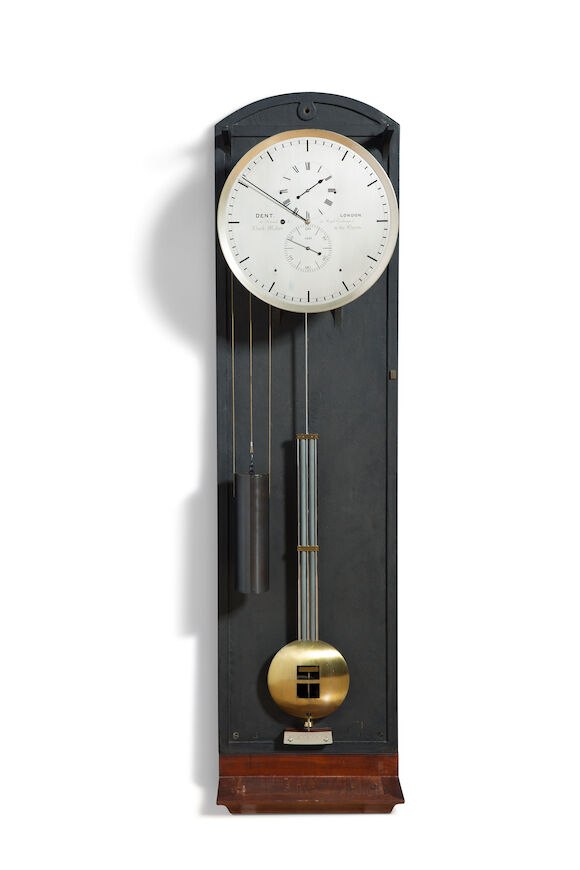
Frontal view of Dent wall regulator no. 1437 mounted on its backplate, showing regulator dial, weight, and gridiron pendulum
Frontal view of Dent wall regulator no. 1437 mounted on its backplate, showing regulator dial, weight, and gridiron pendulum — Bonhams. Rights pending — permission not yet requested. Original source

Catalogue identity

Source
www.bonhams.com
Category
Clock · Wall regulator
Maker / attribution
Dent
Reference
Not recorded
Catalogue / lot identifier
148
Source-reported date
circa 1853
Country
United Kingdom
Source-reported serial
1437

Source-reported attribution and specifications are not independent authentication. A listing does not establish present ownership, current display, availability or permission to reproduce.

Object description

Dial and Visual Configuration

The timekeeper features a circular silvered regulator dial measuring 15 inches across, arranged with an outer minutes ring that encloses an upper subsidiary Roman hour chapter ring and a lower subsidiary seconds dial, indicated by blued steel hands. As photographed without its housing, the clock is mounted directly to a tall dark backplate, with a heavy cylindrical patinated weight suspended to the left of the pendulum rod assembly and a silvered beat scale positioned below the pendulum bob.

The auction text also describes a 'brass shuttered winding hole' and a mahogany housing with glazed sides, though the available photograph depicts only the bare movement, backplate, weight, and pendulum assembly.

Evidence for this section
  • “The circular silvered regulator dial shows an outer minutes track, an upper subsidiary dial with Roman numerals for hours, and a lower subsidiary seconds dial.”
  • “circular glazed aperture with brass shuttered winding hole revealing the 15-inch circular silvered regulator dial with outer minutes ring enclosing a subsidiary roman chapter ring above a seconds dial, blued steel hands”
  • “A heavy cylindrical patinated weight hangs suspended to the left of the pendulum rod assembly.”
  • “The movement and pendulum are mounted to a tall dark backplate, with a silvered beat scale positioned below the pendulum bob.”

Reported Movement and Escapement Mechanics

The internal mechanism is described in the auction text as a 'substantial four pillar movement secured to brackets on the cast - iron backplate'. The movement is catalogued as having Harrison's maintaining power, wheels cut with six crossings, and an escapement pivoted beneath arched cutouts in the plates.

The escapement is source-reported as Dennison's three-legged gravity escapement. The catalogue footnotes link this design to Edmund Beckett Dennison's work on the Westminster clock beginning in 1852, noting that an 1852 drawing sent to Astronomer Royal G. B. Airy is 'virtually identical to the gravity escapement in the present clock'. Because the dial conceals the wheelwork and escapement in the photograph, these mechanical features remain source-reported.

Evidence for this section
  • “substantial four pillar movement secured to brackets on the cast - iron backplate with Harrison̓s maintaining power and wheels cut with six crossings”
  • “the escapement pivoted beneath arched cutouts in the plates”
  • “It employs a very early form of the three - legged gravity escapement, invented by Edmund Beckett Dennison (Lord Grimthorpe) for use in the Westminister clock.”
  • “An 1852 drawing by Dennison, sent to the Astronomer Royal, G. B. Airy, is virtually identical to the gravity escapement in the present clock.”

Pendulum Construction and Compensation

The pendulum follows a design attributed in the catalogue to John Arnold. In the photograph, the assembly consists of a multi-rod gridiron structure carrying a large brass-clad circular bob pierced by two rectangular cutouts.

According to the auction description, the pendulum comprises two zinc and three steel rods suspended from the backplate. The bob's center of gravity rests on a screw threaded into the lowest cross piece, which can be turned for adjustment via small pin holes along its length, terminating in an index pointing to the silvered beat scale.

Evidence for this section
  • “The multi-rod gridiron pendulum features a large brass-clad circular bob with two rectangular central cutouts.”
  • “The pendulum design, introduced by John Arnold, consists of two zinc and three steel rods and a large brass-clad bob, pierced with rectangular openings and a bridge acting as the point of suspension.”
  • “In this configuration, the bob's center of gravity rests on a screw threaded into the lowest cross piece of the pendulum. The screw may be turned for adjustment by means of a pin inserted into small holes along its length. The screw also has a calibrated rating scale and terminates with an index to the silvered beat scale.”

Open research questions

  • Where is the mahogany case with glazed sides and arched trunk lenticle currently located, given that only the backplate and movement assembly are pictured?
  • What specific inscription or numbering appears on the dial plate or backplate to verify the maker attribution and serial number 1437?
  • Does direct examination of the plates confirm the six-crossing wheelwork and Dennison three-legged escapement concealed behind the dial?

Source evidence

Recorded claims and source quotations for Dent Mahogany Wall Regulator with Dennison's Three-Legged Gravity Escapement, No. 1437
FieldSource-reported valueSource quotation
Maker & AddressDent, 61 Strand & 34 Royal Exchange London“Dent, 61 Strand & 34 Royal Exchange London, no. 1437, circa 1853”
EscapementDennison's three-legged gravity escapement“Dennison's three-legged gravity escapement”
Pendulum TypeFive-rod zinc and steel gridiron pendulum“five-rod zinc and steel gridiron pendulum, also suspended from the backplate”
Dial Diameter15 inches“15-inch circular silvered regulator dial”
Overall Height60 inches (152 cm)“60 in. (152 cm) high”
Weight TypePatinated brass-cased weight with integral pulley“patinated brass-cased weight with integral pulley”
Pendulum Adjustment ScaleCalibrated rating scale terminating in an index“The screw also has a calibrated rating scale and terminates with an index to the silvered beat scale.”
Reported Literature RecordRecorded in Vaudrey Mercer's supplement to Edward John Dent“Mercer, Vaudrey. The Life and Letters of Edward John Dent, Chronometer Maker, and Some Account of His Successors London, 1977. and Supplement, 1983. [recorded in the supplement, p. 846]”

Visible details

  • The circular silvered regulator dial shows an outer minutes track, an upper subsidiary dial with Roman numerals for hours, and a lower subsidiary seconds dial.
  • A heavy cylindrical patinated weight hangs suspended to the left of the pendulum rod assembly.
  • The multi-rod gridiron pendulum features a large brass-clad circular bob with two rectangular central cutouts.
  • The movement and pendulum are mounted to a tall dark backplate, with a silvered beat scale positioned below the pendulum bob.

Research qualifications

  • The outer arched mahogany glazed case described in the auction text is not present in this photograph, which shows the clock mounted solely on its backplate.
  • Internal escapement components and wheelwork are concealed behind the regulator dial.

Photograph identity and source facts were screened before import; rights clearance remains pending.