
Skip to content
The Encyclopedia of Horology

Pocket watch · Deck watch

Deck watch by John Arnold and Son

Partially verified

This deck watch by John Arnold & Son, London, is dated to circa 1790 by the source. The jewelled movement features an Earnshaw-type spring detent escapement and is inscribed 'John Arnold & Son London No. 112 Invt et Fec' alongside a broad arrow mark. It is housed in a later silver case hallmarked for 1838–1839 with the maker's mark JJ, and is catalogued alongside an outer mahogany deck-box. According to the Science Museum Group, it was presented by the Lords Commissioners of the Admiralty to the Worshipful Company of Clockmakers in 1906.

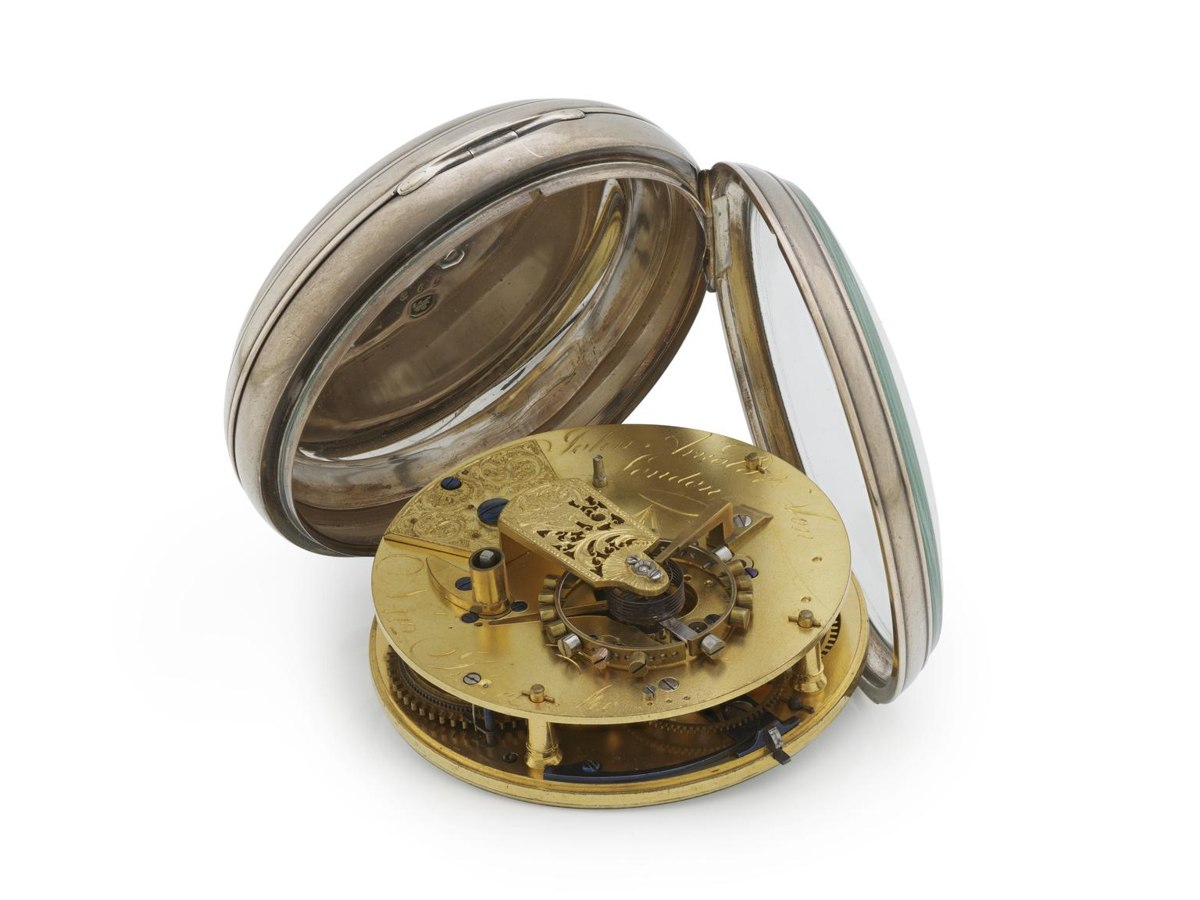
Movement view of John Arnold & Son deck watch No. 112 displayed in its opened silver case
Movement view of John Arnold & Son deck watch No. 112 displayed in its opened silver case — Science Museum Group/The Clockmakers' Museum © The Board of Trustees of the Science Museum. Rights pending — permission not yet requested. Original source

Catalogue identity

Source
collection.sciencemuseumgroup.org.uk
Category
Pocket watch · Deck watch
Maker / attribution
John Arnold & Son
Reference
Not recorded
Catalogue / lot identifier
L2015-3343
Source-reported date
c.1790
Country
United Kingdom
Source-reported serial
112

Source-reported attribution and specifications are not independent authentication. A listing does not establish present ownership, current display, availability or permission to reproduce.

Object description

Movement and Escapement Construction

The timepiece features a jewelled movement with an Earnshaw-type spring detent escapement. The movement is a gilt full-plate design featuring cylindrical pillars.

The top plate is signed 'John Arnold & Son London No. 112 Invt et Fec' and includes an engraved broad arrow mark. A pierced balance cock is fitted with an endstone over a bimetallic compensation balance, which incorporates timing screws and a helical balance spring.

Evidence for this section
  • “Jewelled movement with Earnshaw-type spring detent escapement.”
  • “Gilt full-plate movement showing cylindrical pillars and engraved maker signature on the top plate.”
  • “Signed on the movement 'John Arnold & Son London No. 112 Invt et Fec' also with broad arrow mark.”
  • “Engraved pierced balance cock fitted with an endstone over a bimetallic compensation balance with timing screws and a helical balance spring.”

Case Composition

The watch is housed in a hinged silver case, which is identified in the catalogue as a later replacement hallmarked for 1838–1839. The case bears the maker's mark 'JJ' and is stamped with the number 112.

The case design allows access to the cuvette, back, and glass bezel. Hallmarks are visible inside the case back.

Evidence for this section
  • “Later silver case stamped with 112 with maker's initials JJ, and hallmarked for 1838 – 9.”
  • “Hinged silver case opened to show the cuvette/back and glass bezel, with visible stamped hallmarks inside the case back.”

Provenance and Associated Components

The object is associated with an outer mahogany deck-box and an enamel dial. The box contains an ivory tab signed 'Arnold & Son, London, 112' with a broad arrow mark, and the dial is signed 'Arnold & Son, London 112'.

The watch was presented to the Worshipful Company of Clockmakers by the Lords Commissioners of the Admiralty in 1906 and is catalogued as Clockmakers' Museum No. 431.

Evidence for this section
  • “Outer mahogany deck-box, with Ivory tab signed 'Arnold & Son, London, 112' and broad arrow mark.”
  • “Enamel dial signed ‘Arnold & Son, London 112’.”
  • “Presented by the Lords Commissioners of the Admiralty to the Worshipful Company of Clockmakers in 1906.”
  • “Clockmakers' Museum No. 431.”

Open research questions

  • What is the significance of the broad arrow mark in relation to the initial manufacture versus the subsequent Admiralty service of the piece?
  • Does the inclusion of 'diamond' in the materials list refer to specific components within the escapement or movement?

Source evidence

Recorded claims and source quotations for Deck watch by John Arnold and Son
FieldSource-reported valueSource quotation
Maker and OriginJohn Arnold & Son, London, c.1790“Deck watch by John Arnold & Son, London, c.1790.”
Movement InscriptionSigned 'John Arnold & Son London No. 112 Invt et Fec' with broad arrow mark“Signed on the movement 'John Arnold & Son London No. 112 Invt et Fec' also with broad arrow mark.”
EscapementEarnshaw-type spring detent escapement“Jewelled movement with Earnshaw-type spring detent escapement.”
Case HallmarksSilver case stamped 112, initials JJ, hallmarked 1838–9“Later silver case stamped with 112 with maker's initials JJ, and hallmarked for 1838 – 9.”
ProvenancePresented by the Lords Commissioners of the Admiralty to the Worshipful Company of Clockmakers in 1906“Presented by the Lords Commissioners of the Admiralty to the Worshipful Company of Clockmakers in 1906.”
MaterialsMahogany, ivory, textile, silver, brass, steel, enamel, glass, and diamond“mahogany (wood) , ivory , textile , silver (alloy) , brass (copper, zinc alloy) , steel (metal) , enamel , glass and diamond”

Visible details

  • Gilt full-plate movement showing cylindrical pillars and engraved maker signature on the top plate.
  • Engraved pierced balance cock fitted with an endstone over a bimetallic compensation balance with timing screws and a helical balance spring.
  • Hinged silver case opened to show the cuvette/back and glass bezel, with visible stamped hallmarks inside the case back.

Research qualifications

  • The enamel dial and outer mahogany deck-box listed in the catalogue entry are not shown in this photograph.
  • The silver case is catalogued as a later replacement hallmarked for 1838–9 rather than contemporary to the c.1790 movement.

Photograph identity and source facts were screened before import; rights clearance remains pending.

Consulted source

Deck watch by John Arnold and Son | Science Museum Group Collection

Reviewed 2026-10-22 · Record 7bb2d2de9b

Terms in this record

Glossary explanations for terms named in this object’s record.