
Skip to content
The Encyclopedia of Horology

Pocket watch · Deck watch

Thomas Reid pair-cased ruby duplex deck watch

Partially verified

Source reports document this large 68 mm pair-cased pocket watch attributed to Scottish watchmaker Thomas Reid, dating to 1804. Previously part of the T.P. Camerer Cuss collection sold via Bonhams auction, the watch features an intact ruby duplex escapement and a hacking seconds function activated at 8 o'clock via a brass whip that stops the balance wheel. The movement incorporates a fusee and chain, blued steel components, cylindrical pillars, and an engraved balance cock. Its substantial size and lack of significant outer case wear suggest it was intended as a deck watch.

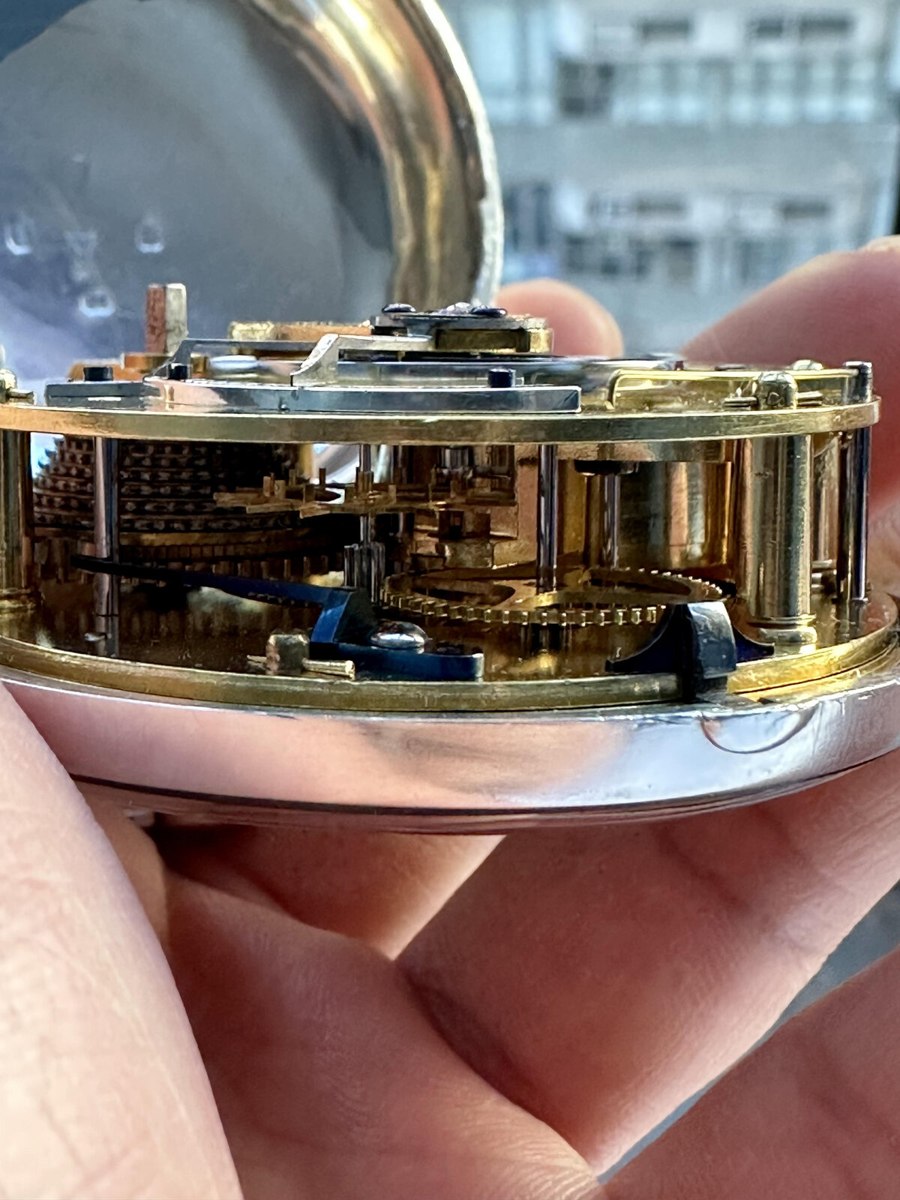
Profile view of the movement within its opened case displaying the fusee, pillars, and gearing
Profile view of the movement within its opened case displaying the fusee, pillars, and gearing — Incroyable / NAWCC Forums. Rights pending — permission not yet requested. Original source

Catalogue identity

Source
mb.nawcc.org
Category
Pocket watch · Deck watch
Maker / attribution
Thomas Reid
Reference
Not recorded
Catalogue / lot identifier
Source URL identifies the listing
Source-reported date
1804
Country
United Kingdom

Source-reported attribution and specifications are not independent authentication. A listing does not establish present ownership, current display, availability or permission to reproduce.

Object description

Identity and Source Attributions

According to forum reports documenting its sale at a Bonhams auction of the T.P. Camerer Cuss collection, this 68 mm pair-cased pocket watch is attributed to Scottish watchmaker Thomas Reid and dated to 1804. The forum poster notes that the piece was published in two books by Camerer Cuss, "The Country Life of Watches" and "The Book of Antique Watches", where it was referenced in Plate 85 as an example of high-quality English work.

The substantial size and lack of significant wear on the silver outer case led the owner to infer that it was intended as a deck watch rather than carried on the person, likely stored in a wooden box during its working life. Maker signatures, dial marks, and serial numbers are not recorded in the visible movement profile photograph.

Evidence for this section
  • “a pair cased ruby duplex from 1804 by the eminent Scottish watchmaker Thomas Reid with a massive size of 68mm from the Bonham's auction of the T.P. Camerer Cuss collection”
  • “The watch was published in both of Camerer Cuss's books: "The Country Life of Watches" and "The Book of Antique Watches" where he commented this was an example of high quality English work "par excellence" in Plate 85”
  • “The lack of wear on the outer silver case also suggests that this was kept in a wooden box during its working life.”

Observed Mechanical Construction

Direct visual inspection of the movement in side profile shows a fusee-and-chain assembly mounted between brass plates separated by cylindrical pillars. The fusee chain is wound around the fusee cone alongside brass wheels and steel pinions.

A blued steel lever mechanism is visible along the lower plate edge. Movement components, including the upper balance cock and steel parts, are partially visible in profile.

Evidence for this section
  • “Fusee chain wound around the fusee cone alongside brass wheels and steel pinions”
  • “Cylindrical movement pillars separating the brass plates”
  • “Blued steel stop/hacking lever visible along the lower plate edge”
  • “Upper balance cock and steel components partially visible in profile”

Reported Escapement and Movement Features

The source post reports that the watch retains an intact ruby duplex escapement and features a hacking seconds function activated at 8 o'clock, where a brass whip stops the balance wheel to allow setting to the second. A forum reply notes that English duplexes were made with ruby locking rollers.

The original poster also notes an engraved "1,2,3,4" marking on the balance cock, fine engraving, bluing, black polishing, and a hairspring attached via a brake-like clamping structure. Discussion in the thread also debates a circular mark or potential filled hole in the dome next to the winding hole.

Evidence for this section
  • “The ruby is still intact.”
  • “has a hacking seconds function at 8:00 where a brass whip will stop the balance wheel so you can set it to the second”
  • “Does anyone know what the "1,2,3,4" engraving on the cock means? What's also interesting is that the hairspring is attached via a sort of brake like structure.”
  • “I think Bernhard's comment about that mark in the dome next to the winding hole could be a filled hole, it's the right size”

Open research questions

  • What specific hallmarks and maker marks are present inside the cases to confirm the 1804 date and the duty mark referenced in forum discussion?
  • Does the movement top plate or dial carry Thomas Reid's signature and an individual movement number?
  • What is the physical nature and origin of the mark observed on the dome adjacent to the winding aperture?

Source evidence

Recorded claims and source quotations for Thomas Reid pair-cased ruby duplex deck watch
FieldSource-reported valueSource quotation
MakerThomas Reid“by the eminent Scottish watchmaker Thomas Reid”
Date1804“a pair cased ruby duplex from 1804”
Diameter68mm“with a massive size of 68mm”
EscapementRuby duplex“ruby duplex”
FunctionHacking seconds“has a hacking seconds function at 8:00 where a brass whip will stop the balance wheel”
ProvenanceT.P. Camerer Cuss collection“from the Bonham's auction of the T.P. Camerer Cuss collection”
Outer Case MaterialSilver“outer silver case”
Literature ReferenceThe Book of Antique Watches and The Country Life of Watches (Plate 85)“published in both of Camerer Cuss's books: "The Country Life of Watches" and "The Book of Antique Watches" where he commented this was an example of high quality English work "par excellence" in Plate 85”
Balance Cock Inscription1,2,3,4“"1,2,3,4" engraving on the cock”

Visible details

  • Side profile of the movement held in hand within an opened metallic case
  • Fusee chain wound around the fusee cone alongside brass wheels and steel pinions
  • Cylindrical movement pillars separating the brass plates
  • Blued steel stop/hacking lever visible along the lower plate edge
  • Upper balance cock and steel components partially visible in profile

Research qualifications

  • Dial, signatures, and back plate engravings are not visible in this specific profile photograph
  • Serial number is not stated in the source text
  • Attribution to Thomas Reid and 1804 date are source-reported

Photograph identity and source facts were screened before import; rights clearance remains pending.

Consulted source

Thomas Reid Ruby Duplex Deck Watch from T.P. Camerer Cuss Collection. | NAWCC Forums

Reviewed 2026-10-21 · Record 7fd182a830

Terms in this record

Glossary explanations for terms named in this object’s record.