
Skip to content
The Encyclopedia of Horology

Pocket watch · Clock watch

Clock-watch

Partially verified

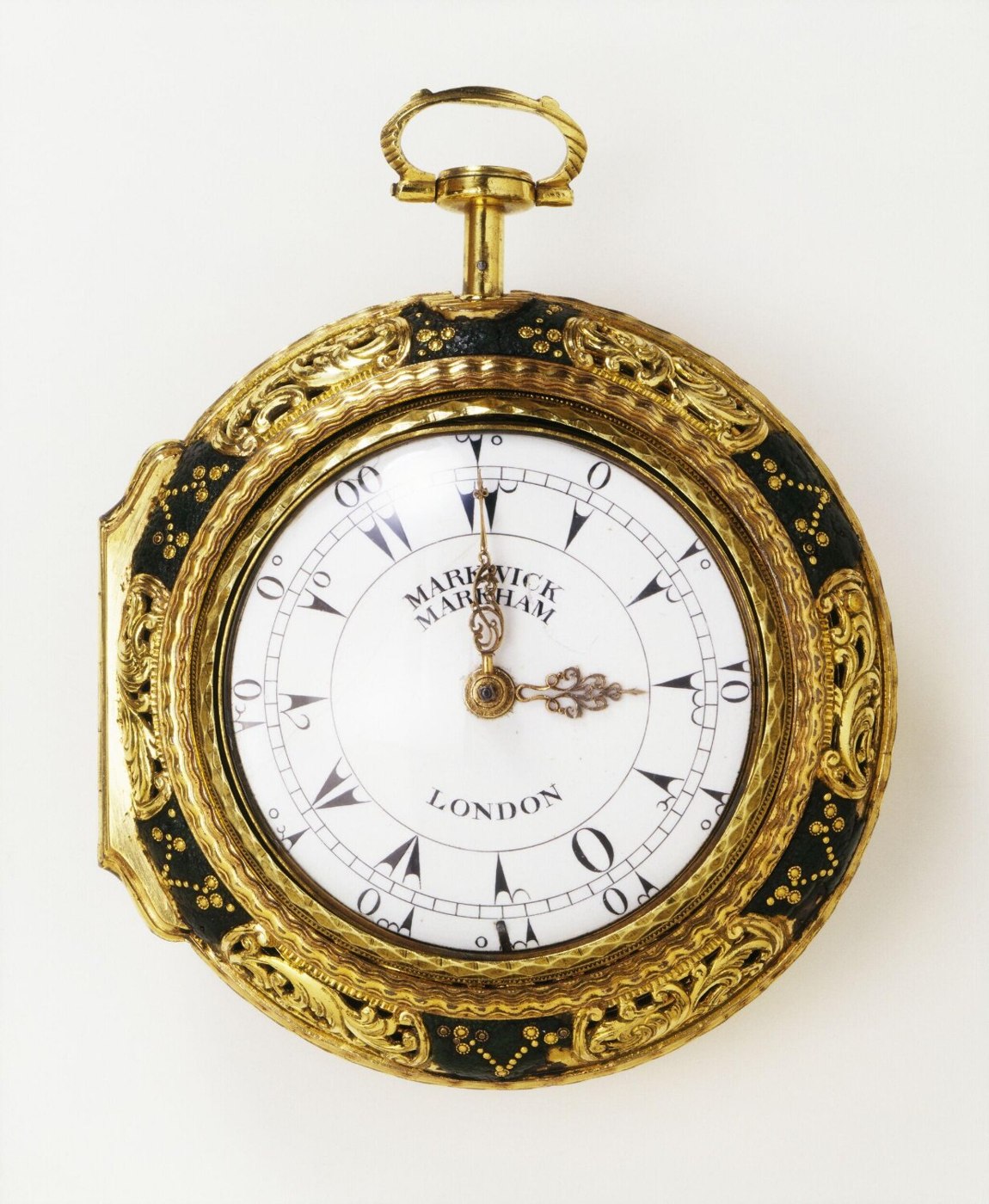
This clock-watch, manufactured in London between 1750 and 1775 by the firm of Markwick and Markham, is designed specifically for the Turkish market. It features a large gilt-metal case that is pierced and engraved with foliage, alongside an extra outer case decorated with openwork scrolls, foliage, and shagreen panels featuring gold piqué. The dial consists of an enamelled surface displaying Arabic numerals. Internally, the watch utilizes a going train with a fusee and a verge escapement, along with a steel balance and spring. The movement includes a striking mechanism that sounds hours and quarters on a silver bell. Due to its significant size, the watch could be hung from a hook to function as a stationary clock during travel.

Clock-watch by Markwick Markham, London, 1750-1775, with white enamel dial and Arabic numerals.
Clock-watch by Markwick Markham, London, 1750-1775, with white enamel dial and Arabic numerals. — Victoria and Albert Museum, London. Rights pending — permission not yet requested. Original source

Catalogue identity

Source
collections.vam.ac.uk
Category
Pocket watch · Clock watch
Maker / attribution
Markwick & Markham
Reference
O77566 / 365 to B-1897
Catalogue / lot identifier
O77566
Source-reported date
1750-1775
Source-reported place
London, England
Source-reported serial
14103

Source-reported attribution and specifications are not independent authentication. A listing does not establish present ownership, current display, availability or permission to reproduce.

Object description

Construction and Design

The timepiece is identified as a clock-watch, a format defined by its large scale that permitted both portable use and stationary operation when suspended from a hook. The watch is encased in gilt-metal that has been pierced and engraved with foliate patterns.

To satisfy the aesthetic preferences of the Turkish market, the watch incorporates multiple outer cases. One of these is decorated similarly to the primary case, while an additional outer case features pierced openwork displaying Rococo scrolls and foliage, punctuated by panels of shagreen inlaid with gold piqué.

Evidence for this section
  • “Large watches of this form are known as clock-watches.”
  • “The gilt-metal case is pierced and engraved with foliage.”
  • “An extra outer case is pierced in openwork with Rococo scrolls and foliage and with panels of shagreen decorated with piqué in gold.”

Mechanism and Dial

The movement relies on a going train powered by a fusee, regulating the time via a verge escapement with a steel balance and spring. The watch is equipped with a complication that allows for the striking of both hours and quarters, utilizing a silver bell.

The dial is finished in enamel and features Arabic numerals. It is signed by the makers and indicates the location of manufacture as London, tailored with specific Turkish gradations to meet the requirements of the intended market.

Evidence for this section
  • “The watch's mechanism comprises a going train with fusee and train, a verge escapement, steel balance and spring.”
  • “It strikes the hours and quarters on a silver bell.”
  • “It is fitted with Turkish gradations.”

Provenance and History

The watch was produced by the firm of Markwick and Markham in London. This partnership, involving James Markwick and Robert Markham, operated from approximately 1725 until 1805, specializing in timepieces destined for the Turkish market.

The piece entered the museum collection in 1897, following a purchase in Istanbul from Mrs. Alice Whitaker. Mrs. Whitaker was the heir to the collection of her father, William Henry Wrench, who had served as the British consul in Istanbul until 1896 and had assembled a significant collection of Ottoman and Iranian objects.

Evidence for this section
  • “James Markwick and Robert Markham specialised in clocks and watches for the Turkish market”
  • “Purchased in Istanbul in 1897 from Mrs Alice Whitaker, daughter and heir of William Henry Wrench (1836-96).”

Open research questions

  • What is the specific nature of the 'Turkish gradations' on the dial?
  • Are there identifiable hallmarks on the gilt-metal cases that could further refine the date of manufacture?

Source evidence

Recorded claims and source quotations for Clock-watch
FieldSource-reported valueSource quotation
MakerMarkwick & Markham“Signed 'Markwick Markham London 14103'”
Serial Number14103“numbered 14103”
Date1750-1775“1750-1775”
Place of manufactureLondon“made in London”
Dimensions (in case)11.5cm H x 9cm W x 4.3cm D“when watch is inside its case then dim: 11.5cm H x 9cm W x 4.3cm D”
EscapementVerge escapement“a verge escapement”
ProvenancePurchased in 1897 from Mrs Alice Whitaker“Purchased in Istanbul in 1897 from Mrs Alice Whitaker”

Visible details

  • White enamel dial with black Arabic numerals
  • Gilt-metal case with pierced foliage decoration
  • Outer case features panels of shagreen with gold piqué
  • Large pendant bow for hanging the timepiece

Research qualifications

  • Origin stated as 'probably Turkey' by source for the intended market
  • Partnership date of Markwick and Markham as 1725-1805 remains an attribution

Photograph identity and source facts were screened before import; rights clearance remains pending.

Consulted source

Watch, 1750-1775

Reviewed 2026-11-02 · Record 57264e509c

Terms in this record

Glossary explanations for terms named in this object’s record.