
Skip to content
The Encyclopedia of Horology

Pocket watch · Clock watch

P. Cuper Clock-Watch

Partially verified

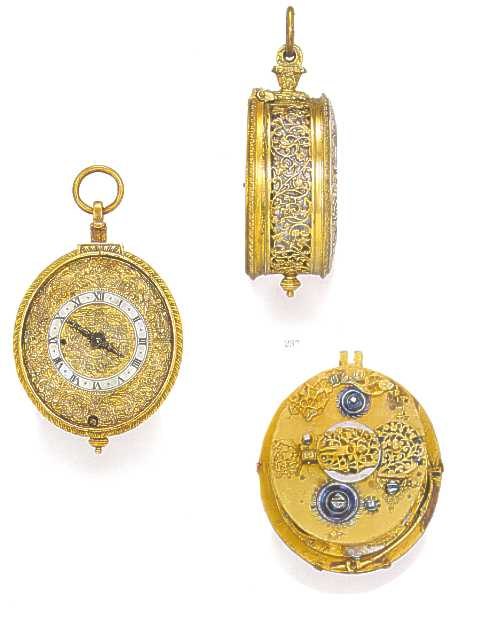
This clock-watch is an oval, two-train timepiece constructed from silver and gilt metal. Attributed to the Blois-based maker P. Cuper, it dates to approximately 1600. The watch features a hinged glazed front cover, a tulip pendant, and a loose ring. The case back is inset with a silver panel engraved with two warriors, while the gilt brass case band is pierced with foliate and floral patterns. The dial is a gilded surface engraved with figures of Psyche and a winged nymph, centered by an applied silver chapter ring with radial champlevé Roman numerals. Internally, the watch uses a gilt brass full plate movement with early Egyptian pillars, a fusee and gut-line drive, and a verge escapement with a foliot. It incorporates an hour-striking mechanism with a fixed barrel and a blued-steel count wheel. The watch measures 73 x 48 mm and includes a distinctive tulip-shaped hand.

P. Cuper clock-watch, circa 1600, showing front, side, and movement views.
P. Cuper clock-watch, circa 1600, showing front, side, and movement views. — Antiquorum. Rights pending — permission not yet requested. Original source

Catalogue identity

Source
catalog.antiquorum.swiss
Category
Pocket watch · Clock watch
Maker / attribution
P. Cuper
Reference
Not recorded
Catalogue / lot identifier
237
Source-reported date
circa 1600
Source-reported place
France

Source-reported attribution and specifications are not independent authentication. A listing does not establish present ownership, current display, availability or permission to reproduce.

Object description

Case and Dial Construction

The timepiece is housed in an oval, two-body case fashioned from silver and gilt metal. The back of the case is set with a silver insert, which is finely engraved to display two naked warriors, each equipped with shields, swords, and plumed helmets, accompanied by dogs. The periphery of the case features a gilt brass band characterized by intricate piercing and engravings of foliate and floral motifs. Attached to the top is a tulip-style pendant with a loose ring.

The dial is a gilded, hinged surface, elaborately engraved and chiselled to depict figures of Psyche and a winged nymph set amidst foliage. A rural scene, including mountains, is present in the center. Time is indicated via an applied silver chapter ring featuring radial champlevé Roman numerals and half-hour markers. A single blued-steel tulip hand indicates the hour, while an aperture at the 9 o'clock position allows for the adjustment of the striking function.

Evidence for this section
  • “C. Oval, two-body, the back with silver inset finely engraved with two naked warriors”
  • “gilt brass band pierced and engraved with floral and foliate pattern”
  • “D. Gilded, hinged, entirely engraved and chiselled with foliage among which are Psyche and a winged nymph”
  • “applied silver chapter ring with radial champlevé Roman chapters and half-hourarkers”

Movement and Striking Mechanism

The movement is of an oval configuration measuring 35.6 x 41.4 mm, utilizing a gilt brass full plate architecture and secured by early Egyptian-style pillars. Power is delivered via a fusee and gut-line assembly driving a short four-wheel train with five-leaf pinions. Regulation of the time is managed by a verge escapement equipped with a two-arm iron circular foliot.

The striking mechanism is powered from a fixed barrel acting on a five-wheel train. The strikes are produced on an oval bell positioned inside the case. The sequence of strikes is governed by a blued-steel count wheel situated on the back plate, which is concealed by a gilded elongated pinned cock. This cock is pierced and engraved with the image of a child and an hour-glass.

Evidence for this section
  • “gilt brass full plate, early Egyptian pillars, fusee and gut-line”
  • “verge escapement, two-arm iron circular foliot”
  • “Striking from a fixed barrel and five-wheel train on an oval bell fixed inside the case”
  • “blued-steel count wheel set on the back plate covered by the pierced and egraved cock”

Signatures and Attribution

The piece is attributed to the clockmaker P. Cuper of Blois, with the signature found on the back plate.

The object is associated with literature concerning the history of Blois and its watchmaking traditions, including works by L. de la Saussaye and Abbé Develle. Additionally, the clock-watch is noted in the Sandberg book on pages 42-43.

Evidence for this section
  • “Signed on the back plate.”
  • “Paul Cuper'Orologeur du Roy', and his brother Pierre, were sons of Barthélemy Cuper”
  • “Published in the Sandberg book, pages 42-43.”
  • “Grading System Grade: AAA Excellent”

Open research questions

  • What is the specific historical significance of the Sandberg collection in the provenance of this clock-watch?
  • Are there extant examples of work by Pierre Cuper that show technical variations from this example by Paul Cuper?

Source evidence

Recorded claims and source quotations for P. Cuper Clock-Watch
FieldSource-reported valueSource quotation
MakerP Cuper“P Cuper, Blois, circa 1600.”
Datecirca 1600“circa 1600.”
Case dimensions73 x 48 mm“Dim. 73 x 48 mm.”
Movement dimensions35.6 x 41.4 mm“Oval, 35.6 x 41.4 mm”
Dial descriptionGilded, engraved with Psyche and a winged nymph“Gilded, hinged, entirely engraved and chiselled with foliage among which are Psyche and a winged nymph”
EscapementVerge with foliot“verge escapement, two-arm iron circular foliot”
LiteratureSandberg book“Published in the Sandberg book, pages 42-43.”

Visible details

  • Oval shape with pierced gilt-brass case band
  • Silver inset on case back depicting warriors
  • Gilded dial with champlevé Roman numeral chapter ring
  • Blued-steel tulip-shaped hand

Research qualifications

  • Date of manufacture is an approximation provided by the source
  • Biographical details of Paul Cuper's family are historical context provided by the source, not internal object markings

Photograph identity and source facts were screened before import; rights clearance remains pending.

Terms in this record

Glossary explanations for terms named in this object’s record.