
Skip to content
The Encyclopedia of Horology

Clock · Carriage clock

Cartier Pre-Art Deco Carriage Clock

Partially verified

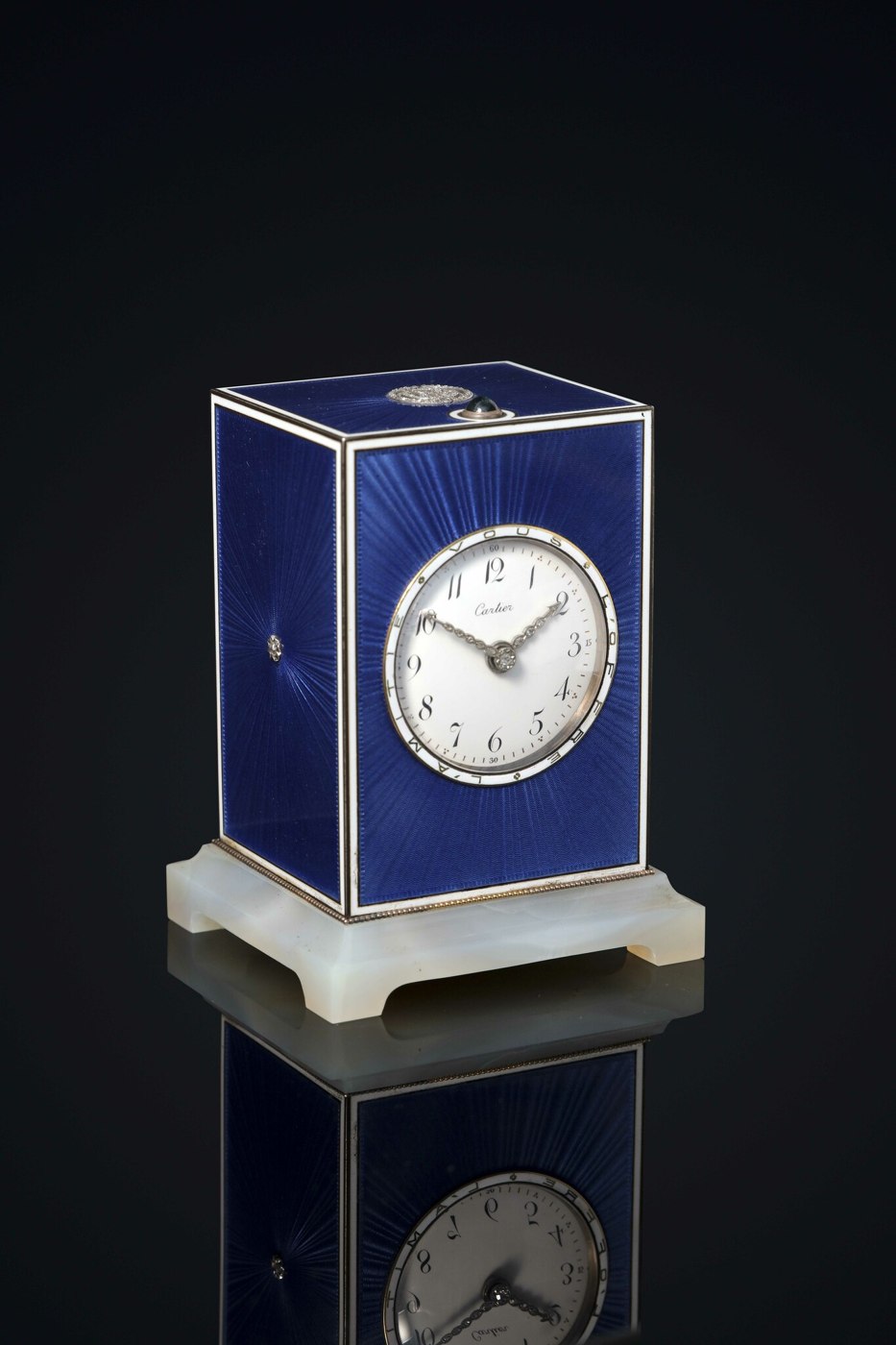
This vertical, rectangular carriage clock is attributed to Cartier, Switzerland, dating to approximately 1910. It is an 8-day going timepiece featuring a quarter-repeater mechanism that strikes on two steel gongs via two hammers, activated by a cabochon sapphire push-piece located on the top panel. The clock is encased in silver with a translucent blue enamel finish over guilloché engine-turning. Each side panel is set with a central rose-cut diamond, with the top panel decorated en suite. The white enamel dial features suspended Breguet numerals and is equipped with rose-cut diamond-set silver hands. The bezel surrounding the dial is engraved with the phrase "l'amitie vous l'offre". The internal movement is rectangular and constructed of gilded brass, housing two going barrels and a platform with a lateral lever escapement, a cut bimetallic compensated balance, and a blued steel flat hairspring. The object includes its original leather box and key.

Cartier carriage clock in its original leather case, featuring a blue enamel finish and diamond accents.
Cartier carriage clock in its original leather case, featuring a blue enamel finish and diamond accents. — Antiquorum. Rights pending — permission not yet requested. Original source

Catalogue identity

Source
catalog.antiquorum.swiss
Category
Clock · Carriage clock
Maker / attribution
Cartier
Reference
Not recorded
Catalogue / lot identifier
48
Source-reported date
1910
Source-reported place
Switzerland
Source-reported serial
16770

Source-reported attribution and specifications are not independent authentication. A listing does not establish present ownership, current display, availability or permission to reproduce.

Object description

Construction and Design

The clock follows a vertical, rectangular geometry constructed primarily of silver with extensive enamel decoration. The exterior surfaces are finished with translucent blue enamel applied over a guilloché engine-turned ground. The design incorporates decorative accents including rose-cut diamonds mounted at the center of the side panels, with the top panel receiving similar treatment.

The dial is formed from white enamel and utilizes suspended Breguet numerals. Time is displayed via silver hands that are set with rose-cut diamonds. The dial bezel carries an engraved inscription, reading 'l'amitie vous l'offre'. The entire housing is supported by an agate base, and a cabochon sapphire button is located on the top of the case to engage the repeater mechanism.

Evidence for this section
  • “silver cabinet with blue enamel (translucent enamel over guilloché engine-turning) décor”
  • “the side panels each with a rose-cut diamond in their centres”
  • “rose-cut diamond-set “fantasy arrow” silver hands”
  • “enamel bezel engraved "l'amitie vous l'offre”

Movement and Repeater Mechanism

The clock is powered by a rectangular, gilded-brass movement designed for an 8-day power reserve. The system operates via two going barrels. Regulation and escapement are handled by a platform-mounted lateral lever escapement, featuring a cut bimetallic compensated balance with gold poising screws. The hairspring is a blued steel flat type, accompanied by a polished steel index-regulator.

A quarter-repeater function is integrated into the movement, using two hammers that strike against two steel gongs. The repeater work is located on the main plate beneath the dial, activated by depressing the sapphire push-piece mounted on the exterior top panel of the clock case.

Evidence for this section
  • “movement, rectangular, gilded-brass, two going barrels, platform with lateral lever escapement”
  • “repeater work on the main plate, under the dial”

Provenance and Documentation

The auction description reports that the clock originates from the Desmarais Collection. The object was linked to the family of Henri and Charles Boutheroüe-Desmarais, who were prominent industrial figures in the 19th-century petroleum sector. The clock is reported to have been gifted to Paule Boutheroüe-Desmarais, who was the granddaughter of Henri.

According to the source, the item was passed through successive generations within the family, eventually reaching the current owner, François, who is a descendant of Paule. The clock is accompanied by its original Cartier-branded leather box and a winding key.

Evidence for this section
  • “Originally from the Desmarais Collection”
  • “According to family tradition, this exquisite Cartier clock was originally gifted to Paule and was subsequently passed down through the generations”
  • “with original cartier leather box with the key”

Open research questions

  • What specific workshop or clockmaker produced the movement for this Cartier-signed carriage clock?
  • Can the date '1910' be confirmed through specific Cartier archives or manufacturing records for this case number?

Source evidence

Recorded claims and source quotations for Cartier Pre-Art Deco Carriage Clock
FieldSource-reported valueSource quotation
MakerCartier“CARTIER, SWITZERLAND”
Date1910“Year 1910”
Case Number16770“Case No. 16770”
Mechanism8-day quarter-repeater“8-day going, key-winding, vertical rectangular-shaped, pre-art deco carriage-clock, with quarter-repeater by two hammers on two steel gongs”
MaterialsSilver, enamel, agate, diamonds, sapphire“silver, enamel and agate”
DialWhite enamel with suspended Breguet numerals“white enamel dial with suspended breguet numerals”
EscapementLateral lever escapement“platform with lateral lever escapement”
ProvenanceDesmarais family“Originally from the Desmarais Collection, subsequently passed down to the current owner.”

Visible details

  • The enamel bezel is engraved with 'l'amitie vous l'offre'.
  • Each side panel contains a single rose-cut diamond center.
  • The top includes a cabochon sapphire push-piece for the repeater.
  • The clock sits on a distinct, light-colored agate base.

Research qualifications

  • The movement is noted by the auction house to require an overhaul.
  • The specific provenance is based on family tradition provided by the consignor.

Photograph identity and source facts were screened before import; rights clearance remains pending.

Terms in this record

Glossary explanations for terms named in this object’s record.