
Skip to content
The Encyclopedia of Horology

Tool · Astrolabe

Astrolabe by Jamal-ud-din of Lahore

Partially verified

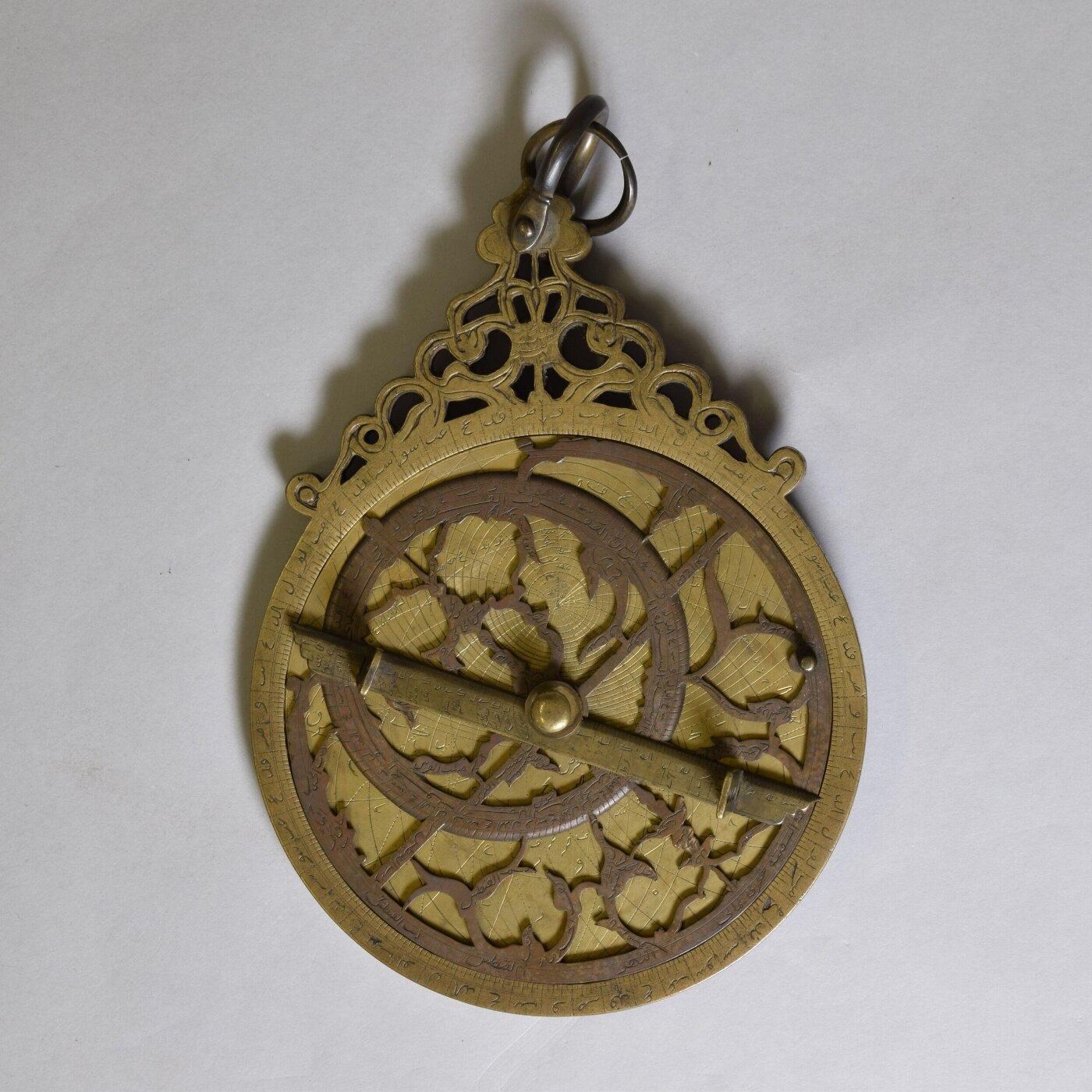
This 17th-century astrolabe, designated by accession number IS.30-1882, is a brass instrument of Indian origin. The object is engraved with Arabic inscriptions and dates to A.D. 1681, corresponding to the Islamic year A.H. 1092. The astrolabe comprises a main body, a rotatable rete with complex cut-outs for stellar observation, and an alidade or sighting rule across the face. It features an ornate, pierced suspension loop at the top for mounting. The instrument is signed by the maker, Jamal-ud-din of Lahore. Acquired from Mrs. G. W. Hamilton, the object is currently held in the collection of the Victoria and Albert Museum. The construction exhibits engraved patterns and calibrated scales consistent with traditional astrolabe design, intended for astronomical calculations and timekeeping. The surface is decorated with dense Arabic calligraphy integrated into the outer ring and the central rete structure.

Front view of the 1681 brass astrolabe showing the rete and alidade.
Front view of the 1681 brass astrolabe showing the rete and alidade. — Victoria and Albert Museum. Rights pending — permission not yet requested. Original source

Catalogue identity

Source
collections.vam.ac.uk
Category
Tool · Astrolabe
Maker / attribution
Jamal-ud-din of Lahore
Reference
Not recorded
Catalogue / lot identifier
IS.30-1882
Source-reported date
1681
Source-reported place
India

Source-reported attribution and specifications are not independent authentication. A listing does not establish present ownership, current display, availability or permission to reproduce.

Object description

Construction and Materials

The astrolabe is manufactured from brass and features extensive engraving across its components. The device consists of a circular base, a complex pierced rete, and an alidade. The suspension mechanism is integrated into an ornate, pierced 'throne' that serves as the attachment point for the instrument.

The dial area displays a grid-like projection etched onto the surface, used for astronomical calculations. The outer rim is marked with divisions that accommodate the Arabic inscriptions, which are etched into the metal surface. The components are held together by a central axis pin.

Evidence for this section
  • “brass, engraved, India, 1681”

Signatures and Inscriptions

The object contains clear inscriptions in Arabic. These markings identify the maker as Jamal-ud-din of Lahore and provide a production date corresponding to A.H. 1092.

The text is distributed across the instrument, with the primary signature located in the central area, clearly stating the maker and the year of manufacture.

Evidence for this section
  • “Inscribed as made by Jamal-ud-din of Lahore in A.H. 1092 (A.D. 1681)”

Provenance and History

The object was acquired by the museum through a purchase from Mrs. G. W. Hamilton. Research into the provenance, including records from the Asia Department, indicates the purchase was recorded in documentation linked to the year 1881.

The history of the piece is verified by the museum's institutional records, which include internal memos such as the one from Sir P. C. Owen regarding the acquisition agenda. This provenance is maintained within the museum's central inventory systems.

Evidence for this section
  • “Purchased from Mrs. G. W. Hamilton, 79, Leyham[?] Gardens. This acquisition information reflects that found in the Museum records”

Open research questions

  • What specific astronomical data points are encoded on the internal plates?
  • Are there additional missing components such as varying latitude plates typically associated with such instruments?

Source evidence

Recorded claims and source quotations for Astrolabe by Jamal-ud-din of Lahore
FieldSource-reported valueSource quotation
MakerJamal-ud-din of Lahore“Inscribed as made by Jamal-ud-din of Lahore”
Date1681“Date: 1681”
Accession numberIS.30-1882“Accession number: IS.30-1882”
Place of originIndia“Place of origin: India (made)”
MaterialBrass“brass, engraved”
Islamic yearA.H. 1092“A.H. 1092 (A.D. 1681)”
Inscription languageArabic“arabic inscriptions”

Visible details

  • Intricate pierced brass work on the suspension throne
  • Engraved Arabic inscriptions covering the outer rim and central rete
  • Central rotating alidade with a visible pivot pin

Research qualifications

  • The exact provenance history prior to acquisition from Mrs. G. W. Hamilton remains limited
  • The full functionality of the internal plates is not documented in the provided source

Photograph identity and source facts were screened before import; rights clearance remains pending.

Consulted source

Astrolabe

Reviewed 2026-10-26 · Record 86b8989abe

Terms in this record

Glossary explanations for terms named in this object’s record.