
Skip to content
The Encyclopedia of Horology

Tool · Astrolabe

'Abd al-A'imma Gilt-Brass Astrolabe

Partially verified

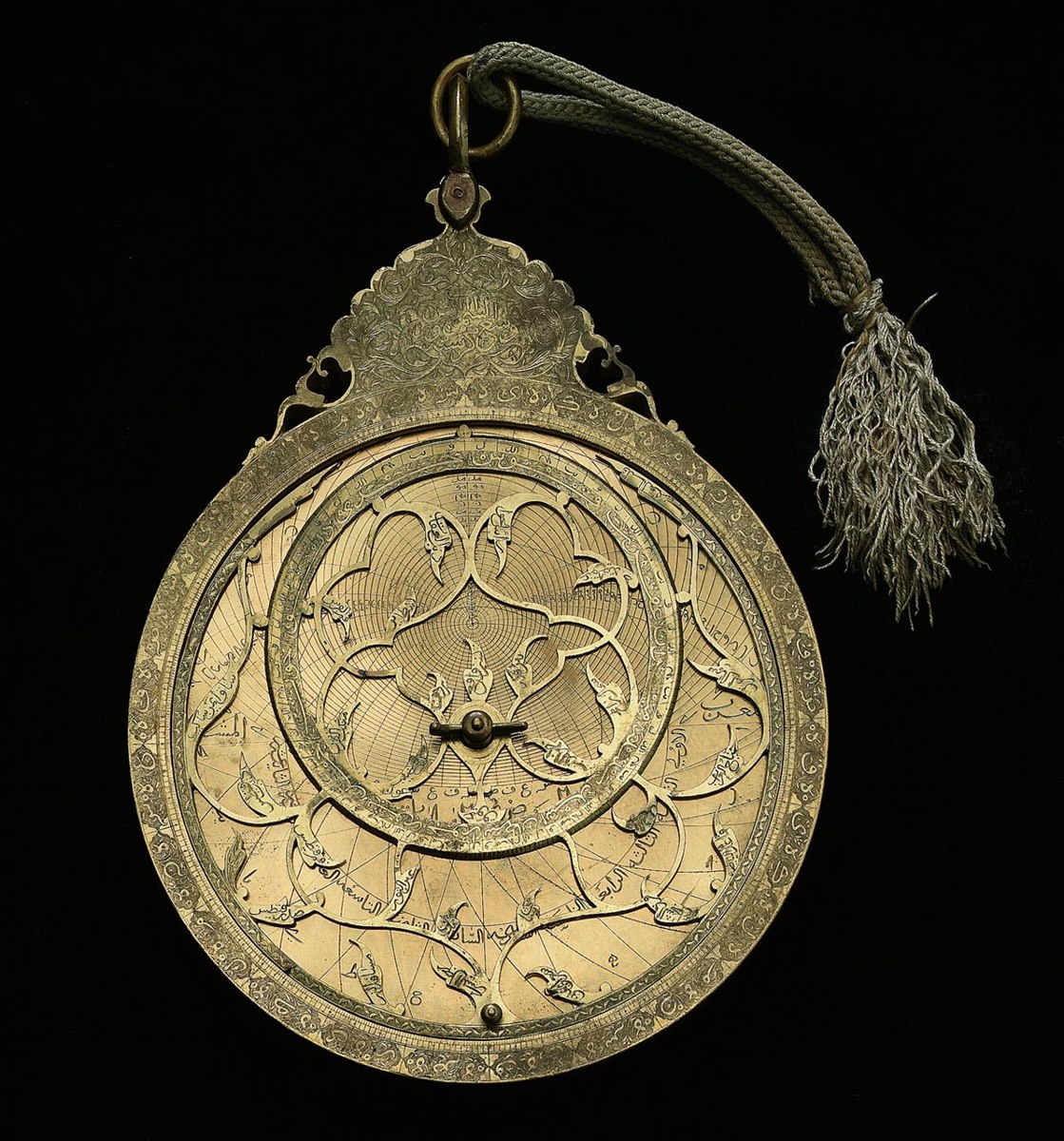
This gilt-brass astrolabe, preserved in the Caird Collection at the National Maritime Museum under ID AST0545, was created by the prolific maker 'Abd al-A'imma. It bears a construction date inscription 'fi sanat 1128' (AH 1128 / approximately 1715–1716 AD) located above the central hole. Cast in one piece with the mater and rim, the throne features an excerpt from Koranic verse II, 255 engraved on its front. The source records that the mater contains a 58-locality gazetteer in concentric rings, alongside five plates calculated for latitudes 30º to 40º. Its openwork rete exhibits curvilinear tracery aligned symmetrically about the meridian.

Front view of the gilt-brass astrolabe AST0545, displaying the rete, engraved limb, throne, and suspension cord
Front view of the gilt-brass astrolabe AST0545, displaying the rete, engraved limb, throne, and suspension cord — National Maritime Museum, Greenwich, London, Caird Collection. Rights pending — permission not yet requested. Original source

Catalogue identity

Source
www.rmg.co.uk
Category
Tool · Astrolabe
Maker / attribution
'Abd al-A'imma
Reference
AST0545
Catalogue / lot identifier
Source URL identifies the listing
Source-reported date
1715-1716
Country
Not established

Source-reported attribution and specifications are not independent authentication. A listing does not establish present ownership, current display, availability or permission to reproduce.

Object description

Construction and Identity

This gilt-brass instrument (AST0545) is attributed to 'Abd al-A'imma. The throne, mater, and rim are cast as a single piece. The front of the throne is engraved with an excerpt from Koranic verse II, 255.

The assembly includes a shackle and rim described as plain. A silvery cord, which may be original, is looped through the suspension shackle.

Evidence for this section
  • “The throne, cast with the mater and rim in one piece”
  • “Part of the Koranic verse II, 255 is engraved on the front: 'His Throne extends over heavens and earth'”
  • “The shackle and rim are plain and the silvery chord might be original.”

Gazetteer and Plate Configuration

The mater contains a 58-locality gazetteer arranged in concentric rings, including entries for Mecca, Kabul, Kashmir, and Damascus. Five plates are provided, calibrated for latitudes between 30º and 40º.

The rete design consists of thin stems in a curvilinear pattern, arranged symmetrically around the meridian.

Evidence for this section
  • “A gazetteer with 58 localities fills the mater, arranged in concentric rings, including places such as Mecca, Kabul, Kashmir and Damascus.”
  • “There are five plates for latitudes between 30º-40º.”
  • “The rete is of the typical 'Abd al-A'imma design, easily recognizable by its curvilinear tracery of thin stems which are placed symmetrically about the meridian.”

Dating and Attribution

An inscription located above the central hole reads 'fi sanat 1128', which is interpreted as AH 1128 (approximately 1715–1716 AD).

The reverse of the instrument includes a double shadow square and a signature cartouche: 'Made by 'Abd al-A'imma, needy of the blessings of his Lord, the All-Sufficient'. The engraving style on the reverse is noted to follow the late-Safavid tradition.

Evidence for this section
  • “Just above the central hole is the date of construction of the instrument: 'fi sanat 1128' (in the year AH 1128 [which approximates to 1715-16 AD]).”
  • “Beneath the double shadow square is a cartouche with the signature: 'Made by 'Abd al-A'imma, needy of the blessings of his Lord, the All-Sufficient'”
  • “The engraving on the back of the instrument closely follows the late-Safavid style”

Open research questions

  • What specific archival or historical criteria define the 'late-Safavid' engraving style referenced by the institution?
  • How does the size of this instrument (noted as one of the maker's largest) correlate to its intended functional use compared to his other recorded astrolabes?

Source evidence

Recorded claims and source quotations for 'Abd al-A'imma Gilt-Brass Astrolabe
FieldSource-reported valueSource quotation
Museum Object IDAST0545“ID: AST0545”
Makeral-A'imma, 'Abd“Creator: al-A'imma, 'Abd”
Date Made1715-1716“Date made: 1715-1716”
MaterialsGilt-brass“Materials: Gilt-brass”
MeasurementsOverall: 23 x 240 x 160 mm; Diameter: 161 mm“Measurements: Overall: 23 x 240 x 160 mm; Diameter: 161 mm”
Date Inscriptionfi sanat 1128 (approx. 1715-16 AD)“Just above the central hole is the date of construction of the instrument: 'fi sanat 1128' (in the year AH 1128 [which approximates to 1715-16 AD])”
Signature TranslationMade by 'Abd al-A'imma, needy of the blessings of his Lord, the All-Sufficient“Beneath the double shadow square is a cartouche with the signature: 'Made by 'Abd al-A'imma, needy of the blessings of his Lord, the All-Sufficient'”
Measurements23 x 240 x 160 mm; Diameter: 161 mm“Measurements: Overall: 23 x 240 x 160 mm; Diameter: 161 mm”

Visible details

  • Braided silvery textile cord with a fringed tassel looped through the suspension shackle
  • Openwork rete with curvilinear tracery and star pointers positioned over an underlying engraved plate
  • Throne and rim profusely engraved with Arabic inscriptions and circular scales
  • Central pin and horse securing the assembly at the centre

Research qualifications

  • Late-Safavid artistic style is cited by the museum description, though no manufacturing country is formally catalogued
  • The signature cartouche and double shadow square on the reverse are noted in the catalogue text but not shown in this front view

Photograph identity and source facts were screened before import; rights clearance remains pending.

Consulted source

Astrolabe | Royal Museums Greenwich

Reviewed 2026-10-25 · Record ff5573aa48

Terms in this record

Glossary explanations for terms named in this object’s record.