
Skip to content
The Encyclopedia of Horology

Tool · Astrolabe

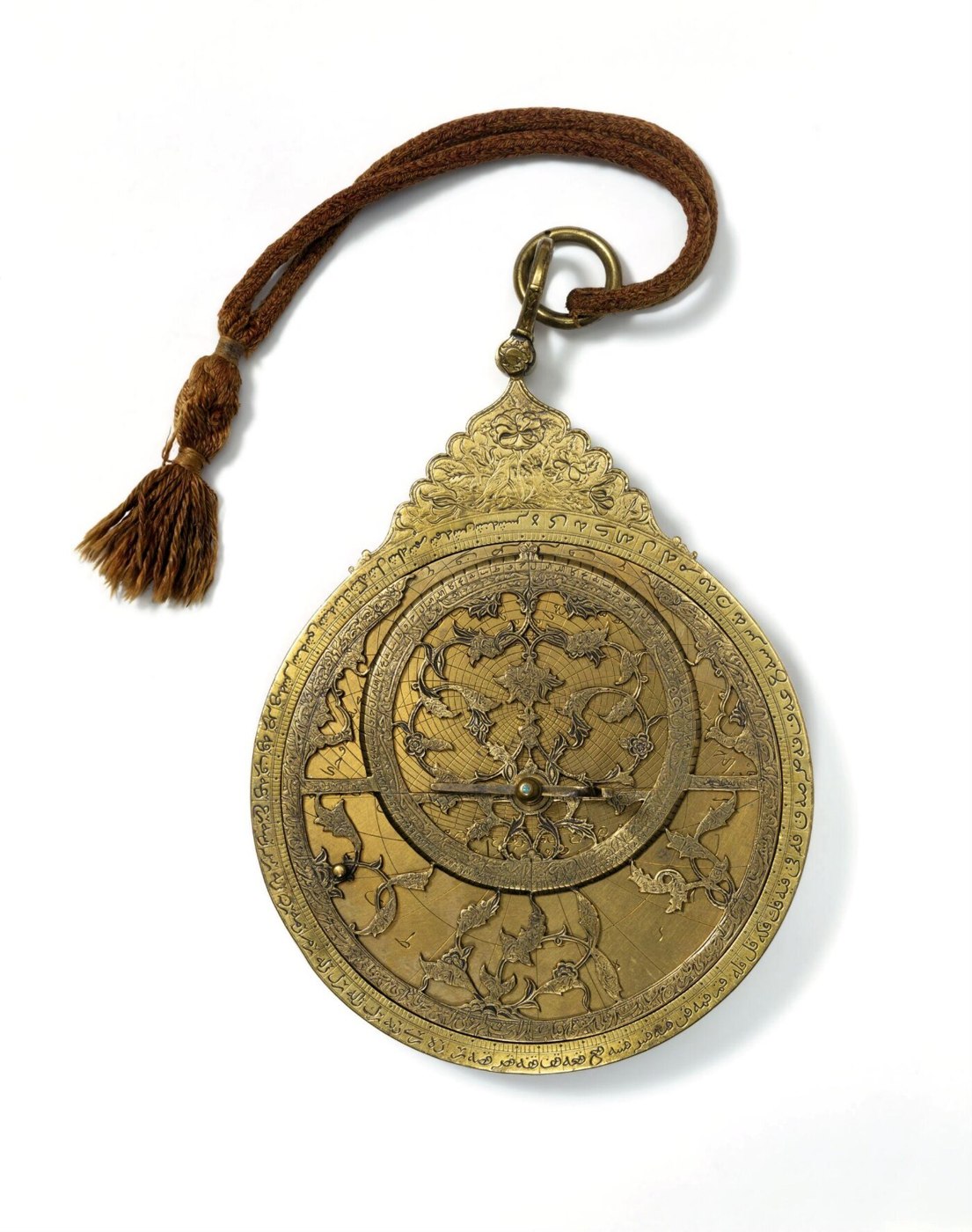
Astrolabe by Muhammad Khalil and Muhammad Mahdi

Partially verified

This astrolabe, designated M.38-1916 in the Victoria and Albert Museum collection, was produced in Isfahan, Iran, in 1667. Constructed from brass, the instrument is both engraved and chased. It bears signatures identifying the maker as Muhammad Khalil, son of Husayn 'Ali, and the decorator as Muhammad Mahdi, son of Amin of Yazd. Measuring 18.6 cm in height, the object consists of a main casing, known as the mater, which houses interchangeable solid plates engraved for specific latitudes. An openwork disc, or rete, acts as a star map with pointers for identifying stellar positions. A sighting device called an alidade is used for observational purposes. The museum suggests it could have been used in scientific enquiry and might have served religious purposes, such as telling the times of the five daily prayers or establishing the direction of Mecca; it notes that astrolabes were also used to cast horoscopes. It is part of the Clarke-Thornhill Gift collection.

Front view of the brass astrolabe showing the rete, alidade, and the calligraphic engraved rim.
Front view of the brass astrolabe showing the rete, alidade, and the calligraphic engraved rim. — Victoria and Albert Museum, London. Rights pending — permission not yet requested. Original source

Catalogue identity

Source
collections.vam.ac.uk
Category
Tool · Astrolabe
Maker / attribution
Muhammad Khalil, Muhammad Mahdi
Reference
Not recorded
Catalogue / lot identifier
M.38-1916
Source-reported date
1667
Source-reported place
Iran

Source-reported attribution and specifications are not independent authentication. A listing does not establish present ownership, current display, availability or permission to reproduce.

Object description

Construction and Design

The astrolabe is fabricated from brass, utilizing engraving and chasing techniques to create its complex decorative and functional surfaces. It features a central mater that houses several solid plates. These plates are individually engraved to correspond with specific geographical latitudes, allowing the user to adapt the instrument for different locations.

The rete, or star map, is designed with elaborate, pierced openwork that incorporates foliate motifs. This component acts as a celestial chart, with pointers indicating the relative positions of stars. The entire assembly is suspended via a throne at the top, which includes a loop and suspension ring for handling and mounting during observations.

Evidence for this section
  • “Brass, pierced and engraved.”
  • “The solid plates are engraved for different latitudes.”
  • “The rete is a star map with pointers showing the position of the stars.”

Signatures and Attribution

The instrument includes specific inscriptions identifying the individuals responsible for its creation. The museum records attribute the manufacture of the astrolabe to Muhammad Khalil, the son of Husayn 'Ali. The ornamental engraving and decoration were executed by Muhammad Mahdi, who is identified as the son of Amin of Yazd.

These signatures distinguish the roles of the maker and the decorator. The museum's brief description gives the place of manufacture as Isfahan and the date as 1667.

Evidence for this section
  • “Signed as made by Khalil (Muhammad) son of Husayn 'Ali, and decorated by Muhammad Mahdi son of Amin of Yazd.”
  • “Astrolabe, Iran (Isfahan), dated 1667.”

Possible uses recorded by the museum

The museum describes how an astrolabe of this kind was used: one of the solid latitude plates was placed in the mater beneath the openwork rete, and the rete, a star map with pointers, was moved to the correct position once an observation had been made with the sighting device, the alidade.

For this instrument the museum states possibilities rather than a documented history of use: it could have been used in scientific enquiry, and it might have served religious purposes such as telling the times of the five daily prayers or establishing the direction of Mecca. The museum adds that astrolabes were also used in astrology, for example to cast horoscopes.

Evidence for this section
  • “It might have served religious purposes, such as telling the times of the five daily prayers or establishing the direction of Mecca.”
  • “Astrolabes were also used in astrology, for example to cast horoscopes.”
  • “They moved it to the correct position once an observation has been made with the sighting device (alidade).”

Open research questions

  • What specific latitudes are represented on the plates contained within this instrument?
  • Does the current rete retain all its original star pointers, or have any been modified?
  • How does the stylistic engraving of Muhammad Mahdi compare to other known instruments from the same workshop?

Source evidence

Recorded claims and source quotations for Astrolabe by Muhammad Khalil and Muhammad Mahdi
FieldSource-reported valueSource quotation
Object TypeAstrolabe“Astrolabe”
Accession NumberM.38-1916“M.38-1916”
MakerMuhammad Khalil, Muhammad Mahdi“Signed as made by Khalil (Muhammad) son of Husayn 'Ali, and decorated by Muhammad Mahdi son of Amin of Yazd.”
Place of OriginIran“Iran (made)”
MaterialsEngraved and chased brass“Engraved and chased brass”
Dimensions18.6 cm height“Height: 18.6 cm”

Visible details

  • Intricately pierced openwork rete featuring foliate patterns
  • Circular outer rim with engraved calligraphic inscriptions
  • Throne at the top with a suspension ring and attached textile cord
  • Sighting device spanning the diameter of the central disc

Research qualifications

  • The exact scientific precision of the instrument in its current state is unverified.
  • The function of the attached cord as a contemporary or later addition remains uncertain.

Photograph identity and source facts were screened before import; rights clearance remains pending.

Consulted source

Astrolabe

Reviewed 2026-10-26 · Record 2bd716c5d2

Terms in this record

Glossary explanations for terms named in this object’s record.