
Skip to content
The Encyclopedia of Horology

Tool · Astrolabe

Small planispheric astrolabe

Partially verified

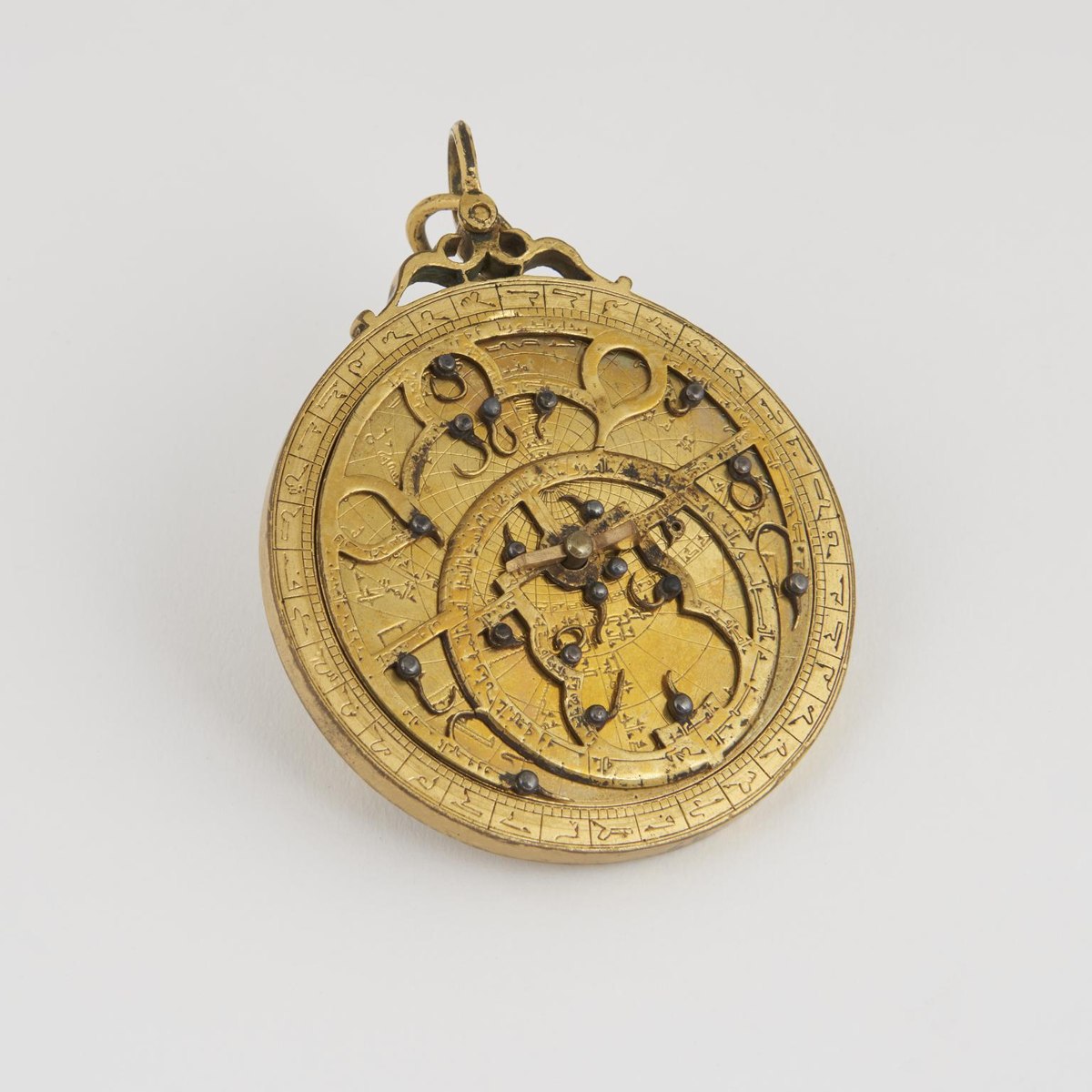
This small brass and silver planispheric astrolabe, dated to circa 1650 and made between 1645 and 1655 in Iran, features Arabic script inscriptions. The instrument is equipped with five plates and an openwork rete decorated with silver studs. The Science Museum Group catalogue records that the reverse side is engraved with a universal Gemma Frisius projection scale. Measuring 90 by 70 by 20 millimetres overall, the instrument is assigned international checklist number IC 1057 and was presented by Miss E. Court.

Obverse view of the brass planispheric astrolabe displaying the rete, central pin, and suspension throne
Obverse view of the brass planispheric astrolabe displaying the rete, central pin, and suspension throne — The Board of Trustees of the Science Museum. Rights pending — permission not yet requested. Original source

Catalogue identity

Source
collection.sciencemuseumgroup.org.uk
Category
Tool · Astrolabe
Maker / attribution
Not established
Reference
1951-287
Catalogue / lot identifier
Source URL identifies the listing
Source-reported date
c. 1650 (made 1645-1655)
Country
Iran

Source-reported attribution and specifications are not independent authentication. A listing does not establish present ownership, current display, availability or permission to reproduce.

Object description

Physical Configuration

The astrolabe is a small-format instrument, constructed from brass and silver, measuring 90 x 70 x 20 mm. The assembly includes a circular brass body fitted with a suspension throne and shackle ring at the top edge.

The obverse face features an openwork rete mounted over an engraved brass plate. The star pointers of the rete are detailed with rounded silver studs, and a central pin and rule mechanism is present.

Evidence for this section
  • “Materials: brass and silver”
  • “Measurements: overall: 90 x 70 x 20 mm”
  • “Small planispheric astrolabe with Arabic script with five plates and a rete with silver studs”
  • “Suspension throne and shackle ring fitted at the top edge of the circular brass body”

Component and Epigraphic Details

The instrument is equipped with five plates. Inscriptions in Arabic characters are engraved around the outer raised limb of the mater.

The reverse side is documented as being engraved with a universal Gemma Frisius projection scale; this side is not visible in the provided image.

Evidence for this section
  • “Small planispheric astrolabe with Arabic script with five plates”
  • “Arabic characters engraved around the outer raised limb of the mater”
  • “The reverse side is engraved with a universal Gemma Frisius projection scale”

Origin and Chronology

The astrolabe is assigned the international checklist number IC 1057. It is catalogued as dating to approximately 1650, with a specified period of manufacture between 1645 and 1655.

The record states the object was made in Iran and includes the note that it 'may be Persian'.

Evidence for this section
  • “Made: 1645-1655 in Iran”
  • “IC 1057 [international checklist]”
  • “may be Persian”
  • “c. 1650”

Open research questions

  • Do the markings on the five plates correspond to specific geographical latitudes?
  • Are there maker's marks or specific identifying signatures within the Arabic script?
  • What is the historical significance of the silver studs on the rete stars in this regional style?

Source evidence

Recorded claims and source quotations for Small planispheric astrolabe
FieldSource-reported valueSource quotation
Object Number1951-287“Object Number: 1951-287”
Date Made1645-1655“Made: 1645-1655 in Iran”
Materialsbrass and silver“Materials: brass and silver”
Measurementsoverall: 90 x 70 x 20 mm“Measurements: overall: 90 x 70 x 20 mm”
International ChecklistIC 1057“IC 1057 [international checklist]”
CreditMiss E. Court“credit: Miss E. Court”
ProvenancePresented by Miss E. Court.“credit: Miss E. Court”

Visible details

  • Front face showing an openwork rete mounted over an engraved brass plate
  • Numerous rounded dark silver studs situated on the star pointers of the rete
  • Suspension throne and shackle ring fitted at the top edge of the circular brass body
  • Central pin and rule or pointer mechanism secured at the center of the rete
  • Arabic characters engraved around the outer raised limb of the mater

Research qualifications

  • The reverse side showing the universal Gemma Frisius projection scale is not visible in the provided photo
  • Origin is stated as made in Iran though catalogued with the note 'may be Persian'

Photograph identity and source facts were screened before import; rights clearance remains pending.

Consulted source

Astrolabe, c.1650 | Science Museum Group Collection

Reviewed 2026-10-25 · Record 6e5c949738

Terms in this record

Glossary explanations for terms named in this object’s record.