
Skip to content
The Encyclopedia of Horology

Tool · Astrolabe

Safavid silver-inlaid brass astrolabe

Partially verified

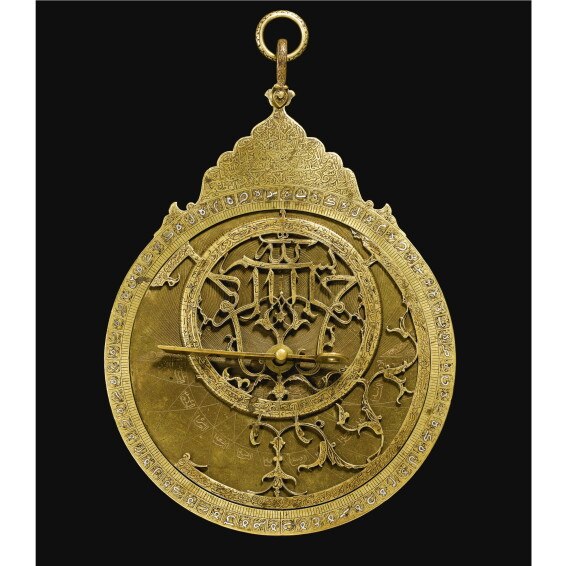
This late 17th-century Safavid astrolabe from Isfahan is made of silver-inlaid brass. The source records that it is signed by Muhammad Khalîl ibn Hasan 'Alî on the rete rim and decorated by Muhammad Bâqir. The openwork rete incorporates the basmala invocation rendered in mirror script (muthannâ) within the ecliptic ring, with star pointers positioned at letter terminals. The scalloped throne is engraved with the Qur'anic Throne Verse. The limb features silver-inlaid cartouches, while the mater holds an engraved gazetteer of around ninety localities. Surviving plates are engraved with altitude circles for latitudes between 27° and 39°.

Front view of the Safavid silver-inlaid brass astrolabe showing the rete, mater rim, rule, and suspension throne
Front view of the Safavid silver-inlaid brass astrolabe showing the rete, mater rim, rule, and suspension throne — Sotheby's. Rights pending — permission not yet requested. Original source

Catalogue identity

Source
www.sothebys.com
Category
Tool · Astrolabe
Maker / attribution
Muhammad Khalîl ibn Hasan 'Alî (decorator: Muhammad Bâqir)
Reference
Not recorded
Catalogue / lot identifier
169
Source-reported date
late 17th century
Country
Iran

Source-reported attribution and specifications are not independent authentication. A listing does not establish present ownership, current display, availability or permission to reproduce.

Object description

Identity and Attribution

This late 17th-century Safavid astrolabe is attributed to the school of instrument making in Isfahan. The maker’s signature, 'Muhammad Khalîl ibn Hasan 'Alî', is recorded on a small bar on the upper left circumference of the rete. A separate cartouche on the back identifies the decorator as 'Muhammad Bâqir'.

The object features a scalloped suspension throne engraved with the Qur'anic 'Throne Verse'. Decorative elements include silver-inlaid cartouches on the mater rim and mirror-script inscriptions.

Evidence for this section
  • “The name of the maker of this splendid astrolabe has been preserved for us on a small bar which is all that remains of the upper left of the circumference of the rete: "made by ( sana'ahu ) Muhammad Khalîl ibn Hasan 'Alî"”
  • “In a cartouche on the back is the statement that the piece is "decorated by ( namaqahu ) Muhammad Bâqir".”
  • “The throne is engraved with the well-known "Throne Verse" from the Qur'ân”

Rete Construction and Calligraphy

The openwork rete retains pointers for approximately 25 stars. Within the ecliptic ring, the basmala is engraved in 'muthannâ' (mirror script), with letters distributed across the center, right, and left fields. Star pointers are positioned at the terminals of these letters.

Physical observations of the rete include the loss of a small piece from the upper left circumference and the loss of the right half of the fronds outside the ecliptic ring.

Evidence for this section
  • “Within the ecliptic ring the basmala , that is, the formula bi-smi llâhi r-rahmâni r-rahîm , "in the name of God, the Merciful and Compassionate, is engraved in mirror script, called muthannâ in Arabic.”
  • “a small piece missing to the top left of the rete”
  • “the right half of the fronds outside the ecliptic ring have survived.”

Internal Components and Markings

The mater is engraved with a gazetteer containing longitudes and latitudes for approximately 90 localities, with the qibla values left unfilled. Surviving plates are engraved with altitude circles for latitudes between 27° and 39°. The back includes a trigonometric quadrant, solar quadrant, and a double shadow square.

The horizontal shadow scale features mirror-script inscriptions, with the words 'zill-i aqdâm-i mustawî' written backwards on the left, symmetrically to 'zill-i asâbi'-i mustawî' on the right. The alidade is reported as a replacement lacking required scales.

Evidence for this section
  • “The mater is engraved with the longitudes and latitudes of some 90 localities. The spaces for the values of the qibla have not been filled.”
  • “the words zill-i aqdâm-i mustawî are written backwards on the left, symmetrically to the words zill-i asâbi'-i mustawî on the right.”
  • “The alidade is a replacement without the scales to serve the markings in the upper left and right of the back.”

Open research questions

  • Does the Persian statement that originally spanned the rete circumference contain information beyond the maker's signature?
  • What is the physical condition of the reverse face, which is described in the catalogue but not depicted?

Source evidence

Recorded claims and source quotations for Safavid silver-inlaid brass astrolabe
FieldSource-reported valueSource quotation
Maker SignatureMuhammad Khalîl ibn Hasan 'Alî“"made by ( sana'ahu ) Muhammad Khalîl ibn Hasan 'Alî"”
Decorator InscriptionMuhammad Bâqir“"decorated by ( namaqahu ) Muhammad Bâqir"”
Throne DecorationThrone Verse from the Qur'an“The throne is engraved with the well-known "Throne Verse" from the Qur'ân”
Rete CalligraphyBasmala in mirror script“Within the ecliptic ring the basmala , that is, the formula bi-smi llâhi r-rahmâni r-rahîm , "in the name of God, the Merciful and Compassionate, is engraved in mirror script”
Replacement ComponentAlidade“The alidade is a replacement without the scales to serve the markings in the upper left and right of the back.”
Maker SignatureMuhammad Khalîl ibn Hasan 'Alî“"made by ( sana'ahu ) Muhammad Khalîl ibn Hasan 'Alî"”
Decorator InscriptionMuhammad Bâqir“"decorated by ( namaqahu ) Muhammad Bâqir"”
Alidade StatusReplacement“The alidade is a replacement without the scales”

Visible details

  • Pierced calligraphic rete positioned over an engraved plate, held by a central pin and rule
  • High scalloped suspension throne surmounted by a swivel shackle and suspension ring
  • Silver-inlaid numeral and letter cartouches around the outer rim of the brass mater
  • Loss of the openwork fronds on the left side of the rete outside the ecliptic ring

Research qualifications

  • A small piece is missing from the upper left circumference of the rete
  • Source notes the alidade is a later replacement lacking scales
  • The reverse face described in the catalogue note is not depicted in this view

Photograph identity and source facts were screened before import; rights clearance remains pending.

Terms in this record

Glossary explanations for terms named in this object’s record.