
Skip to content
The Encyclopedia of Horology

Tool · German astrolabe

Astrolabe by Hans Bamman

Partially verified

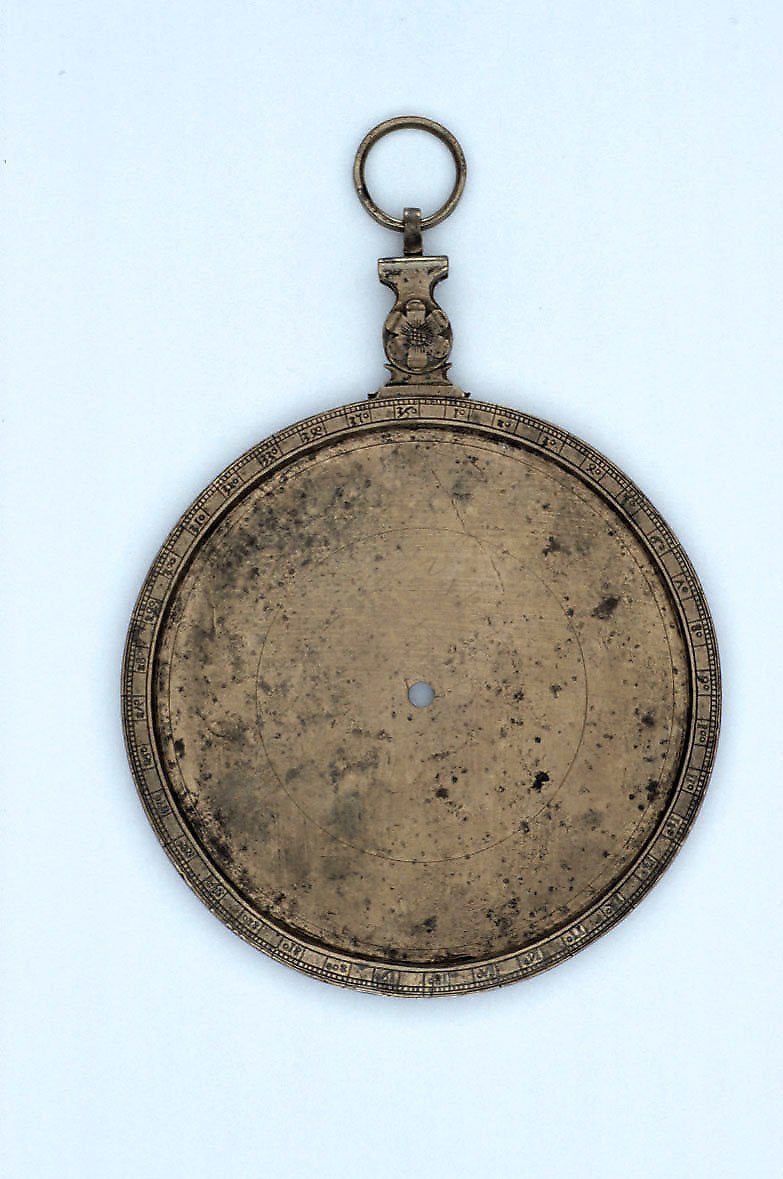
This brass planispheric astrolabe, dating to 1490 and measuring 140 mm in diameter, is the work of maker Hans Bamman. Only the mater of this instrument currently survives. The piece features a throne with a shackle adorned by rose decoration on both sides and includes a suspension ring. The limb contains a degree scale from 0 to 360, while the outer rim is marked for hours in two sets of 1 to 12. The back of the mater displays an intricate arrangement of scales including a degree scale, a zodiacal scale with names and symbols, a scale for 28 lunar mansions, and an eccentric calendar scale for accounting for the sun's progress. Centrally, the instrument is etched with a double shadow square and a diagram for unequal hours. It is signed with the mark 'h b' along with the maker's distinctive triangular mark.

The back of the mater of the Hans Bamman astrolabe, showing the degree, zodiacal, lunar mansion, and eccentric calendar scales.
The back of the mater of the Hans Bamman astrolabe, showing the degree, zodiacal, lunar mansion, and eccentric calendar scales. — Museum of the History of Science, Oxford. Rights pending — permission not yet requested. Original source

Catalogue identity

Source
www.mhs.ox.ac.uk
Category
Tool · German astrolabe
Maker / attribution
Hans Bamman
Reference
Not recorded
Catalogue / lot identifier
46769
Source-reported date
1490
Source-reported place
Germany

Source-reported attribution and specifications are not independent authentication. A listing does not establish present ownership, current display, availability or permission to reproduce.

Object description

Structural Design of the Mater

The surviving mater of this 140 mm diameter astrolabe consists of a back plate integrated with a limb. The structural integrity of the instrument is maintained by a throne located at the top, which incorporates a shackle featuring rose decorations on both sides and a functional suspension ring.

The limb itself is marked with a comprehensive degree scale ranging from 0 to 360, divided into 5-degree increments and subdivided into 1-degree units, with markings numbered by 10. The perimeter of the rim is further divided to accommodate an hour scale, which is presented as two sets of 1 to 12. The construction is strictly of brass, maintaining a consistent circular form that housed the missing internal components.

Evidence for this section
  • “The mater comprises a back plate attached to the limb.”
  • “The throne has a shackle with a rose decoration on both sides and a suspension ring.”
  • “The limb has a degree scale 0 to 360, divided to 5, subdivided to 1, numbered by 10. The rim is divided for hours, 1 to 12 twice.”

Astronomical and Calendar Scales

The reverse side of the mater is heavily engraved with multiple concentric scales designed for astronomical calculation. The outermost ring is a degree scale (90-0-90-0-90) used for altitude measurement. Moving inward, the zodiacal scale provides names and symbols for the twelve signs, each paired with a 30-degree scale. A significant feature is the inclusion of a scale of 28 lunar mansions, representing the zodiacal sections occupied by the moon.

The innermost scale is a calendar, which is purposely eccentric. This eccentricity is positioned offset relative to the zodiacal scale to reconcile the sun's apparent motion along the ecliptic over the year. Additionally, the central area of the plate is occupied by a double shadow square, containing scales 0 to 12, and a geometric diagram dedicated to calculating unequal hours.

Evidence for this section
  • “The back has an outermost degree scale 90 to 0 to 90 to 0 to 90”
  • “the calendar scale is eccentric, that is, is offset with respect to the zodiacal scale.”
  • “The central space has a double shadow square with scales 0 to 12 to 0 to 12 to 0, divided to 3, subdivided to 1, numbered by 3, and a diagram for unequal hours.”

Identification and Attribution

The instrument is dated to the year 1490 and carries the signature of the maker. The identification is confirmed by the initials 'h b' engraved on the surface, accompanied by a specific triangular mark associated with Hans Bamman.

The object remains in the collection of the Museum of the History of Science, Oxford, under inventory number 46769. The information provided serves as the primary record for this item, emphasizing the survival of the mater as the sole remaining structural component of what would have been a more complex assembly including the rete and various climate-specific plates.

Evidence for this section
  • “Dated '1490' and signed 'h b' with Hans Bamman's triangular mark.”
  • “Only the mater of this instrument survives.”

Open research questions

  • What is the historical evidence confirming the 'triangular mark' belongs to Hans Bamman?
  • Are there records of other surviving components that were originally part of this specific astrolabe?

Source evidence

Recorded claims and source quotations for Astrolabe by Hans Bamman
FieldSource-reported valueSource quotation
MakerHans Bamman“Signed by Hans Bamman”
Date1490“Dated 1490”
Diameter140 mm“140 mm in diameter”
Inventory Number46769“Inventory number 46769”
OriginGerman“German”
Signatureh b with triangular mark“signed 'h b' with Hans Bamman's triangular mark.”

Visible details

  • The instrument features a throne with a rose-decorated shackle.
  • The back plate is circular with a central hole for an alidade or rule pivot.
  • The outer rim is graduated for degree measurements.
  • The object exhibits visible surface patina and wear marks throughout the brass plate.

Research qualifications

  • The source notes that only the mater of the instrument survives, meaning other components like the rete, alidade, and plates are absent.
  • The specific identification of the 'h b' initials with Hans Bamman relies on the presence of a triangular mark attributed to him by the museum.

Photograph identity and source facts were screened before import; rights clearance remains pending.

Consulted source

Astrolabe

Reviewed 2026-10-26 · Record c66883797e

Terms in this record

Glossary explanations for terms named in this object’s record.