
Skip to content
The Encyclopedia of Horology

Tool · German astrolabe

Astrolabe attributed to Gerard Mercator

Partially verified

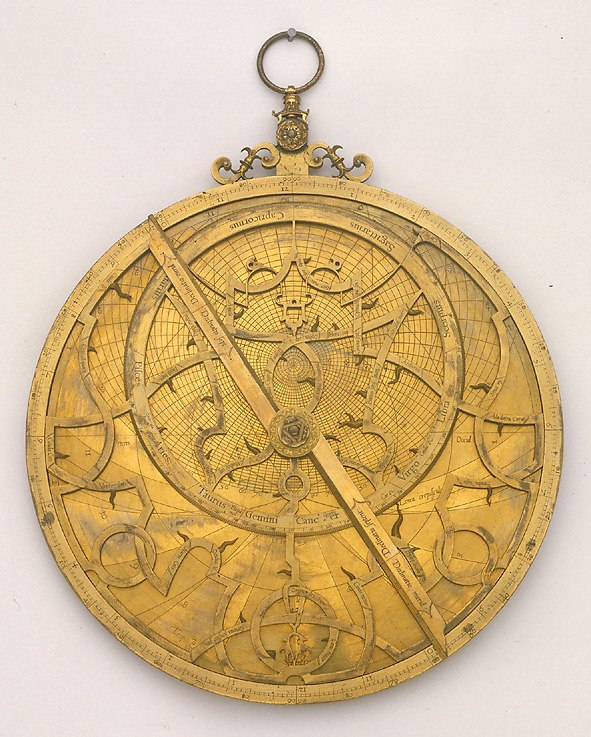
This gilt brass astrolabe, measuring 316 mm in diameter, is attributed to the workshop of Gerard Mercator and dated circa 1570. The instrument features a circular disc fixed to the limb with 16 rivets, surmounted by a throne with S-shaped brackets. The rete is engraved with 42 star names or groups and the zodiac circle. It includes seven latitude plates, six of which are calibrated for latitudes between 36 and 60 degrees. A seventh plate serves as a geographical mirror for the Northern and Southern hemispheres. The back of the instrument contains a shadow square and a conversion diagram for equal and planetary hours. An alidade with sighting wings and a rule for declination are also included. One latitude plate, designed for 43 degrees, is attributed to the Florentine workshop of Giovan Battista Giusti. The instrument is part of the bequest of Robert Dudley to the Grand Duke of Tuscany.

Front view of the 316 mm diameter gilt brass astrolabe, showing the rete, limb, and alidade.
Front view of the 316 mm diameter gilt brass astrolabe, showing the rete, limb, and alidade. — Istituto e Museo di Storia della Scienza, Firenze. Rights pending — permission not yet requested. Original source

Catalogue identity

Source
www.mhs.ox.ac.uk
Category
Tool · German astrolabe
Maker / attribution
Gerard Mercator (attributed)
Reference
Not recorded
Catalogue / lot identifier
1098
Source-reported date
circa 1570
Source-reported place
Germany

Source-reported attribution and specifications are not independent authentication. A listing does not establish present ownership, current display, availability or permission to reproduce.

Object description

Construction and Design

The astrolabe is constructed primarily from gilt brass and measures 316 mm in diameter. It comprises a circular disc secured to the limb using 16 rivets. The suspension system consists of a throne formed by a bar attached to the limb, which is further supported by two S-shaped brackets decorated with ornamental work. The limb's face is graduated in degrees and divided into four quadrants marked 90 to 10 degrees, alongside a 24-hour scale engraved 1-12 twice.

The rete serves as the primary component for star observation, featuring the zodiac circle and 42 named stars or star clusters. The mater is engraved with projections for the latitudes of 90 degrees North and 0 degrees, alongside astrological houses and markings for unequal hours. The instrument includes an alidade, which features a scale labeled 'Horae ortus solis', and sighting wings equipped with a hole and a dot.

Evidence for this section
  • “The astrolabe is formed from a circular disc fixed to the limb by 16 rivets.”
  • “The throne is formed by a bar attached to the limb and supported by two S-shaped brackets with elaborate decoration.”
  • “The rete bears the names of 42 stars or groups of stars.”

Plates and Accessories

The astrolabe is accompanied by seven plates. Six of these are calibrated for latitudes between 36 and 60 degrees. The seventh plate is a geographical map of the Earth with North and South polar projections, where land masses are gilded and seas are left as bare copper; this specific plate is not fitted with a lug or hole for hanging.

One of the latitude plates is designed for 43 degrees, corresponding to Florence.

Evidence for this section
  • “Associated with the astrolabe are six latitude plates (one made in Florence) and a seventh plate engraved with projections of the Earth from the North and South Poles.”
  • “The sixth plate is made for the latitude of Florence, 43?, and it is not from the same workshop as the rest of the astrolabe.”

Back and Inscriptions

The back of the astrolabe features a shadow square within the lower semicircle. The upper-left quadrant contains a diagram intended for conversions between equal and planetary hours, calculated based on the times of sunrise and sunset, while the right quadrant remains blank. The circumference of the back is marked with scales for degrees, the zodiac, and a calendar.

The rule is marked on both arms with scales ranging from 0 to 70 degrees North and 0 to 20 degrees South, labeled respectively as 'Declinatio septent:' and 'Declinatio merid:'.

Evidence for this section
  • “The back of the instrument is a shadow square in the lower semicircle, and in the upper left quadrant is a diagram for conversions between equal and planetary hours based on the times of sunrise and sunset.”
  • “The rule is divided on both arms 0? to 70?N and 0? to 20?S. The scales are labelled 'Declinatio septent:' and 'Declinatio merid:'.”

Open research questions

  • What is the definitive evidence linking the stylistic features of this instrument specifically to the output of the Mercator workshop?
  • How did the plate attributed to Giovan Battista Giusti come to be integrated into this set?

Source evidence

Recorded claims and source quotations for Astrolabe attributed to Gerard Mercator
FieldSource-reported valueSource quotation
MakerAttributed to Gerard Mercator“Attributed to Gerard Mercator”
Datecirca 1570“circa 1570”
Diameter316 mm“316 mm in diameter”
Inventory number1098“Inventory number: 1098”
MaterialGilt brass“Gilt brass”
ProvenanceBequest of Robert Dudley to the Grand Duke of Tuscany“The instrument derives from the bequest of Robert Dudley to the Grand Duke of Tuscany.”
Latitudes36 to 60 degrees“Six plates are calibrated for particular latitudes , from 36 to 60?”

Visible details

  • The limb is engraved with a 24-hour scale marked 1-12 twice.
  • The rete features pointers for 42 stars or star groups.
  • The back includes a shadow square and a conversion diagram for equal and planetary hours.
  • The throne is supported by two ornate S-shaped brackets.

Research qualifications

  • The instrument is anonymous and only attributed to Mercator based on formal characteristics.
  • The latitude plate for 43 degrees originates from a different workshop, attributed to Giovan Battista Giusti.

Photograph identity and source facts were screened before import; rights clearance remains pending.

Consulted source

Astrolabe

Reviewed 2026-10-26 · Record 704d64b61a

Terms in this record

Glossary explanations for terms named in this object’s record.