
Skip to content
The Encyclopedia of Horology

Tool · German astrolabe

16th-Century German Gilt Copper Astrolabe

Partially verified

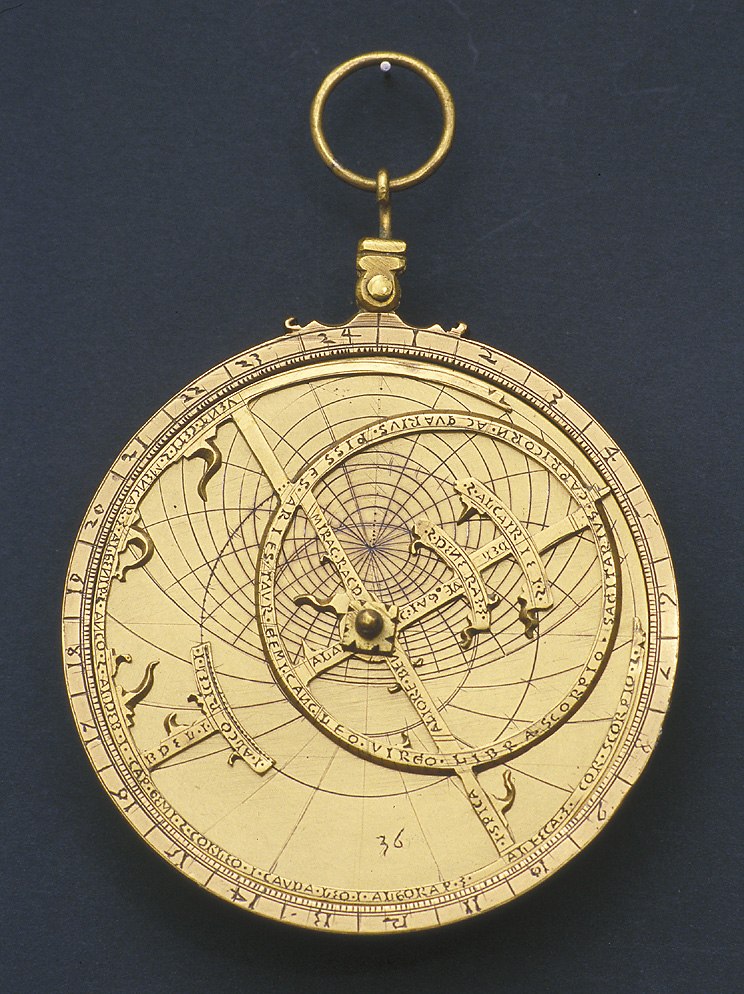
This 16th-century German astrolabe is a gilt copper astronomical instrument measuring 88 mm in diameter. It is unsigned and preserved at the Istituto e Museo di Storia della Scienza in Florence, Italy. The device features a central mater with three plates, calibrated for different latitudes including 36, 40, 42, 45, and 50 degrees with a polar projection. The rete is designed to indicate eighteen stars, rendered either through names or protruding points. The astrolabe is characterized by notable idiosyncrasies in its Latin inscriptions, including abbreviated zodiac names and reversed letters, specifically the character 'N' and the 'S' in 'MARCIUS'. The back includes a half-shadow square with rough divisions and a scale for hours. Suspended via a ring on the throne, the instrument is completed by a non-graduated pointer equipped with sights. The source notes specific orthographic variations that deviate from expected standard formatting for such scientific tools.

The face of the 16th-century gilt copper astrolabe showing the rete, pointer, and zodiac engravings.
The face of the 16th-century gilt copper astrolabe showing the rete, pointer, and zodiac engravings. — Istituto e Museo di Storia della Scienza, Firenze. Rights pending — permission not yet requested. Original source

Catalogue identity

Source
www.mhs.ox.ac.uk
Category
Tool · German astrolabe
Maker / attribution
Not established
Reference
Not recorded
Catalogue / lot identifier
1106
Source-reported date
16th century
Source-reported place
Germany

Source-reported attribution and specifications are not independent authentication. A listing does not establish present ownership, current display, availability or permission to reproduce.

Object description

Construction and Design

The instrument is constructed from gilt copper and measures 88 mm in diameter. It features a throne at the top, which serves as a mounting point for a ring used to suspend the astrolabe. The outer limb is divided into segments ranging from 1 to 24. The rete displays eighteen stars, identified either by name or by small protruding points. A non-graduated pointer, fitted with sights, completes the instrument's face configuration.

The interior mater is designed to house three separate plates. These plates provide latitude calibrations for 36, 40, 42, 45, and 50 degrees, utilizing a polar projection system. The back of the instrument contains a half-shadow square situated in the lower portion. This square is lightly marked with rough divisions from 3 to 6 to 9 to 12, while the lower half also includes a scale representing hours, marked from 1 to 12.

Evidence for this section
  • “Gilt copper; 88 mm in diameter”
  • “The throne bears a ring to suspend the instrument.”
  • “Eighteen stars are indicated on the rete”
  • “contains three plates, calibrated for the latitudes 40 and 45?, 42 and 36?, and 50?”

Orthography and Inscriptions

The astrolabe contains various Latin inscriptions across its components. The rete features zodiac sign names, some of which are abbreviated. The reverse side of the instrument also includes zodiac signs and names of months in Latin. The engraving of these inscriptions contains repeated irregularities noted in the source documentation.

Specific orthographic peculiarities are present, including the consistent reversal of the letter 'N'. Additionally, the sign for Pisces is recorded as 'PISSES' rather than the standard Latin spelling. The word 'MARCIUS' also features a reversed letter 'S'. These idiosyncrasies occur across both the zodiac and month designations, differentiating this instrument from standard historical examples of the period.

Evidence for this section
  • “is has certain idiosyncrasies in the engraving of both the signs of the zodiac and the months of the year”
  • “Pisces is written as 'PISSES', for example, and the letter N is frequently reversed, along with the letter S in the word 'MARCIUS'”

Provenance and Documentation

The astrolabe is currently held within the collection of the Istituto e Museo di Storia della Scienza in Florence, Italy, identified under inventory number 1106. The piece is attributed to a 16th-century German origin, though it remains unsigned.

The object has been formally catalogued by the museum, with specific reference provided in the publication by M. Miniati, titled 'Museo di Storia della scienza: Catalago', published in Florence in 1991. The record is included as part of the Epact archive, which documents scientific instruments from the medieval and Renaissance periods.

Evidence for this section
  • “Holding museum: Istituto e Museo di Storia della Scienza, Firenze”
  • “Inventory number: 1106”
  • “16th century; German”
  • “See M. Miniati, Museo di Storia della scienza: Catalago (Florence, 1991), p.8.”

Open research questions

  • What is the significance of the reversed letters regarding the maker's linguistic background or training?
  • Are there known contemporary German astrolabes that share these specific orthographic patterns?

Source evidence

Recorded claims and source quotations for 16th-Century German Gilt Copper Astrolabe
FieldSource-reported valueSource quotation
MaterialGilt copper“Gilt copper”
Diameter88 mm“88 mm in diameter”
Inventory Number1106“Inventory number: 1106”
OriginGerman“German”
Date16th century“16th century”
Signature StatusUnsigned“Unsigned”
Latitude Calibrations36, 40, 42, 45, and 50 degrees“calibrated for the latitudes 40 and 45?, 42 and 36?, and 50? with a polar projection.”

Visible details

  • Gilt copper construction
  • Includes three plates with varied latitude calibrations
  • Reversed lettering in Latin inscriptions
  • Suspension ring attached to the throne

Research qualifications

  • Attribution to German origin is not substantiated by maker marks
  • The exact function of the non-graduated pointer is only identified as being equipped with sights

Photograph identity and source facts were screened before import; rights clearance remains pending.

Consulted source

Astrolabe

Reviewed 2026-10-26 · Record b2a5d18946

Terms in this record

Glossary explanations for terms named in this object’s record.