
Skip to content
The Encyclopedia of Horology

Tool · German astrolabe

Gilt brass astrolabe

Partially verified

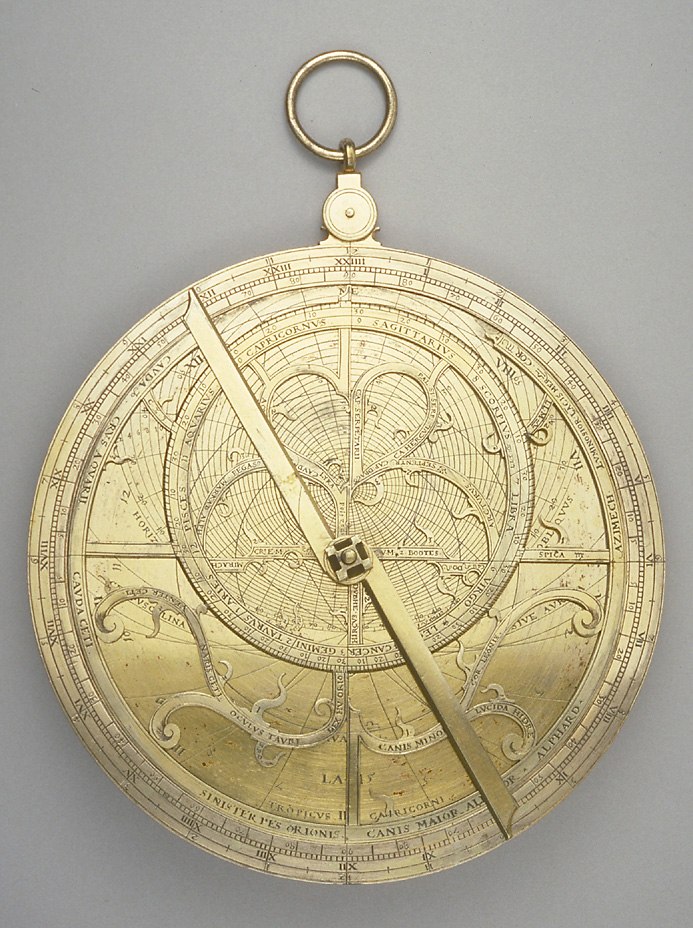
This 170 mm diameter gilt brass astrolabe is attributed to the maker Johann Anton Linden of Heilbronn, Germany, based on stylistic similarities to other known instruments by the same maker. The astrolabe features an unusually shallow mater designed to accommodate a single plate, which is marked for latitudes 45 and 48 degrees. The rete incorporates a foliate scroll design and flame-shaped star pointers, while the back displays concentric scales including altitude, zodiacal, Julian calendar, and Gregorian calendar divisions. Additionally, the back includes a double shadow scale and two specific horary quadrants for latitudes 45 and 48 degrees. The instrument, which lacks both signature and date, was bequeathed to the British Museum by Octavius Morgan in 1888 and is documented in the institutional catalogue of European scientific instruments. The construction includes a throne with a swiveling plate and a riveted rim.

Front view of the gilt brass astrolabe showing the rete, star pointers, and ecliptic markings.
Front view of the gilt brass astrolabe showing the rete, star pointers, and ecliptic markings. — British Museum, London. Rights pending — permission not yet requested. Original source

Catalogue identity

Source
www.mhs.ox.ac.uk
Category
Tool · German astrolabe
Maker / attribution
Johann Anton Linden
Reference
Not recorded
Catalogue / lot identifier
MLA 1888,12-1.279
Source-reported date
circa 1583
Source-reported place
Germany

Source-reported attribution and specifications are not independent authentication. A listing does not establish present ownership, current display, availability or permission to reproduce.

Object description

Construction and Design

The instrument is a gilt brass astrolabe with a diameter of 170 mm. It features an unusually shallow mater capable of holding only one plate. The outer rim is riveted to the back plate and contains a recess at the 12 o'clock position underneath the throne to secure the plate's tongue. The internal surface of the mater does not feature any markings.

The throne assembly consists of a round plate fitted with an additional swiveling component. On the exterior, the rete is characterized by a foliate scroll pattern outside the ecliptic ring. The solstitial bar, located inside the ecliptic and positioned above the equinoctial bar, is formed into a distinct heart shape. The instrument also features star pointers shaped like flames.

Evidence for this section
  • “The mater is unusually shallow only accommodating one plate”
  • “The rete has a foliate scroll design outside the ecliptic; the solstitial bar inside the ecliptic above the equinoctial bar is broken into a heart shape”

Scales and Markings

The rim of the astrolabe displays two parallel 24-hour scales, one utilizing Arabic numerals (1 to 12 repeated) and one using Roman numerals (I to XXIV). Both are calibrated to half-hour increments. A central altitude scale is also present, divided into 90-degree quadrants. The back of the instrument contains four primary concentric scales: an altitude scale, a zodiacal scale with Latin names and symbols, a Julian calendar scale, and a Gregorian calendar scale.

The inner area of the back plate features a double shadow scale labeled 'VMBRA VERSA' and 'VMBRA RECTA'. The upper section of this space contains two specific horary quadrants, configured for latitudes 45 and 48 degrees, respectively. The instrument does not contain any markings on the rule or the alidade.

Evidence for this section
  • “The rim bears two equal 24-hour scales”
  • “The back of the instrument has several concentric scales”
  • “The top half contains two horary quadrants laid out for equal and unequal hours for the same latitudes as the plates”

Provenance and Attribution

This astrolabe does not bear a maker's signature or a date of production. The attribution to Johann Anton Linden of Heilbronn, Germany, and the proposed date of circa 1583 are based on the instrument's morphological and decorative alignment with a signed astrolabe by the same maker held in the Museum of the History of Science in Oxford.

The instrument was acquired by the British Museum through a bequest from Octavius Morgan in 1888. It is recorded in the museum's collection under the registration number MLA 1888,12-1.279 and is further documented in F. A. B. Ward's 1981 catalogue of European scientific instruments.

Evidence for this section
  • “This instrument is neither signed nor dated, but the close resemblance to an astrolabe by Johann Anton Linden of Heilbronn in Germany”
  • “The instrument was bequeathed to the Museum by Octavius Morgan in 1888”

Open research questions

  • What specific visual evidence confirms the instrument was made in Heilbronn rather than merely influenced by the Heilbronn school?
  • Does the absence of markings on the rule and alidade indicate they are replacements or original to the instrument?

Source evidence

Recorded claims and source quotations for Gilt brass astrolabe
FieldSource-reported valueSource quotation
MakerJohann Anton Linden“Attributed to Johann Anton Linden”
MaterialGilt brass“Gilt brass; 170 mm in diameter”
Diameter170 mm“170 mm in diameter”
Place of manufactureHeilbronn“Heilbronn”
Inventory numberMLA 1888,12-1.279“MLA 1888,12-1.279”
Horary featuresTwo horary quadrants on the back“this instrument has on the back two different horary quadrants made for the same latitudes as the plates”
Star capacity39 stars“the names of 39 stars are given with their magnitudes”

Visible details

  • Rete features a foliate scroll design
  • Solstitial bar has a heart-shaped design
  • Star pointers are flame-shaped
  • Back plate incorporates two horary quadrants

Research qualifications

  • Attribution to Johann Anton Linden is based on stylistic resemblance to other instruments rather than a signature
  • Date is suggested by comparison with other instruments and is not engraved on this object

Photograph identity and source facts were screened before import; rights clearance remains pending.

Consulted source

Astrolabe

Reviewed 2026-10-26 · Record 87841afc50

Terms in this record

Glossary explanations for terms named in this object’s record.