
Skip to content
The Encyclopedia of Horology

Tool · German astrolabe

Astrolabe

Partially verified

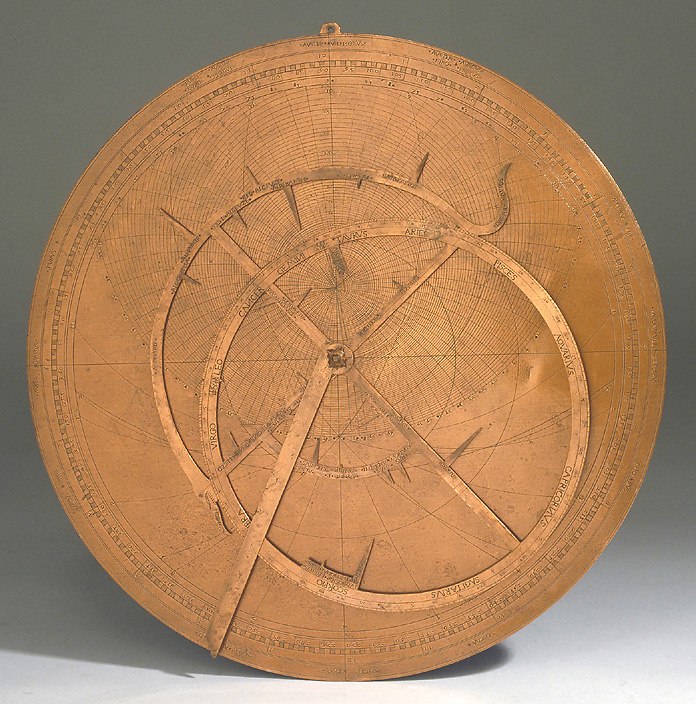
This 16th-century astrolabe, crafted from copper and measuring 385 mm in diameter, is part of the collection at the Istituto e Museo di Storia della Scienza in Florence. The instrument, which is unsigned, is attributed to German manufacture based on its construction. It possesses an unusual design, lacking a traditional mater; instead, a single plate serves as the foundation for the rete, rule, and alidade. The device features extensive engravings, including wind names, scales for degrees and hours, almucantars, azimuth lines, and astrological houses. The rete incorporates 28 star pointers and a Capricorn band terminating in dragon-like features. The instrument was historically associated with the legacy of Vincenzo Viviani. It is currently missing its suspension apparatus, though the basic astronomical components remain intact for analysis of its complex geometric and celestial markings.

Frontal view of the copper astrolabe showing the rete, ecliptic circle, and plate engravings.
Frontal view of the copper astrolabe showing the rete, ecliptic circle, and plate engravings. — Istituto e Museo di Storia della Scienza, Firenze. Rights pending — permission not yet requested. Original source

Catalogue identity

Source
www.mhs.ox.ac.uk
Category
Tool · German astrolabe
Maker / attribution
Not established
Reference
Not recorded
Catalogue / lot identifier
1282
Source-reported date
16th century
Source-reported place
Germany

Source-reported attribution and specifications are not independent authentication. A listing does not establish present ownership, current display, availability or permission to reproduce.

Object description

Construction and Plate Design

The astrolabe is composed of a 385 mm diameter copper disk. Unlike standard instruments of this type, this example does not include a traditional mater. Instead, the assembly relies on a single plate that supports the rete, rule, and alidade. The outer rim of this plate displays the twelve main winds in Latin, with north oriented at the bottom.

The plate surface is densely engraved with astronomical and astrological data. This includes a scale of degrees and hours, as well as specific zones for almucantars, azimuth lines, unequal hour lines, and twelve astrological houses. These details provide a comprehensive surface for solar and stellar calculations, despite the unusual structural configuration of the instrument.

Evidence for this section
  • “The astrolabe has not a mater as such, only a plate to which are fixed the very simple rete, the rule and the alidade.”
  • “The rim of the plate is inscribed with the names of the main 12 winds in Latin, with north on the bottom of the plate.”

Rete and Astronomical Indicators

The rete is a simplified construction consisting only of the ecliptic circle and the lower portion of the Capricorn band. The latter is noted for its decorative termination, shaped like the head and tail of a dragon. There are 28 star pointers, all shaped as simple points, with individual star names inscribed in Latin. The ecliptic circle itself includes a degree scale.

The central portion of the plate is engraved for astrolabe functionality, featuring almucantars marked every degree and numbered from 5 to 80. Azimuth lines, also spaced at five-degree intervals, are included to aid in determining celestial positioning. These markings work in conjunction with the rete to facilitate the tracking of various astronomical events.

Evidence for this section
  • “The rete is constituted only by the ecliptic circle and the lower part of the Capricorn band.”
  • “There are 28 star pointers in a simple point shape and the stars are all named in Latin.”
  • “The Capricorn band ends in the shape of the head and tail of a Dragon.”

Reverse Plate and Calendar Functions

The reverse of the plate features a comprehensive set of scales for measurement and timekeeping. This includes a rim degree scale and a shared zodiacal scale, both with Latin labeling. A calendar scale, divided to the day, occupies the central area, with the first point of Aries designated on 10 April.

The bottom half of the reverse contains a double shadow scale, while the top right quadrant includes additional zodiacal, unequal hour, and equal hour markings. The alidade, which is plain, features two double sights, allowing for observational use. The absence of the original suspension apparatus is noted, marking a significant change in the physical completeness of the instrument from its period of use.

Evidence for this section
  • “The back of the plate is engraved with a scale of degrees on the rim”
  • “The first point of Aries is on 10 April.”
  • “The alidade is plain and has two double sights.”
  • “The suspension apparatus is missing.”

Open research questions

  • What specific solar or stellar observations were intended for the single latitude represented on the plate?
  • How does the unconventional 'no-mater' structural design influence the mechanical precision of the rete movement?

Source evidence

Recorded claims and source quotations for Astrolabe
FieldSource-reported valueSource quotation
MaterialCopper“Copper”
Diameter385 mm“385 mm in diameter”
Inventory Number1282“Inventory no. 1282”
ProvenanceVincenzo Viviani legacy“It belonged to the legacy of the scientist Vincenzo Viviani.”
OriginGerman“From the manner in which the instrument is constructed, it appears to have been made in the German lands.”
ConditionMissing suspension“The suspension apparatus is missing.”

Visible details

  • Capricorn band features dragon head and tail terminals
  • Plate rim engraved with 12 wind names in Latin
  • Rete configured with 28 simple point-shaped star pointers
  • Rule and alidade components are of plain, unadorned design

Research qualifications

  • Maker identity is unknown
  • Suspension apparatus is missing

Photograph identity and source facts were screened before import; rights clearance remains pending.

Consulted source

Astrolabe

Reviewed 2026-10-26 · Record 4a6eea2382

Terms in this record

Glossary explanations for terms named in this object’s record.