
Skip to content
The Encyclopedia of Horology

Clock · Carriage clock

Arnold & Frodsham Rosewood Giant Carriage Clock with Chronometer Escapement

Partially verified

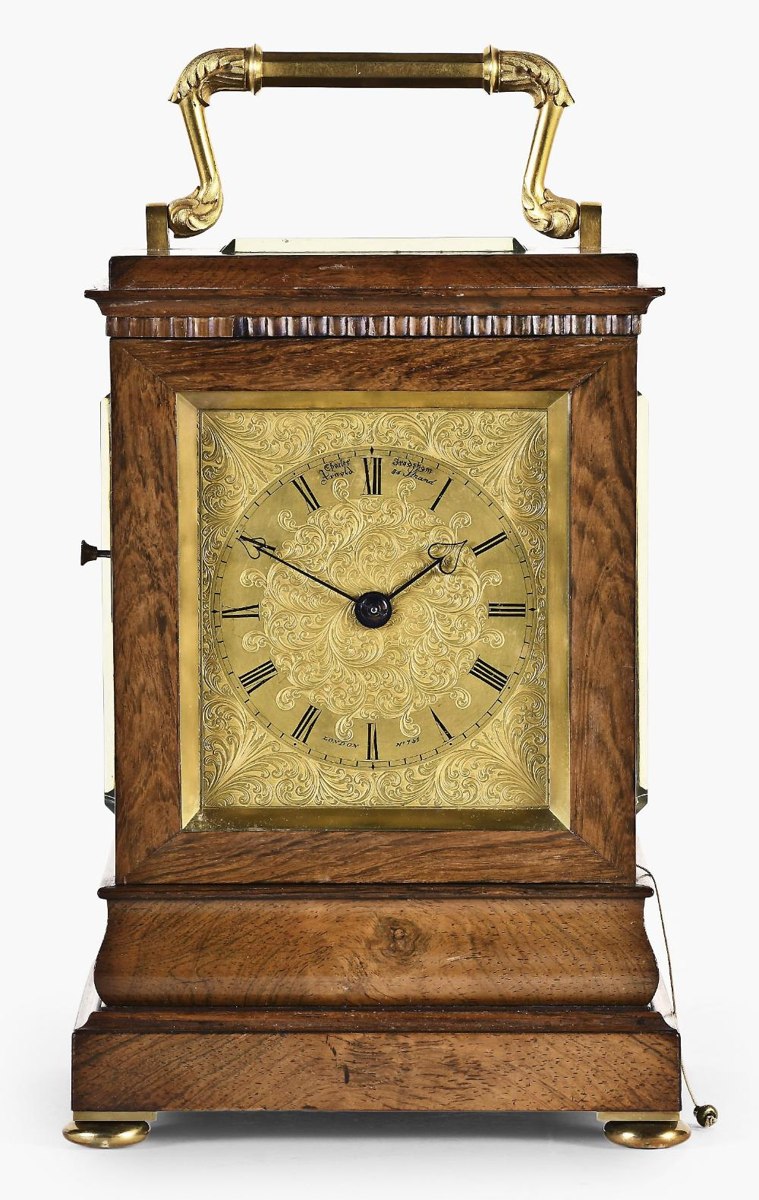
This mid-19th-century giant carriage clock is attributed to Arnold & Frodsham, London, and features a rosewood-veneered case mounted on compressed gilt ball feet. Its molded top and fluted band are complemented by a heavy gilt carrying handle and beveled glass panels, including an aperture over the escapement. The gilt square dial is richly engraved with foliate scrolls and marked with Roman numerals, traversed by blued steel hands with open heart tips. According to the auction catalog, the two-train, five-pillar fusee movement features Harrison's maintaining power, Earnshaw's spring detent escapement, a free-sprung cut bimetallic balance, and a helical balance spring, striking and repeating on a blued steel gong.

Front view of the Arnold & Frodsham rosewood giant carriage clock showing engraved dial, blued hands, and gilt handle
Front view of the Arnold & Frodsham rosewood giant carriage clock showing engraved dial, blued hands, and gilt handle — Schmitt Horan & Co.. Rights pending — permission not yet requested. Original source

Catalogue identity

Source
www.invaluable.com
Category
Clock · Carriage clock
Maker / attribution
Arnold & Frodsham
Reference
Not recorded
Catalogue / lot identifier
437
Source-reported date
circa 1855
Country
United Kingdom
Source-reported serial
751

Source-reported attribution and specifications are not independent authentication. A listing does not establish present ownership, current display, availability or permission to reproduce.

Object description

Case Construction and Design

The giant carriage clock is presented in a rosewood-veneered case set on gilt compressed ball feet. The design includes a molded base, an ogee surbase, and a molded top situated above a narrow fluted band.

The case features thick beveled glass on the front and sides, with an additional beveled glass aperture allowing for observation of the escapement. A substantial gilt handle is mounted at the top.

Evidence for this section
  • “the rosewood veneered case on gilt compressed ball feet below a molded base and ogee surbase”
  • “the sides and front with thick beveled glasses, and molded top above a narrow fluted band, with substantial gilt handle”
  • “thick beveled glass allowing observation of the escapement”

Dial and Operational Features

The dial is a gilt, square face ornamented with foliate scrolls and marked with Roman numerals. The clock uses blued steel hands with open heart-form ends.

On the right side of the case, there is a lever provided for adjusting the volume of the striking mechanism.

Evidence for this section
  • “roman numeral gilt dial ornamented with foliate scrolls and blued steel hands with open heart form ends”
  • “the right side of the case with lever for adjusting the volume of the striking”

Mechanical Specifications

The clock is powered by a five-pillar, two-train fusee movement. It incorporates Harrison's maintaining power and an Earnshaw's spring detent escapement. The regulation is achieved through a free-sprung cut bimetallic balance and a helical balance spring.

The movement strikes the hour and half-hour on a large blued steel gong and includes a repeating function. The backplate is signed 'Arnold Chas. Frodsham 84 Strand London 751'.

Evidence for this section
  • “five pillar, two train fusee movement with Harrison's maintaining power and Earnshaw's spring detent escapement”
  • “freesprung cut bimetallic balance and helical balance spring”
  • “striking the hour and half hour on a large blued steel gong and repeating the last hour on demand”
  • “the back plate signed "Arnold Chas. Frodsham 84 Strand London 751"”

Condition and Observations

The auction catalog reports the movement is dirty with thickened lubricants. Reported damage includes repaired splits to the veneer surrounding the dial and veneer repair and minor detachment on the rear door.

The volume control mechanism is currently ineffective due to straightened hammer lifting pins. Additionally, there are minor losses to the blue finish on the gong.

Evidence for this section
  • “movement dirty and with thickened lubricants”
  • “veneer surrounding dial with repaired splits, rear door with veneer repair at left and with minor veneer detachment”
  • “some hammer lifting pins straightened thereby rendering the volume control ineffective”
  • “gong with minor losses to blue”

Open research questions

  • What is the significance of the 'Arnold Chas. Frodsham' signature in relation to the company history and serial 751?
  • Can the hammer lifting pins be restored to enable the volume control mechanism?

Source evidence

Recorded claims and source quotations for Arnold & Frodsham Rosewood Giant Carriage Clock with Chronometer Escapement
FieldSource-reported valueSource quotation
Back Plate SignatureArnold Chas. Frodsham 84 Strand London 751“the back plate signed "Arnold Chas. Frodsham 84 Strand London 751"”
EscapementEarnshaw's spring detent escapement“Earnshaw's spring detent escapement”
Movement ConstructionFive pillar, two train fusee movement with Harrison's maintaining power“five pillar, two train fusee movement with Harrison's maintaining power”
Dimensions10.75in x 7in x 6.5in“10.75in x 7in x 6.5in”
BalanceFreesprung cut bimetallic balance and helical balance spring“freesprung cut bimetallic balance and helical balance spring”
ProvenanceFrom the collection of Victor Kochaver“From the collection of Victor Kochaver”
AccessoriesCase Key“ACCESSORIES: Case Key”

Visible details

  • Square gilt dial ornately engraved with dense foliate scrollwork and Roman numerals.
  • Blued steel hands terminating in open heart motif tips.
  • Substantial gilt-brass folding handle mounted above a fluted frieze and beveled top glass.
  • Rosewood veneered case resting on four compressed gilt ball feet.
  • Small adjustment lever visible protruding from the upper left side of the case.

Research qualifications

  • Internal movement, rear door, and backplate signature are not visible in the photograph.
  • Condition report notes repaired veneer splits and an ineffective volume control mechanism.

Photograph identity and source facts were screened before import; rights clearance remains pending.