
Skip to content
The Encyclopedia of Horology

Tool · Astrolabe

14th Century Engraved Brass Astrolabe

Partially verified

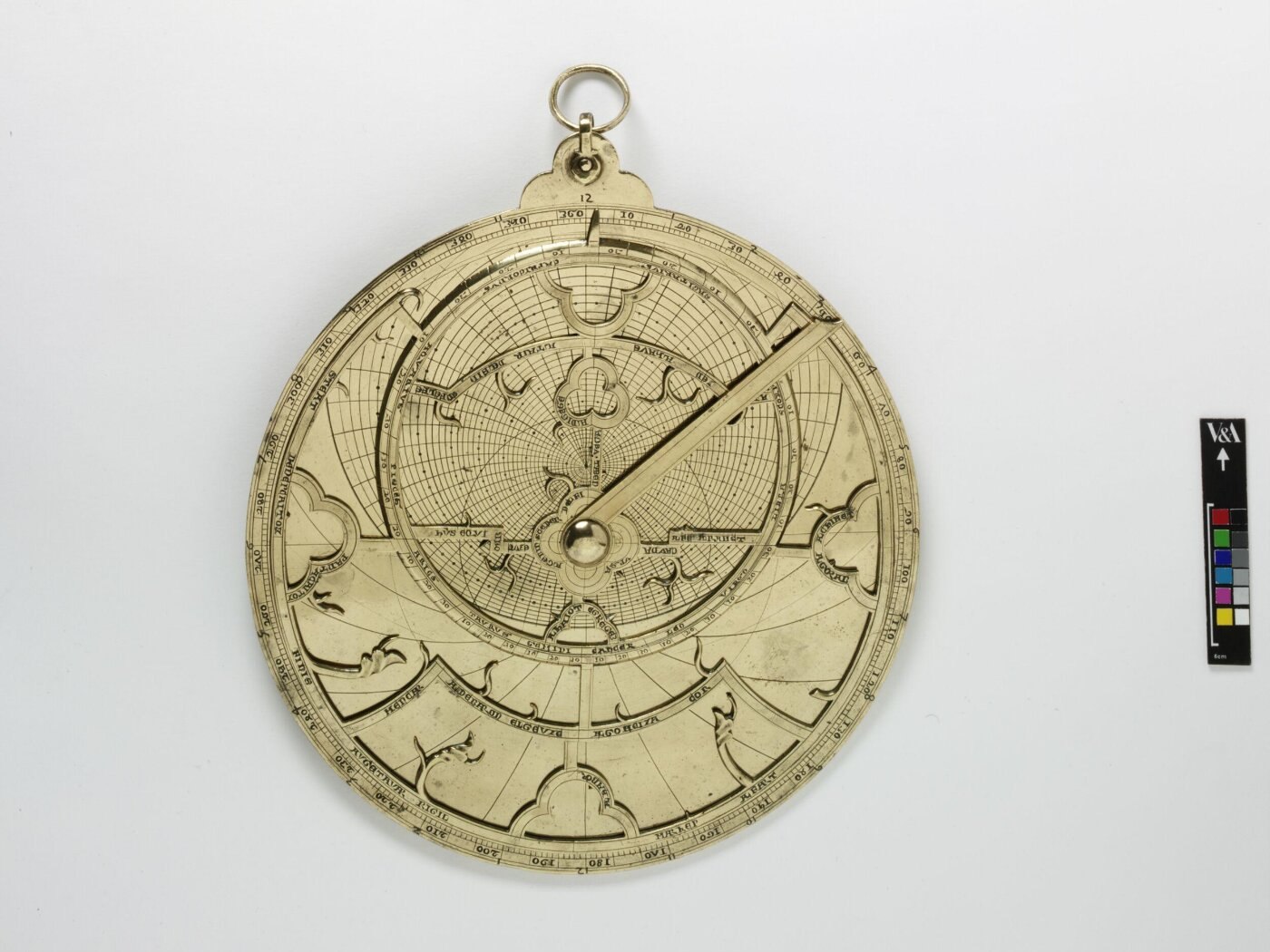
This object is a portable astronomical instrument, specifically an astrolabe, attributed to France and dated between 1300 and 1400. Constructed from cast sheet brass with additional cast elements, the instrument is decorated with engravings. The front face features a pierced plate inscribed with the names of 37 stars. The design allows for the calculation of time, sunrise and sunset times, the rising and setting times of celestial bodies, and the configuration of the heavens at various points in time. As a scientific instrument, it served functions in both astronomy and astrology. The object is held within the Victoria and Albert Museum collection, having been received as a gift. The construction involves techniques of casting, sheet working, and engraving to create the flattened representation of the universe.

Front view of the 14th-century brass astrolabe showing the rete, star pointers, and central alidade.
Front view of the 14th-century brass astrolabe showing the rete, star pointers, and central alidade. — Victoria and Albert Museum, London. Rights pending — permission not yet requested. Original source

Catalogue identity

Source
collections.vam.ac.uk
Category
Tool · Astrolabe
Maker / attribution
Not established
Reference
Not recorded
Catalogue / lot identifier
M.128-1923
Source-reported date
1300-1400
Source-reported place
France

Source-reported attribution and specifications are not independent authentication. A listing does not establish present ownership, current display, availability or permission to reproduce.

Object description

Construction and Materials

The body of the instrument incorporates both cast and sheet components, which have been assembled to form a precise, flattened representation of the cosmos. Surface finishing includes engraving, which provides the functional scales, star positions, and lettering required for the operation of the device.

The instrument is designed with a pierced plate on the front that identifies 37 distinct stars. The structural integrity and functional requirements of the device are met through the combination of these cast and sheet elements, allowing for the precise measurement of angular distances and the alignment of the alidade over the scales.

Evidence for this section
  • “Astrolabe of cast sheet brass, with additional cast elements, engraved”
  • “The names of 37 stars are engraved on the pierced plate on the front.”

Functionality and Use

This device serves as a multifunctional tool for both astronomical calculations and astrological readings. It is capable of determining specific temporal data, including the time of day and the precise moments of sunrise and sunset. Furthermore, it aids in tracking the celestial motions, such as the rising and setting times of identified stars.

By configuring the components, a user can model the state of the heavens for any requested time, whether in the past or the future. This capability makes it an instrument for celestial observation and prediction, functioning by mapping the universe onto a flat, operable surface.

Evidence for this section
  • “The astrolabe calculated the time, the times of sunrise and sunset, the rising and setting times for stars, and the configuration of the heavens for a time in the future or past.”
  • “It was a particularly useful tool in astronomy and astrology.”

Provenance and Identification

The object is identified by the accession number M.128-1923 within the Victoria and Albert Museum collection. It is recorded as a gift, designated as the Williams Hearn Gift. Scholarly records place its manufacture in France within the 14th century, specifically dating it to the years 1300-1400.

The identification of the piece as French-made rests on attribution rather than signed documentation. Historical records associated with the item emphasize its status as an engraved brass instrument, consistent with the described time and place of origin.

Evidence for this section
  • “Accession number: M.128-1923”
  • “Place of origin: France (made)”
  • “Date: 1300-1400”

Open research questions

  • Are there any makers' marks or hidden signatures within the engravings that could narrow the attribution beyond France?
  • Does the specific arrangement of the 37 engraved stars correlate to a known medieval star catalogue?

Source evidence

Recorded claims and source quotations for 14th Century Engraved Brass Astrolabe
FieldSource-reported valueSource quotation
Accession NumberM.128-1923“M.128-1923”
Date1300-1400“1300-1400”
MaterialBrass“Brass, cast sheet, engraved”
OriginFrance“Place of origin: France (made)”
Star Count37“The names of 37 stars are engraved on the pierced plate on the front.”
TechniqueCast and engraved“Astrolabe of cast sheet brass, with additional cast elements, engraved”

Visible details

  • Front plate features pierced cutouts and star name engravings
  • Reverse side includes a linear scale and central rotatable alidade
  • Suspension ring attached to a prominent upper lug

Research qualifications

  • The exact maker remains anonymous
  • Exact attribution to France is stated as a source-attributed provenance rather than an inscribed fact

Photograph identity and source facts were screened before import; rights clearance remains pending.

Consulted source

Astrolabe

Reviewed 2026-10-26 · Record 3779c3393a

Terms in this record

Glossary explanations for terms named in this object’s record.