
Skip to content
The Encyclopedia of Horology

Tool · Arabic-inscribed astrolabe, Near East

Wooden Astrolabe by Shaykh Sakkūt

Partially verified

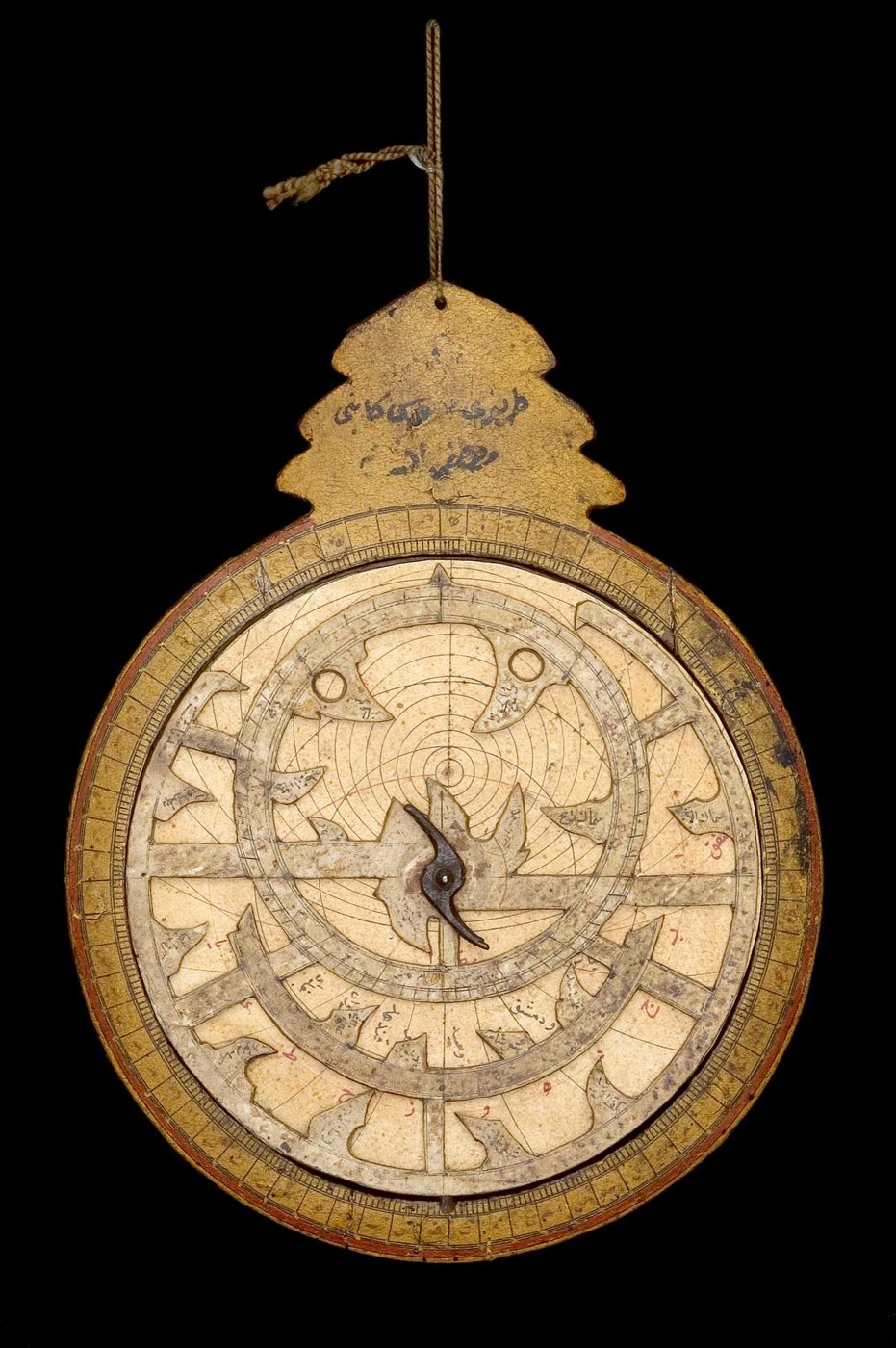
This wooden astrolabe, attributed to the maker Shaykh Sakkūt and dated circa 1800, originates from Turkey. The instrument features a tree-shaped, engraved throne and a mater and limb assembly of two-piece, nailed construction. The limb exhibits damage in the upper left quadrant. The back of the instrument displays 12 scales, including altitude, sine/cosine, shadow square, unequal hours, calendar, cotangent, zodiacal signs, and a lunar cycle. Notably, the instrument includes a Syrian calendar scale, with months progressing clockwise. The central band on the back contains zodiacal signs written in red. Eleven plates are present with latitudes ranging to 90 degrees. The sighting vanes on the double-ended alidade have detached from the main body, preventing inspection of the original sighting arrangement.

Front view of the wooden astrolabe (inventory number 47792) showing the rete, throne, and limb.
Front view of the wooden astrolabe (inventory number 47792) showing the rete, throne, and limb. — History of Science Museum, University of Oxford. Rights pending — permission not yet requested. Original source

Catalogue identity

Source
www.mhs.ox.ac.uk
Category
Tool · Arabic-inscribed astrolabe, Near East
Maker / attribution
Shaykh Sakkūt
Reference
47792
Catalogue / lot identifier
1992-24
Source-reported date
ca. 1800
Source-reported place
Turkey

Source-reported attribution and specifications are not independent authentication. A listing does not establish present ownership, current display, availability or permission to reproduce.

Object description

Construction and Mechanical Assembly

The instrument is constructed primarily from wood, comprising a mater and limb built in two pieces joined with nails. The throne, also made of wood, is integrated into the base and features an engraved, tree-like silhouette. The overall structural integrity is compromised by a break in the upper left quadrant of the limb, located roughly 45 degrees from the throne's position. The edge of the limb is marked with a distinctive red color. The internal womb area is lined with paper, which has suffered significant damage from worm activity over time.

The central attachment mechanism for the rete consists of a nut and bolt, which are noted as probable later replacements rather than original components. A metal tab is positioned at the bottom of the instrument, 180 degrees opposite the throne, to secure the plates in place. The sighting alidade is double-ended and rigid, though the loss of its sighting vanes makes it impossible to determine the original configuration of its apertures.

Evidence for this section
  • “The mater and limb are of two pieces, nailed construction.”
  • “The throne is shaped like a tree.”
  • “The limb is brokenin the upper left quadrant, ca. 45° from the throne.”
  • “The wingnut and bolt look like later replacements.”

Scales and Astronomical Features

The back of the astrolabe is highly complex, featuring 12 distinct scales used for astronomical calculation. These include standard divisions for altitude and shadow squares (measured in both feet and fingers), alongside more specific indicators for unequal hours, cotangents, and lunar cycles. The lower two quadrants are dedicated to the calendar, the Syrian calendar specifically, and the zodiacal signs.

The innermost circle on the back remains an area of investigative uncertainty. Theories suggest it could track the length of the longest day per month or the dates of lunar phases, though neither explanation is fully conclusive. On the front, the rete serves as an indicator-line device holding 23 star pointers. The zodiacal signs are inscribed on the rete, though several are noted as currently illegible.

Evidence for this section
  • “The back contains 12 scales of the following types: Altitude; Sine/Cosine; Shadow square; Unequal hours; Calendar; Cotangent; Zodiacal signs; Lunar cycle.”
  • “This instrument is one of only a handful in the collection that has the Syrian calendar on it.”
  • “The innermost circle, however, is something of a mystery.”

Provenance and Documentation

The astrolabe was acquired by the History of Science Museum, University of Oxford, in 1992. It was purchased at an auction conducted by Ader Tajan at the Hotel Drouot in Paris on June 2, 1992, listed as lot 126. The acquisition was facilitated by the PRISM Fund and the Scientific Instrument Research Fund. The object is assigned the inventory number 47792, which corresponds to the internal catalogue record provided by the museum.

The attribution to Shaykh Sakkūt as the maker is recorded in the museum's catalogue, with a suggested dating of circa 1800. The museum maintains detailed technical reports for the individual components of the instrument, including the rete, plates, and alidade, which serve as the primary documentary evidence for its current condition and structural attributes.

Evidence for this section
  • “The Museum bought it with grants from the PRISM Fund and the Scientific Instrument Research Fund.”
  • “It was lot 126 in the auction sale conducted by Ader Tajan on 2 June 1992.”
  • “Date ca. 1800”
  • “Maker Shaykh Sakkūt”

Open research questions

  • What is the specific function of the innermost circle on the back of the instrument given the conflicting interpretations of solar versus lunar data?
  • Can the illegible zodiacal labels on the rete be recovered through multi-spectral imaging to verify the full star chart?

Source evidence

Recorded claims and source quotations for Wooden Astrolabe by Shaykh Sakkūt
FieldSource-reported valueSource quotation
MakerShaykh Sakkūt“Maker Shaykh Sakkūt”
Dateca. 1800“Date ca. 1800”
MaterialWood“Material Wood”
Inventory number47792“Inventory no. 47792”
Place of manufactureTurkey“Place Turkey”
Accession number1992-24“Accession 1992-24”
ProvenancePurchased from the Hotel Drouot, Paris, in 1992“Purchased from the Hotel Drouot, Paris, in 1992”
Rete star count23“The rete contains 23 stars.”

Visible details

  • Throne is shaped like a tree
  • Limb broken in the upper left quadrant, approximately 45 degrees from the throne
  • Sighting vanes on the alidade have broken off
  • Womb covered with paper showing significant worm damage

Research qualifications

  • Innermost circle on back is of uncertain function; hypotheses include longest day length or lunar cycle dates
  • Nut and bolt holding the rete are identified as potential later replacements
  • Inability to verify if original alidade vanes had pin-hole sights due to damage

Photograph identity and source facts were screened before import; rights clearance remains pending.

Consulted source

Astrolabe, inventory 47792 (Turkey, ca. 1800)

Reviewed 2026-10-26 · Record e6fed9eb4f

Terms in this record

Glossary explanations for terms named in this object’s record.