
Skip to content
The Encyclopedia of Horology

Tool · Arabic-inscribed astrolabe, Near East

Brass Astrolabe by ‘Abdī

Partially verified

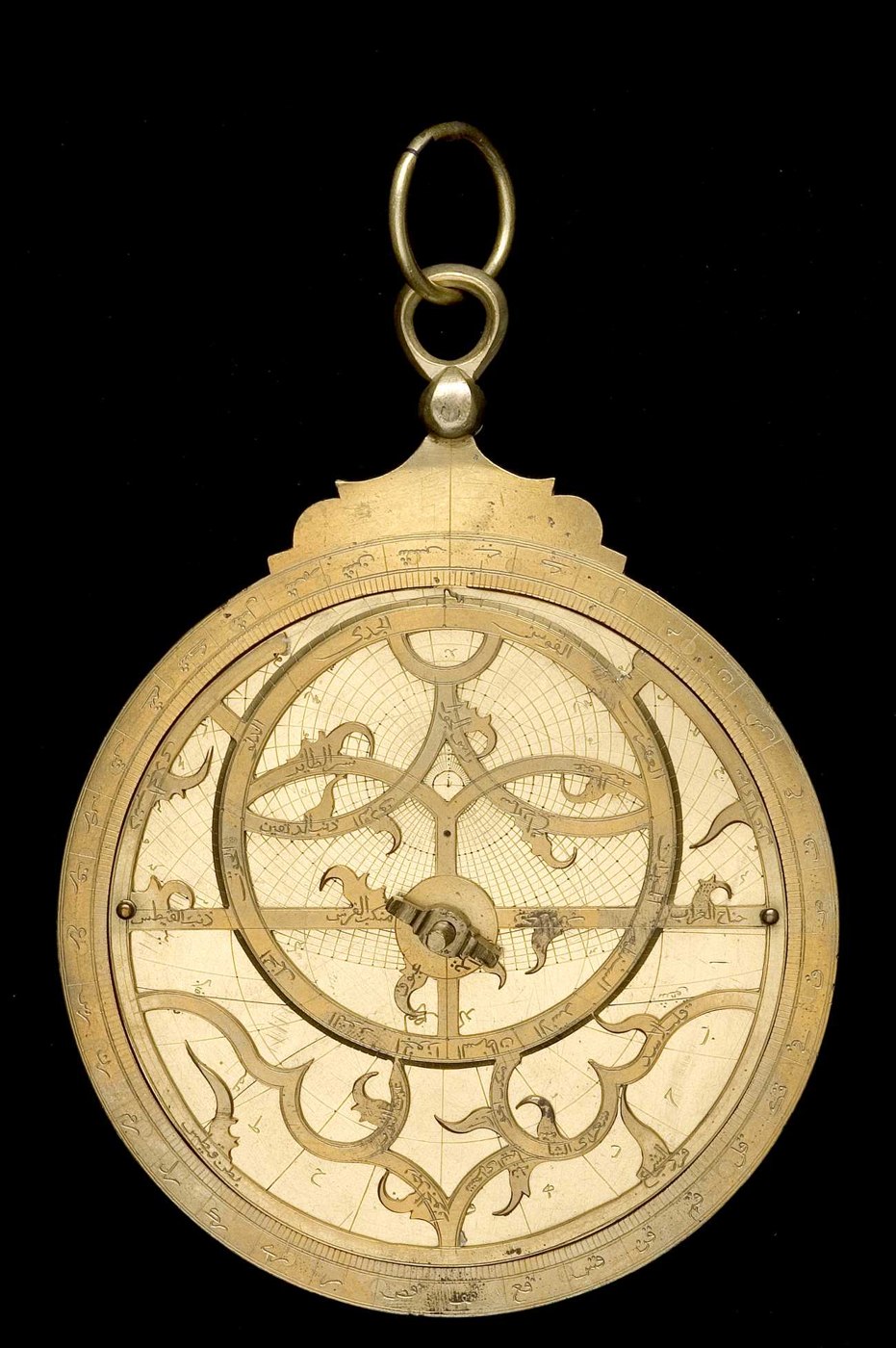
This planispheric astrolabe, inventory number 39955, is attributed to the maker ‘Abdī and dates to 1713/4. Manufactured in Turkey, the instrument is constructed primarily of brass and features a Y-shaped rete with 22 stars. The mater and limb are joined via soldered and riveted construction, with rivets spaced at approximately 15-degree intervals. The back of the instrument displays 7 distinct scales including altitude, sine/cosine, and a shadow square. The maker’s signature, ‘Abdī designed this (رسمه علي), is engraved on the back of the throne. The instrument includes four plates with latitudes ranging from 21°0' to 42°0' and a double-ended alidade. The original nut and bolt assembly for the rete has been superseded by a recent, overly long replacement.

The rete and throne of the brass astrolabe, inventory 39955.
The rete and throne of the brass astrolabe, inventory 39955. — History of Science Museum, University of Oxford. Rights pending — permission not yet requested. Original source

Catalogue identity

Source
www.mhs.ox.ac.uk
Category
Tool · Arabic-inscribed astrolabe, Near East
Maker / attribution
‘Abdī
Reference
Not recorded
Catalogue / lot identifier
39955
Source-reported date
1713/4
Source-reported place
Turkey

Source-reported attribution and specifications are not independent authentication. A listing does not establish present ownership, current display, availability or permission to reproduce.

Object description

Construction and Mater

The astrolabe is fabricated from brass and follows a construction method involving two pieces for the mater and limb, which are soldered and riveted together. Rivets are visible at approximately 15-degree intervals along the circumference of the limb. The degree scale on the limb ranges from 0 to 360, numbered every 10 degrees.

A guide for inscribing the limb numerals is indicated by a ring of dots situated in the center of the limb. The instrument features a Y-shaped rete designed to accommodate 22 stars marked with flamant pointers. The rete, however, is currently secured with a recent, non-original nut and bolt that exceeds the required length for the instrument.

Evidence for this section
  • “The mater and limb are of two pieces, soldered and riveted construction.”
  • “The rivets that hold the backplate to the limb can be seen approximately every 15° around the limb.”
  • “A recent replacement, which is far too long for this instrument.”

Back and Throne Design

The back of the instrument is characterized by its restrained decoration, lacking the dense astrological tables often found on contemporary Persian examples. It incorporates seven functional scales: altitude, sine/cosine, equal hours, unequal hours, shadow square, cotangent, and degree. The date is recorded as the year 1125.

The maker's signature is located on the back of the throne, simply stating '‘Abdī designed this'. The shackle is teardrop-shaped and attached via two similarly shaped tabs.

Evidence for this section
  • “The back contains 7 scales”
  • “The shape of the throne with its clean, unadorned style and almost complete absence of decorative engraving set this astrolabe apart.”
  • “Set into the centre of the back of the throne, the maker dispensed with formalities, saying simply: ‘Abdī designed this (رسمه علي).”

Provenance and History

The instrument was acquired by the History of Science Museum, University of Oxford, in 1957 following a presentation by J. A. Billmeir. The provenance research indicates that the astrolabe was previously in the collection of Bay Fahri İmrek of Balıkesir, Turkey, prior to its purchase by Billmeir between 1955 and 1957.

The source notes that only four Turkish astrolabes exist within the museum's collection, identifying this particular piece as the older of a known pair. The object’s stylistic features, including the strap-work within the ecliptic and the calligraphic style, serve as references for Turkish production of the period.

Evidence for this section
  • “Presented by J. A. Billmeir in 1957”
  • “It formerly belonged to Bay Fahri İmrek, of Balıkesir, Turkey. ”
  • “Astrolabes made in Turkey are comparatively rare: there are only four in the Museum's collection.”

Open research questions

  • What is the historical context of the maker ‘Abdī beyond this signed instrument?
  • Are there additional components (such as specific plates) that might have been lost given the non-original state of the nut and bolt?

Source evidence

Recorded claims and source quotations for Brass Astrolabe by ‘Abdī
FieldSource-reported valueSource quotation
Maker‘Abdī“Maker ‘Abdī”
Place of manufactureTurkey“Place Turkey”
Date1713/4“Date 1713/4”
Inventory number39955“Inventory no. 39955”
MaterialBrass“Material Brass”
ProvenanceFormerly belonged to Bay Fahri İmrek of Balıkesir, Turkey; presented by J. A. Billmeir in 1957“It formerly belonged to Bay Fahri İmrek, of Balıkesir, Turkey. ”
Signature‘Abdī designed this (رسمه علي)“‘Abdī designed this (رسمه علي)”

Visible details

  • The rete contains 22 stars with flamant pointers.
  • The back of the instrument is inscribed with the date year 1125.
  • The alidade is double-ended and decorated with two simple lines.

Research qualifications

  • The current nut and bolt assembly is a recent, non-original replacement and is noted as being too long for the instrument.
  • While the maker is named as ‘Abdī, other details regarding his career are not provided in the source.

Photograph identity and source facts were screened before import; rights clearance remains pending.

Consulted source

Astrolabe, inventory 39955 (Turkey, 1713/4)

Reviewed 2026-10-26 · Record b1a82f30ce

Terms in this record

Glossary explanations for terms named in this object’s record.