
Skip to content
The Encyclopedia of Horology

Tool · Arabic-inscribed astrolabe, Near East

Astrolabe by Khafīf

Partially verified

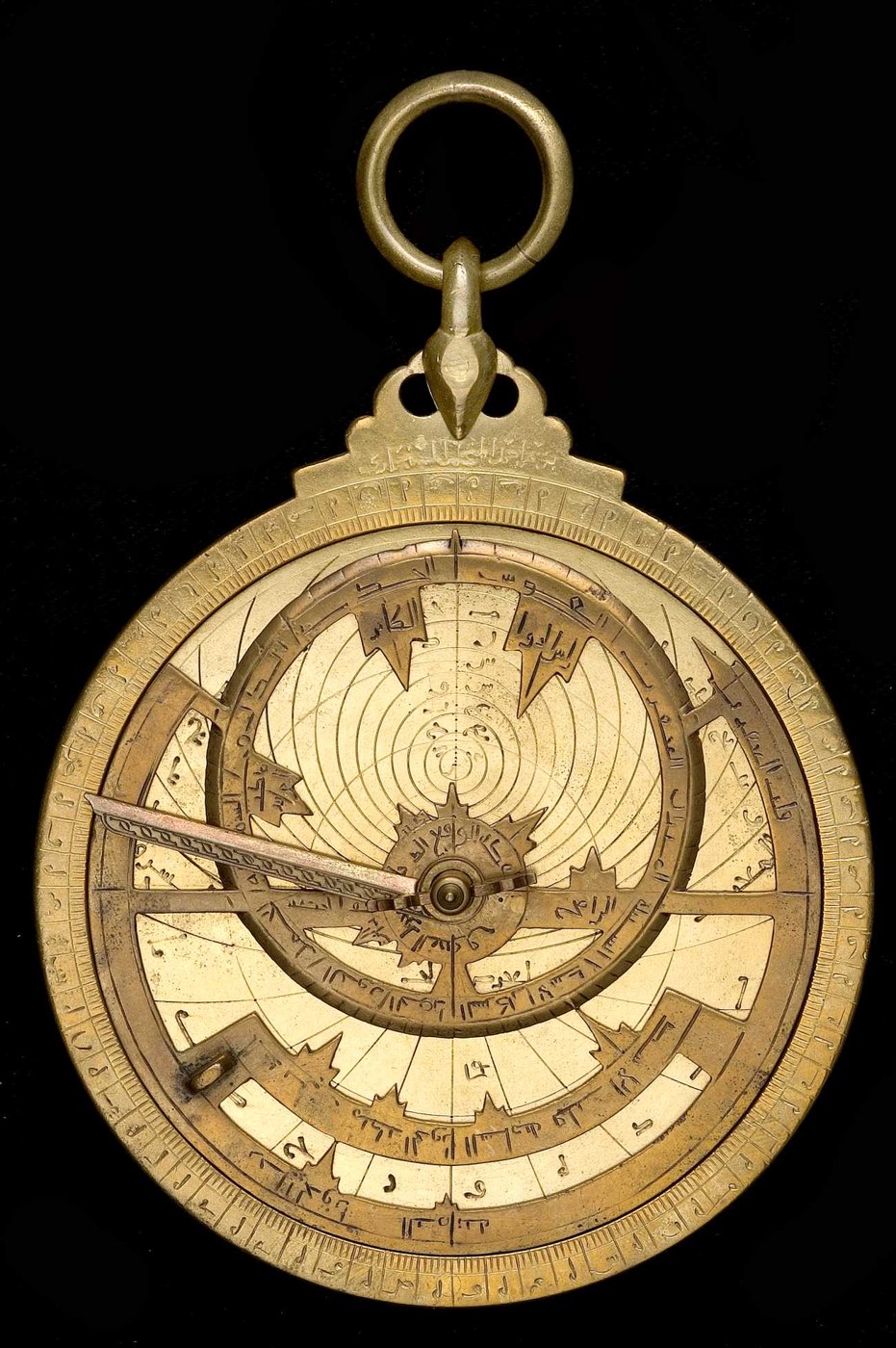
This late 9th-century astrolabe, crafted from brass, is attributed to Khafīf, an apprentice of ‘Alī ibn ‘Īsā. It is held in the University of Oxford’s History of Science Museum collection under inventory number 47632. The instrument features a pierced, five-lobed throne with an integrated base and an omega-type shackle. The mater and limb are of one-piece construction. Three plates are included, covering latitudes from 33° to 41°. The reverse side is engraved with altitude scales, a cotangent scale, a shadow square, and a Dastūr circle. Added Armenian inscriptions appear on the shadow square and two of the plates. The device, which includes an original single-ended pointer and a counter-changed alidade, was presented to the museum by J. A. Billmeir in 1957.

Front view of the brass astrolabe (inventory 47632) showing the rete, pin and wedge, and the five-lobed throne.
Front view of the brass astrolabe (inventory 47632) showing the rete, pin and wedge, and the five-lobed throne. — History of Science Museum, University of Oxford. Rights pending — permission not yet requested. Original source

Catalogue identity

Source
www.mhs.ox.ac.uk
Category
Tool · Arabic-inscribed astrolabe, Near East
Maker / attribution
Khafīf, apprentice of ‘Alī ibn ‘Īsā
Reference
Not recorded
Catalogue / lot identifier
47632
Source-reported date
late 9th century
Source-reported place
Syria

Source-reported attribution and specifications are not independent authentication. A listing does not establish present ownership, current display, availability or permission to reproduce.

Object description

Construction and Design

The astrolabe is constructed from brass and consists of a one-piece mater and limb assembly. The throne, which is pierced and features a five-lobed design, is attached to an integrated base. A simple, squared cross-section ring is connected to the instrument via an omega-type shackle, with notably large attachment tabs. The rete is of the simple indicator-line style, featuring 17 stars marked by distinct, dagger-shaped pointers. A single knob facilitates rotation of the rete, which is held in place by a pin and wedge, the pin head being decorated with radial lines.

The instrument includes three plates calibrated for latitudes ranging from 33°0' to 41°0'. These latitudes are associated with regions in Syria and Armenia. The front of the astrolabe is fitted with an original, single-ended pointer, while the reverse side features a double-ended, counter-changed alidade. Both the pointer and the alidade are decorated with matching engraved patterns.

Evidence for this section
  • “The throne is of the pierced type made of brass attached with integrated base made of brass and has a simple, squared cross-section ring made of brass and omega type shackle made of brass”
  • “The rete contains 17 stars. The zodiac on the rete is labelled”
  • “There are 3 plates with latitudes ranging from 33°0' to 41°0'”

Scales and Inscriptions

The reverse of the instrument contains four primary scales: altitude, cotangent, a shadow square, and a Dastūr circle. The altitude scales are arranged in the upper quadrants, while the cotangent and shadow square scales occupy the lower quadrants. The shadow square includes Armenian numbers and a specific inscription indicating the word 'shadow' along its diagonal.

Inscriptions are present on both the front and back of the instrument. These include a maker's signature identifying Khafīf as an apprentice of ‘Alī ibn ‘Īsā and a mark denoting ownership by Aḥmad, an astronomer from Ṣinjār. Additionally, two of the three plates feature latitude markings in Armenian, indicating early modifications to the instrument.

Evidence for this section
  • “The back contains 4 scales of the following types: Altitude; Cotangent; Shadow square; Dastūr Circle.”
  • “The shadow square has Armenian numbers and an inscription for 'shadow' on the diagonal, and there are latitude indications in Armenian on two of the three plates.”
  • “[For] Aḥmad the astronomer from Ṣinjār”

Provenance and History

This astrolabe was acquired by the History of Science Museum in Oxford following a donation by J. A. Billmeir in 1957. Records indicate that Billmeir had previously purchased the instrument from the Parisian collector and dealer Nicolas Landau between 1955 and 1957. The object is identified by the museum accession number 1957-84/155.

The museum notes that this specific astrolabe is the oldest specimen currently held within its collection.

Evidence for this section
  • “Presented by J. A. Billmeir in 1957”
  • “Billmeir bought it from Nicolas Landau, a collector and dealer of Paris, during the period 1955-57.”
  • “This astrolabe by his apprentice Khafīf is the oldest in the collection.”

Open research questions

  • The significance of the early Armenian additions regarding the trade or ownership history of the instrument in the late 9th century
  • The specific function and regional utility of the Dastūr circle in 9th-century Syrian astrolabe design

Source evidence

Recorded claims and source quotations for Astrolabe by Khafīf
FieldSource-reported valueSource quotation
Inventory number47632“Inventory no. 47632”
MakerKhafīf, apprentice of ‘Alī ibn ‘Īsā“Maker Khafīf, apprentice of ‘Alī ibn ‘Īsā”
Datelate 9th century“Date late 9th century”
Place of manufactureSyria“Place Syria”
MaterialBrass“Material Brass”
ProvenancePresented by J. A. Billmeir in 1957“Presented by J. A. Billmeir in 1957”
Plate range33°0' to 41°0'“latitudes ranging from 33°0' to 41°0'”
Number of stars17“There are 17 stars on the rete”

Visible details

  • Pierced five-lobed throne
  • Dagger-shaped star pointers on the rete
  • Original single-ended pointer and counter-changed alidade
  • Engraved Armenian inscriptions and numbers on the reverse side

Research qualifications

  • The exact date is considered approximate based on the known apprenticeship lineage
  • The specific historical ownership by Aḥmad the astronomer from Ṣinjār is based on interpreted inscriptions

Photograph identity and source facts were screened before import; rights clearance remains pending.

Consulted source

Astrolabe, inventory 47632 (Syria, late 9th century)

Reviewed 2026-10-26 · Record d1e12da7b2

Terms in this record

Glossary explanations for terms named in this object’s record.