
Skip to content
The Encyclopedia of Horology

Tool · Arabic-inscribed astrolabe, Near East

Brass Astrolabe

Partially verified

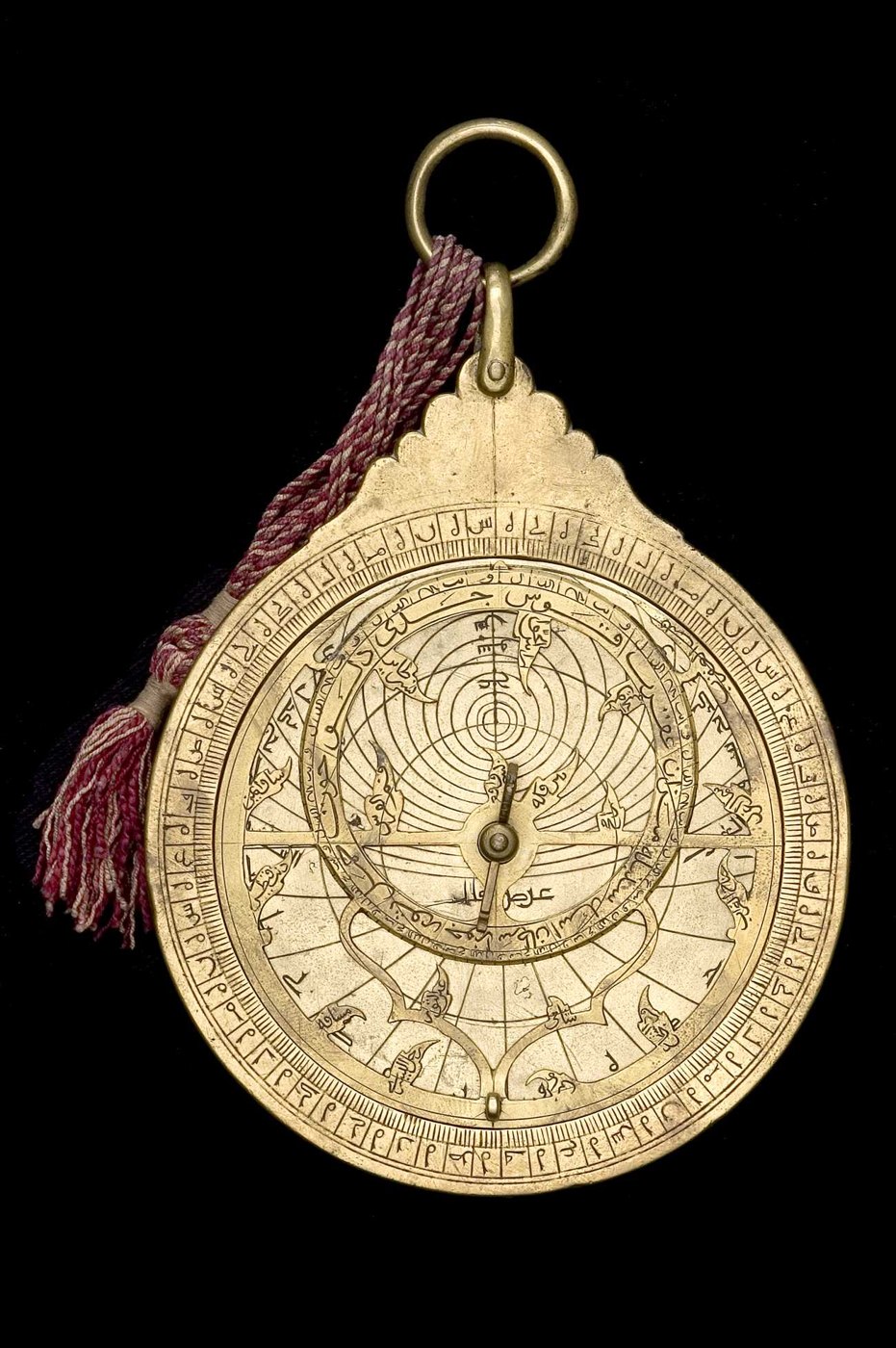
This 17th-century brass astrolabe (inventory 53307) was presented to the History of Science Museum by J. A. Billmeir in 1957. The instrument features a simple brass throne attached to an integrated base, a round-section suspension ring, and an omega-type shackle. The mater and limb are constructed from two soldered pieces, with the limb featuring a circular degree scale. The rete is of the foliate, single-knob type with star pointers extending from bulbous bases, while the back displays scales for altitude, unequal hours, cotangents, and a shadow square. The instrument includes three plates covering latitudes from 21°0' to 45°0'. Provenance research identifies plates for 21° 31' and 41° 31', suggesting an original intended use for a Muslim at the latter latitude, possibly Istanbul. The double-ended alidade is rigid and features single pinhole sights.

Front view of the brass astrolabe showing the rete, pin, and degree scale.
Front view of the brass astrolabe showing the rete, pin, and degree scale. — History of Science Museum, University of Oxford. Rights pending — permission not yet requested. Original source

Catalogue identity

Source
www.mhs.ox.ac.uk
Category
Tool · Arabic-inscribed astrolabe, Near East
Maker / attribution
Not established
Reference
Not recorded
Catalogue / lot identifier
1957-84/171
Source-reported date
17th century (?)
Source-reported place
Turkey
Source-reported serial
53307

Source-reported attribution and specifications are not independent authentication. A listing does not establish present ownership, current display, availability or permission to reproduce.

Object description

Construction and Mater

The astrolabe is manufactured entirely from brass. The mater and limb are composed of two distinct pieces, which are joined through a soldered construction. The limb is graduated with a degree scale, which is numbered every 5 degrees in a circular, concentric geometry from 0 to 90 degrees.

The throne is of the simple type, featuring an integrated base that is composed of two distinct components. The front part is integral with the limb, while the back part serves as an extension of the rear plate. A simple, round cross-section ring is attached to the throne via an omega-type shackle.

Evidence for this section
  • “The mater and limb are of two pieces, soldered construction.”
  • “The throne is of the simple type made of brass attached with integrated base made of brass and has a simple, round cross-section ring made of brass and omega type shackle made of brass”

Rete and Plates

The rete is a foliate, single-knob design with star pointers that originate from bulbous, bulb-shaped bases. The zodiac signs on the rete are engraved in Arabic script. The rete is secured to the mater using a central pin and wedge arrangement, featuring a decorative, neatly carved horse.

There are three plates provided with the instrument, which cover latitudes ranging from 21°0' to 45°0'. The back of the astrolabe incorporates four primary scales: altitude, unequal hours, cotangent, and a shadow square. The altitude scales are arranged in the upper quadrants of the circular area.

Evidence for this section
  • “The rete is of the foliate (single knob) type.”
  • “The zodiac on the rete is labelled: حمل , ثور , جوزا , سرطان , اسد , سنبله , ميزان , عقرب , قوس , جدي , دلو , حوت .”
  • “There are 3 plates with latitudes ranging from 21°0' to 45°0' .”

Provenance and Origin

The astrolabe was acquired by the museum following a donation by J. A. Billmeir in 1957, having been purchased by him between 1955 and 1957. The object is assigned the accession number 1957-84/171.

The presence of two specific plates with latitudes of 21° 31' (associated with Mecca) and 41° 31' suggests that the instrument was originally created for a user at the latter latitude. Based on this, historical research suggests that the instrument may have been intended for use in Istanbul, Turkey.

Evidence for this section
  • “Presented by J. A. Billmeir in 1957”
  • “The two specific plates (not in round degrees) for 21° 31' (Mecca) and 41° 31' indicate that it was originally made for a Muslim living at the latter latitude, perhaps Istanbul.”

Open research questions

  • What specific star coordinates correspond to the unmarked pointers on the rete?
  • Can the provenance of the instrument be traced further back than its purchase by Billmeir in 1955?

Source evidence

Recorded claims and source quotations for Brass Astrolabe
FieldSource-reported valueSource quotation
Inventory Number53307“Inventory no. 53307”
MaterialBrass“Material Brass”
Date17th century (?)“Date 17th century (?)”
OriginTurkey“Place Turkey”
AcquisitionPresented by J. A. Billmeir in 1957“Presented by J. A. Billmeir in 1957”
Plate Latitude Range21°0' to 45°0'“latitudes ranging from 21°0' to 45°0'”
Rete TypeFoliate (single knob)“The rete is of the foliate (single knob) type.”

Visible details

  • The rete zodiac is engraved with Arabic lettering.
  • The throne has a simple design integral to the limb.
  • The back instrument scales are arranged in quadrants.
  • The alidade is double-ended with single pinhole sights.

Research qualifications

  • The exact 17th-century dating remains uncertain.
  • The attribution of the place of manufacture as Turkey is based on source analysis.

Photograph identity and source facts were screened before import; rights clearance remains pending.

Consulted source

Astrolabe, inventory 53307 (Turkey, 17th century (?))

Reviewed 2026-10-26 · Record 633de7b827

Terms in this record

Glossary explanations for terms named in this object’s record.