
Skip to content
The Encyclopedia of Horology

Clock · Table clock

Wilhelmus Köberle Table Clock

Partially verified

This table clock, attributed to the maker Wilhelmus Köberle (born circa 1648), dates to approximately 1700. The object is housed in an original decorated wooden and leather case, which features brass fittings, a lock, and a viewing window. The movement is constructed with a hexagonal brass design and is fire-gilded, displaying applied floral decorations throughout. Mechanically, the clock utilizes a chain and fusee system, paired with a verge escapement and a three-armed iron balance. The movement features baluster-shaped pillars, and its striking mechanism includes two hammers engraved with mythical creatures. A significant decorative element is the finely engraved, openwork balance cock, which incorporates the motif of a bird of prey. The overall design reflects the output of Köberle, who is documented as a prolific maker of table and travel timepieces. Its dimensions are recorded as 75 mm.

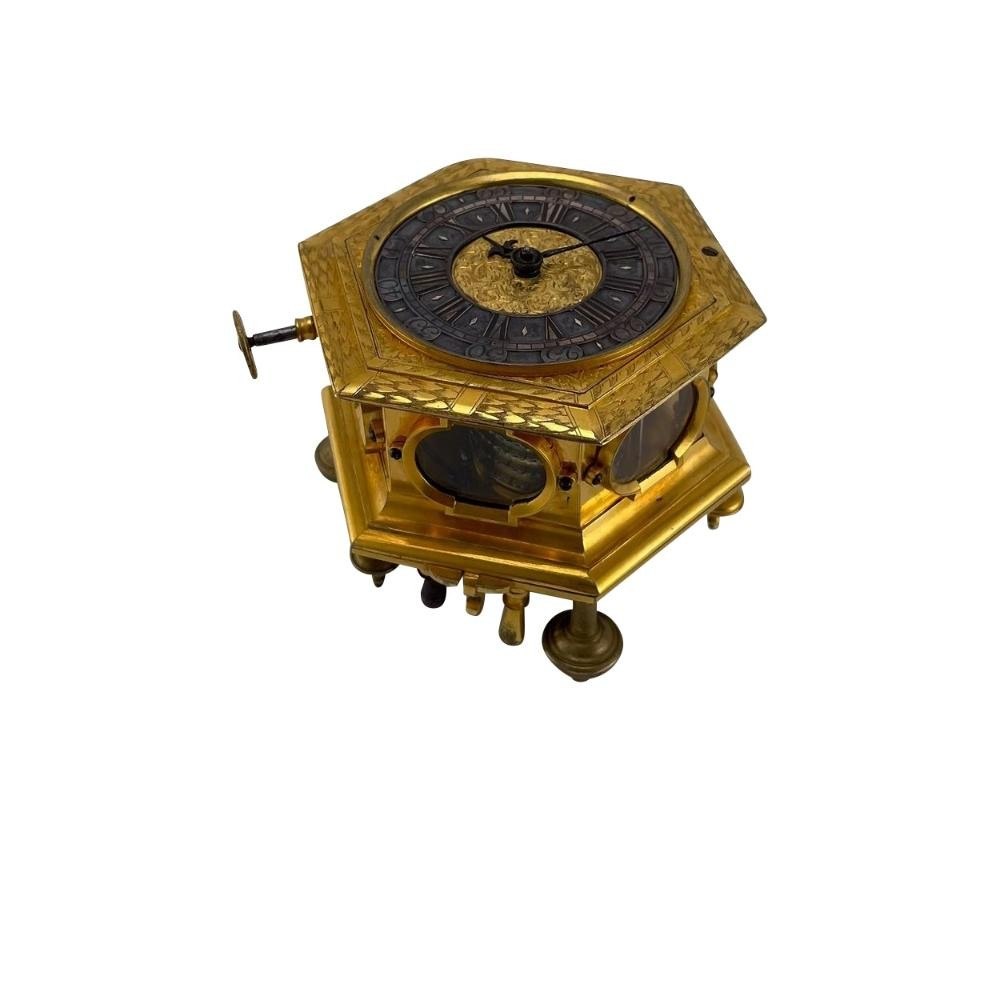
Top-down view of the hexagonal table clock, showing the dial, hands, and the fire-gilded, engraved case construction.
Top-down view of the hexagonal table clock, showing the dial, hands, and the fire-gilded, engraved case construction. — Auktionen Dr. Crott / Invaluable. Rights pending — permission not yet requested. Original source

Catalogue identity

Source
orbiscollectibles.com
Category
Clock · Table clock
Maker / attribution
Wilhelmus Köberle
Reference
Not recorded
Catalogue / lot identifier
b64bcba903
Source-reported date
circa 1700
Source-reported place
Germany

Source-reported attribution and specifications are not independent authentication. A listing does not establish present ownership, current display, availability or permission to reproduce.

Object description

Case and External Features

The clock is contained within an original case constructed from a combination of wood and leather. This housing is designed with a hexagonal profile and includes a dedicated viewing window. The exterior is further secured and ornamented with brass fittings, including a lock to provide closure for the housing.

The primary body of the clock shows intricate detailing, with applied floral decorations integrated into the gilded surface. The entire assembly sits upon small feet, with the overall dimensions recorded by the source as 75 mm.

Evidence for this section
  • “Original decorated wooden and leather case with viewing window and brass fittings with lock.”
  • “applied floral decorations”

Movement and Escapement

The timepiece is powered by a hexagonal brass movement that has been finished with fire gilding. Internally, the mechanism is built upon baluster-shaped pillars and utilizes a chain and fusee system to manage energy delivery.

Timekeeping is governed by a verge escapement connected to a three-armed iron balance. The movement also includes a striking capability, featuring two hammers that are finished with engravings of mythical creatures. A notable decorative feature is the balance cock, which is finely engraved as an openwork piece featuring a bird of prey.

Evidence for this section
  • “Hexagonal brass movement, fire-gilded”
  • “chain/fusee, baluster-shaped pillars”
  • “verge escapement, three-armed iron balance”
  • “two hammers engraved with mythical creatures, verge escapement, three-armed iron balance, finely engraved, openwork balance cock with a bird of prey.”

Maker and Historical Context

The object is attributed to Wilhelmus Köberle, who was born around 1648 in Wasserburg am Bodensee. He is recorded in historical accounts as a productive maker, specifically noted for his contributions to the field of table and travel clocks.

The present record classifies the object's classification as 'probable', noting that while evidence exists for the attribution, it remains an area for further specialist research.

Evidence for this section
  • “Wilhelm Köberle was born around 1648 in Wasserburg am Bodensee. He is known as an important and prolific clockmaker”
  • “Probable”

Open research questions

  • Does internal movement marking confirm the signature of Wilhelmus Köberle?
  • Can the origin of the leather-covered case be matched to other known examples from the Wasserburg region?

Source evidence

Recorded claims and source quotations for Wilhelmus Köberle Table Clock
FieldSource-reported valueSource quotation
MakerWilhelmus Köberle“Wilhelmus Köberle”
Datingcirca 1700“circa 1700”
CaseWooden and leather construction with brass fittings“Original decorated wooden and leather case with viewing window and brass fittings with lock.”
EscapementVerge“verge escapement”
BalanceThree-armed iron balance“three-armed iron balance”
Movement decorationFire-gilded hexagonal brass“Hexagonal brass movement, fire-gilded, signed, applied floral decorations”

Visible details

  • Hexagonal case design with side viewing window
  • Gilded metal surface with applied floral detail
  • Dark finish dial with clear chapter ring
  • Short pedestal feet supporting the case

Research qualifications

  • The wider type classification is described as probable but not fully established.
  • Authenticity and full attribution details remain subject to further specialist research.

Photograph identity and source facts were screened before import; rights clearance remains pending.

Consulted source

Wilhelmus Köberle - A Fine Table Clock

Reviewed 2026-11-02 · Record 7ed59600eb

Terms in this record

Glossary explanations for terms named in this object’s record.