
Skip to content
The Encyclopedia of Horology

Pocket watch · Complicated hunter pocket watch

Watch with complications and minute repeating by Samuel Smith & Son

Partially verified

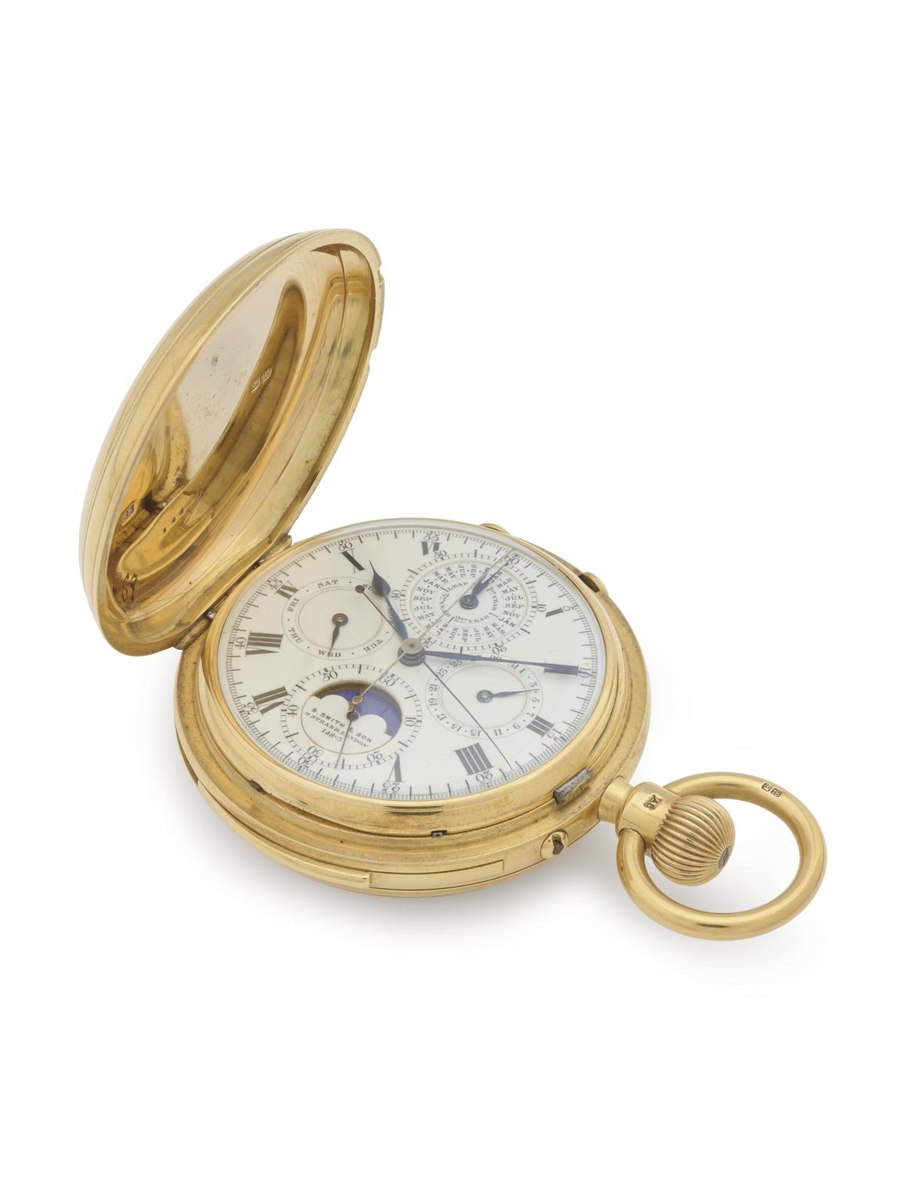
This 18 ct gold hunter-cased pocket watch was made in London in 1899 by Samuel Smith & Son. The white enamel dial incorporates blued steel hands, Roman numerals, subsidiary dials for running seconds, day of the week, day of the month, and a perpetual calendar with leap-year indication, along with a split-seconds chronograph and moon phase aperture. The source reports that the lever escapement movement features a minute repeating mechanism striking on two gongs and is signed 'S. Smith & Son, 9 Strand, London. No 148-3. Makers to the Admiralty & the Indian Government.'

Front view of the Samuel Smith & Son 18 ct gold complicated pocket watch with hunter case opened
Front view of the Samuel Smith & Son 18 ct gold complicated pocket watch with hunter case opened — Science Museum Group/The Clockmakers' Museum. Rights pending — permission not yet requested. Original source

Catalogue identity

Source
collection.sciencemuseumgroup.org.uk
Category
Pocket watch · Complicated hunter pocket watch
Maker / attribution
Samuel Smith and Sons Limited
Reference
Not recorded
Catalogue / lot identifier
L2015-3563
Source-reported date
1899
Country
United Kingdom
Source-reported serial
148-3

Source-reported attribution and specifications are not independent authentication. A listing does not establish present ownership, current display, availability or permission to reproduce.

Object description

Case Construction and Exterior Markings

The pocket watch is set within an 18 ct gold hunter case with overall dimensions recorded as 86 mm by 58 mm by 21.5 mm. Visual observations show the hinged yellow gold front cover opened, revealing hallmarks on the inner lid, alongside a fluted winding crown and an articulated suspension bow hallmarked near its neck.

According to the museum catalogue, the case is hallmarked for 1899, carries the maker's mark 'S.S' for Samuel Smith and Son, and is punch-marked with the number 148-3.

Evidence for this section
  • “18 ct gold hunter case hallmarked for 1899, with makers mark 'S.S' for Samuel Smith and Son and punch marked with the number 148-3.”
  • “overall: 86 mm x 58 mm x 21.5 mm, type: watch and lever movement”
  • “Hinged 18 ct yellow gold hunter front cover open to reveal internal hallmarks.”

Dial Configuration and Complications

The white enamel dial features blued steel hands, including split-seconds chronograph sweep hands, paired with four subsidiary registers. Roman numerals indicate the hours on the primary chapter ring, and the dial is signed 'S Smith & Son, 9 Strand London, 148-3'.

The subsidiary registers include displays for running seconds, day of the week, day of the month, and a perpetual calendar designed to adjust for variable month lengths including leap years. An aperture positioned within the seconds subsidiary dial indicates the phase of the moon.

Evidence for this section
  • “Enamel dial with seperate dials for seconds, day of the week, day of the month and perpetual calendar. This automatically corrects the date for the changing numbers of days in each month, including for leap years.”
  • “Within the seconds dial is an aperture for the phase of the moon. The dial also features a split second chronograph. Blued steel hands.”
  • “Dial signed 'S Smith & Son, 9 Strand London, 148-3'.”

Reported Movement and Striking Mechanism

Movement details are not visible in the provided exterior photograph and rely on museum cataloguing. The internal mechanism features a lever escapement, split-seconds chronograph work, and a minute repeating mechanism striking on two distinct pitched gongs.

The collection record notes that the repeating mechanism is actuated via a slide button on the side of the case to sound the nearest minute. The movement is signed 'S. Smith & Son, 9 Strand, London. No 148-3. Makers to the Admiralty & the Indian Government.'

Evidence for this section
  • “Movement with lever escapement, split seconds chronograph mechanism and minute repeating.”
  • “The minute repeating mechanism enables the user to hear the time to the nearest minute by sliding a button on the side of the case, which causes hammers within the watch to strike on two different pitched gongs.”
  • “Signed on the movement 'S. Smith & Son, 9 Strand, London. No 148-3. Makers to the Admiralty & the Indian Government.'”

Open research questions

  • What specific London assay hallmarks and date letter stamps are struck inside the front and rear covers?
  • Where is diamond utilized in the movement or case assembly as catalogued in the museum materials summary?
  • Does the movement utilize an English or Swiss ebauche for the perpetual calendar and split-seconds chronograph repeating train?

Source evidence

Recorded claims and source quotations for Watch with complications and minute repeating by Samuel Smith & Son
FieldSource-reported valueSource quotation
MakerSamuel Smith and Sons Limited“maker: Samuel Smith and Sons Limited”
Date of manufacture1899“Made: 1899 in London”
Case material and hallmarks18 ct gold hunter case hallmarked for 1899“18 ct gold hunter case hallmarked for 1899, with makers mark 'S.S' for Samuel Smith and Son and punch marked with the number 148-3.”
Dial signatureS Smith & Son, 9 Strand London, 148-3“Dial signed 'S Smith & Son, 9 Strand London, 148-3'.”
Movement signatureS. Smith & Son, 9 Strand, London. No 148-3. Makers to the Admiralty & the Indian Government.“Signed on the movement 'S. Smith & Son, 9 Strand, London. No 148-3. Makers to the Admiralty & the Indian Government.'”
Object NumberL2015-3563“Object Number: L2015-3563”
Overall dimensions86 mm x 58 mm x 21.5 mm“overall: 86 mm x 58 mm x 21.5 mm, type: watch and lever movement”
Component materialsGold, steel, brass, glass, enamel, and diamond“Materials: gold (metal) , steel (metal) , brass (copper, zinc alloy) , glass , enamel and diamond”
Bequest donorColonel Humphrey Quill“The watch was bequeathed to the Clockmakers' Museum by Colonel Humphrey Quill, author of 'John Harrison the Man who found Longitude' and Commanding Officer of the 30 Assault Unit (30AU) at the end of World War II.”
Clockmakers' Museum inventory numberNo. 690“Clockmakers' Museum No. 690”

Visible details

  • Hinged 18 ct yellow gold hunter front cover open to reveal internal hallmarks.
  • White enamel dial featuring four subsidiary registers and an integrated moon phase aperture at the 6 o'clock position.
  • Blued steel central hands including split-seconds chronograph sweep hands.
  • Fluted winding crown with an articulated suspension bow hallmarked near the neck.

Research qualifications

  • Internal movement condition, escapement details, and movement signatures are not visible in the supplied photograph and rely entirely on museum cataloguing.
  • Punch marks and internal case signatures are partially obscured by reflection.

Photograph identity and source facts were screened before import; rights clearance remains pending.

Terms in this record

Glossary explanations for terms named in this object’s record.