
Skip to content
The Encyclopedia of Horology

Clock · Vienna regulator wall clock

Vienna regulator wall clock by Detter, Wien

Partially verified

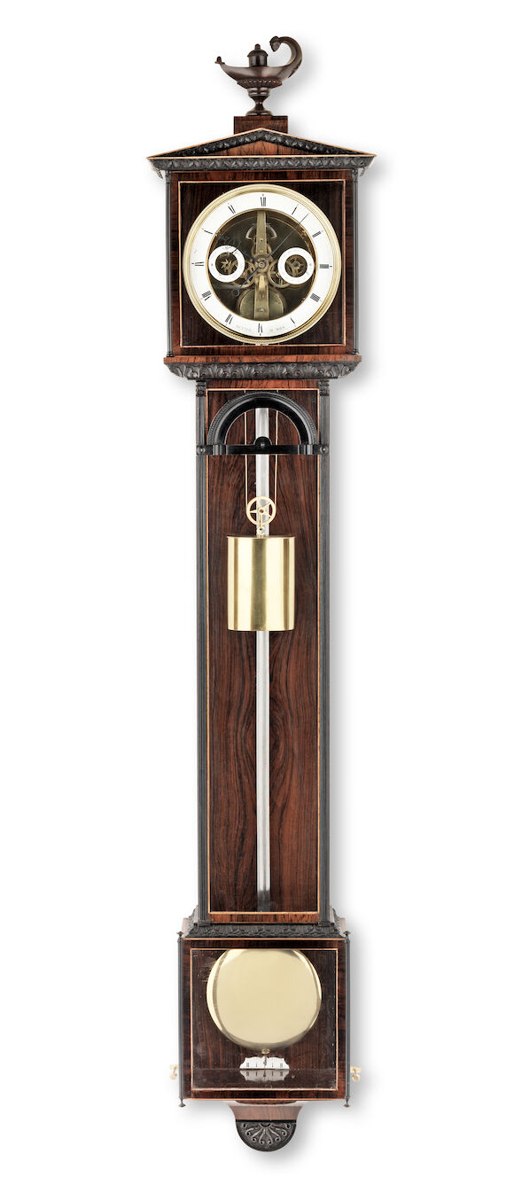
This month-going Vienna regulator clock is housed in a rosewood case measuring 1.35 meters in height. The architectural pediment features a carved cornice supported by carved columns, surmounting a glazed trunk with a lift-out door framed by reeded columns and a glazed base with a concave foot and levelling screws. Signed Detter In Wien on its 6.5-inch dial, the movement incorporates an open center revealing two subsidiary dials for day of the week and date of the month. The 30-day, weight-driven mechanism employs a skeletonised front plate, five-wheel train, maintaining power, deadbeat escapement with shaped steel pallets, and a steel bar pendulum with a brass bob swinging before an enamel beat scale.

Full front view of the rosewood-cased Vienna regulator wall clock with pediment, dial, weight, and pendulum
Full front view of the rosewood-cased Vienna regulator wall clock with pediment, dial, weight, and pendulum — Bonhams. Rights pending — permission not yet requested. Original source

Catalogue identity

Source
www.bonhams.com
Category
Clock · Vienna regulator wall clock
Maker / attribution
Detter
Reference
Not recorded
Catalogue / lot identifier
77
Source-reported date
Not established
Country
Austria

Source-reported attribution and specifications are not independent authentication. A listing does not establish present ownership, current display, availability or permission to reproduce.

Object description

Case Architecture and Exterior Features

The clock is housed in a rosewood case measuring 1.35 meters (4 feet 5 inches) in total height. The upper portion features an architectural pediment with a carved cornice supported on carved columns set above a carved throat moulding. Direct observation confirms that the pediment peak is surmounted by a carved oil lamp finial.

Below the pediment, the long glazed trunk incorporates a lift-out door framed by reeded columns. The trunk rests upon an enclosed glazed base terminating in a concave foot fitted with levelling screws for plumb adjustment on a wall.

Evidence for this section
  • “rosewood cased”
  • “1.35m (4ft 5ins) high”
  • “The architectural pediment with carved cornice supported on carved columns over a carved throat moulding and a long glazed trunk with lift-out door framed by reeded columns on a glazed base with concave foot mounted with levelling screws”
  • “Carved oil lamp finial surmounts the pediment peak.”

Dial and Subsidiary Calendar Indications

The clock features a 6.5-inch dial inscribed 'Detter In Wien', framed by an enamel chapter ring with Roman numerals. Direct visual observation notes an open dial center that exposes the movement arbor alongside two subsidiary circular indicator rings.

As described in the auction text, these twin subsidiaries mounted in the cutaway dial center indicate the days of the week and the date of the month, providing full day and date calendar readouts.

Evidence for this section
  • “signed Detter In Wien on the 6.5 inch dial with enamel Roman chapter ring enclosing twin subsidiaries mounted in the open centre displaying days of the week and date of the month”
  • “Open dial center exposing movement arbor and dual subsidiary circular rings.”

Movement Train and Regulating Mechanism

The movement is recorded as a weight-driven, 30-day (month-going) mechanism constructed with a skeletonised front plate. It features a five-wheel train equipped with maintaining power and terminates in a deadbeat escapement with shaped steel pallets.

Regulation is provided by a steel bar pendulum carrying a brass bob, suspended from a turned steel pivot mounted directly on the backplate. Observed components include a prominent cylindrical brass-toned driving weight suspended from a spoked pulley in the trunk, and a circular brass pendulum bob oscillating behind the glazed lower base over an enamel beat scale.

Evidence for this section
  • “the weight driven 30-day movement with skeletonised front plate, five wheel train with maintaining power and terminating in a deadbeat escapement with shaped steel pallets to a steel bar pendulum with brass bob reading against an enamel beat scale and suspended from a turned steel pivot mounted on the backplate”
  • “Prominent cylindrical brass-toned driving weight suspended from a spoked pulley in the trunk.”
  • “Circular brass pendulum bob positioned behind the glazed lower base over an enamel beat scale.”

Open research questions

  • Which Viennese clockmaker named Detter produced this regulator, and what are his recorded working dates in Viennese guild literature?
  • Does direct physical inspection of the movement backplate reveal serial numbers, workshop marks, or historical service records?
  • Are the movement, calendar work, and rosewood case completely original to one another, or do seatboard or bracket modifications indicate a re-housing?

Source evidence

Recorded claims and source quotations for Vienna regulator wall clock by Detter, Wien
FieldSource-reported valueSource quotation
Maker and originDetter in Wien“signed Detter in Wien”
Duration30 days (month-going)“month-going Vienna regulator of 30 day duration”
Dial diameter6.5 inches“fitted with a 6 ½ in dial”
Case materialRosewood“rosewood cased”
Total height1.35 m (4 ft 5 ins)“1.35m (4ft 5ins) high”
EscapementDeadbeat escapement with shaped steel pallets“deadbeat escapement with shaped steel pallets”
Pendulum suspension mountingTurned steel pivot mounted on the backplate“suspended from a turned steel pivot mounted on the backplate”
Front plate designSkeletonised“skeletonised front plate”
Train layoutFive-wheel train with maintaining power“five wheel train with maintaining power”

Visible details

  • Carved oil lamp finial surmounts the pediment peak.
  • Prominent cylindrical brass-toned driving weight suspended from a spoked pulley in the trunk.
  • Circular brass pendulum bob positioned behind the glazed lower base over an enamel beat scale.
  • Open dial center exposing movement arbor and dual subsidiary circular rings.

Research qualifications

  • No specific year or period of manufacture is stated in the catalogue text.
  • Interior movement plates are largely obscured by the dial and case structure.

Photograph identity and source facts were screened before import; rights clearance remains pending.

Terms in this record

Glossary explanations for terms named in this object’s record.