
Skip to content
The Encyclopedia of Horology

Clock · Vienna regulator wall clock

Josef Lorenz Vienna regulator wall clock

Partially verified

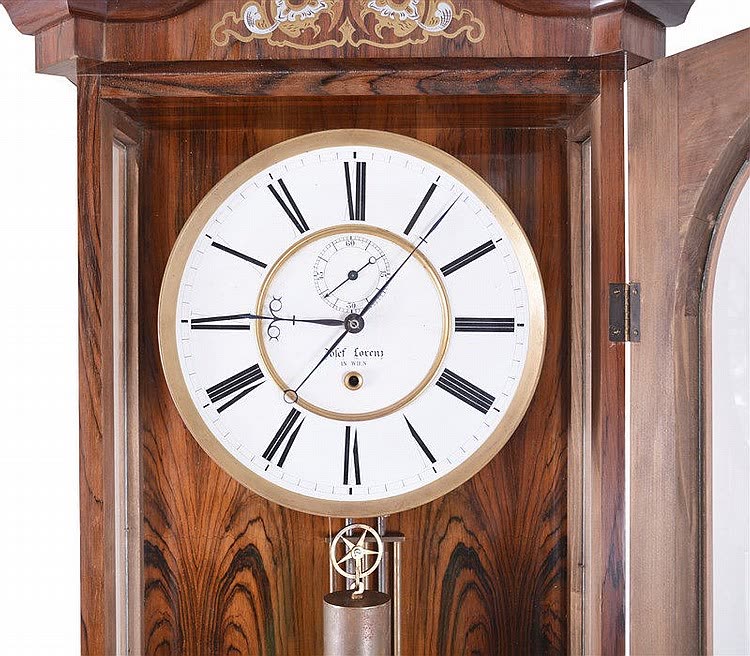
This Vienna regulator wall clock features a brass, weight-driven movement and dial signed Josef Lorenz, In Wien, housed within a later custom-made case. According to the auction catalogue, the movement dates to circa 1870, while the rosewood-veneered case with pewter and brass inlays is of late 20th-century manufacture. The movement is configured as a 30-day, time-only mechanism accompanied by a gridiron pendulum and cylindrical weight. Its white enamel dial displays Roman numeral hour markers, an auxiliary seconds register, and a winding arbor aperture. Case dimensions measure 77 inches in height, 22 inches in width, and 10 inches in depth.

Upper portion of the Vienna regulator showing the white enamel dial signed Josef Lorenz and the open rosewood veneered case
Upper portion of the Vienna regulator showing the white enamel dial signed Josef Lorenz and the open rosewood veneered case — Schmitt Horan & Co.. Rights pending — permission not yet requested. Original source

Catalogue identity

Source
www.invaluable.com
Category
Clock · Vienna regulator wall clock
Maker / attribution
Josef Lorenz
Reference
Not recorded
Catalogue / lot identifier
194
Source-reported date
circa 1870 (movement); late 20th century (case)
Country
Austria

Source-reported attribution and specifications are not independent authentication. A listing does not establish present ownership, current display, availability or permission to reproduce.

Object description

Dial and Visual Presentation

The clock features a white enamel dial marked with Roman numeral hours and an upper subsidiary seconds dial. It bears the inscription 'Josef Lorenz IN WIEN' positioned below the center arbor. A single winding aperture is visible on the dial plane.

Suspended below the dial within the open case door is an elongated cylindrical brass-toned weight. The surrounding wooden cabinet features grained rosewood veneer with decorative inlay detailing situated on the crest directly above the dial.

Evidence for this section
  • “White enamel dial with Roman numeral hours and an upper subsidiary seconds dial”
  • “Dial signed 'Josef Lorenz IN WIEN' below the center arbor”
  • “Suspended cylindrical brass-toned weight visible below the dial through the open hinged case door”
  • “Grained rosewood veneer with decorative inlay on the crest above the dial”

Movement Specifications and Catalogued Attributes

According to the auction catalogue description, the mechanism is a brass, weight-driven movement designed for 30-day, time-only operation. Regulation is provided by a gridiron pendulum assembly.

The movement is catalogued as dating to circa 1870. The auction house's condition report notes that the movement requires cleaning, and the overall casing dimensions measure 77 inches in height, 22 inches in width, and 10 inches in depth.

Evidence for this section
  • “30 day, time only, brass, weight driven movement with gridiron pendulum”
  • “Dimensions 77in x 22in x 10in”
  • “the movement dates to circa 1870 and needs cleaning.”

Case Construction and Discrepancies

The clock's housing is not contemporary with the 19th-century movement. The catalogue describes it as a 'later custom made case' composed of rosewood veneer with pewter and brass inlays.

The auction house dates the case to 'late 20th century manufacture' and describes it as being of 'very good quality', while recording condition issues including 'some minor veneer and inlay lifting'.

Evidence for this section
  • “later custom made case”
  • “rosewood veneered, pewter and brass inlaid case”
  • “The case is of very good quality, of late 20th century manufacture, with some minor veneer and inlay lifting.”

Open research questions

  • What specific mounting bracket or seatboard adaptations were used to fit the circa 1870 Josef Lorenz movement into the late 20th-century custom case?
  • Do the movement plates or internal components bear workshop serial numbers or additional Austrian maker marks?
  • Are the gridiron pendulum and cylindrical weight 19th-century pieces associated with the movement or later components paired with the modern case?

Source evidence

Recorded claims and source quotations for Josef Lorenz Vienna regulator wall clock
FieldSource-reported valueSource quotation
Movement Duration and Mechanism30 day, time only, brass, weight driven movement with gridiron pendulum“30 day, time only, brass, weight driven movement with gridiron pendulum”
Case MaterialsRosewood veneered, pewter and brass inlaid case“rosewood veneered, pewter and brass inlaid case”
DialSigned, Roman numeral, white enamel dial“signed, Roman numeral, white enamel dial”
Dimensions77in x 22in x 10in“77in x 22in x 10in”
Movement DateCirca 1870“the movement dates to circa 1870”
Case DateLate 20th century“of late 20th century manufacture”
Reported Movement ConditionNeeds cleaning“the movement dates to circa 1870 and needs cleaning.”
Reported Case ConditionMinor veneer and inlay lifting“with some minor veneer and inlay lifting.”

Visible details

  • White enamel dial with Roman numeral hours and an upper subsidiary seconds dial
  • Dial signed 'Josef Lorenz IN WIEN' below the center arbor
  • Suspended cylindrical brass-toned weight visible below the dial through the open hinged case door
  • Grained rosewood veneer with decorative inlay on the crest above the dial

Research qualifications

  • The case is not original to the circa 1870 movement and dial, dating to the late 20th century
  • Source condition report notes that the movement needs cleaning and the case has minor veneer and inlay lifting

Photograph identity and source facts were screened before import; rights clearance remains pending.

Terms in this record

Glossary explanations for terms named in this object’s record.