
Skip to content
The Encyclopedia of Horology

Clock · Wall clock

Victorian Railways No.1 Wall Clock

Partially verified

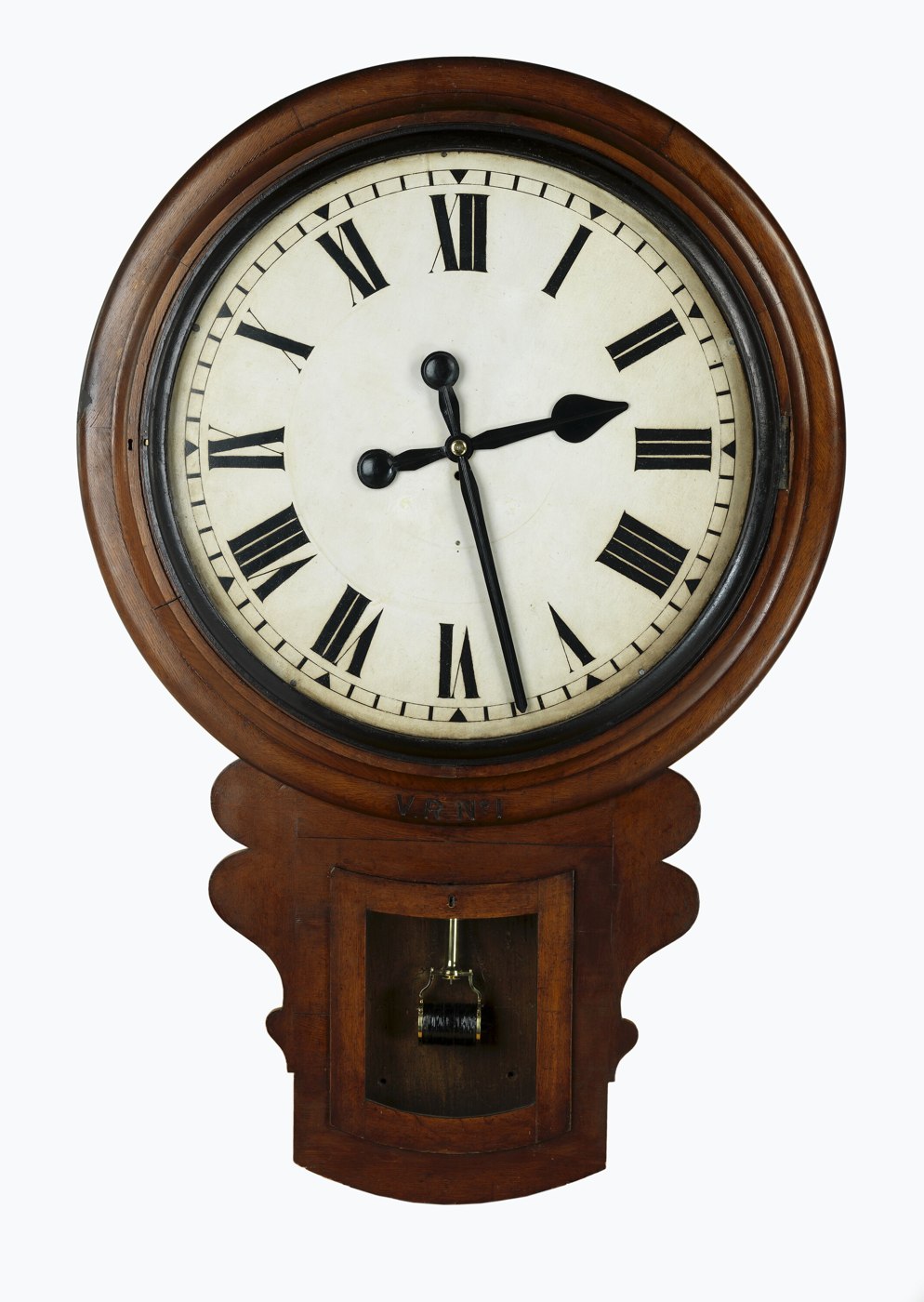
This wall clock, known as the Victorian Railways No.1 or 'Main Line Starter Clock', is constructed with a cedar drop dial case featuring a glazed, 914 mm diameter face and a cast-iron bezel. It was manufactured by T. Gaunt & Co. in Melbourne, Victoria, and was installed at the former Spencer Railway Station in 1858, where it served until 1937. The timepiece is weight-driven and features a dead-beat escapement. In 1871, it was integrated with the Melbourne Observatory's precision regulator clock via a telegraph line to ensure synchronized time for railway operations. To facilitate this control, the pendulum bob was fitted with an electromagnet. Following its removal from the station in 1960 and transfer to the museum in 1964, a discrete electrical movement was added in 2016 to allow operation without manual winding. The case front is inscribed 'V.R. No.1'.

Front view of the Victorian Railways No.1 wall clock, showing the dial, pendulum opening, and V.R. No.1 inscription.
Front view of the Victorian Railways No.1 wall clock, showing the dial, pendulum opening, and V.R. No.1 inscription. — Museums Victoria. Rights pending — permission not yet requested. Original source

Catalogue identity

Source
collections.museumsvictoria.com.au
Category
Clock · Wall clock
Maker / attribution
T. Gaunt and Co.
Reference
Not recorded
Catalogue / lot identifier
ST 38326
Source-reported date
circa 1858
Source-reported place
Australia

Source-reported attribution and specifications are not independent authentication. A listing does not establish present ownership, current display, availability or permission to reproduce.

Object description

Case and Dial

The clock is housed in a substantial cedar drop-dial case, measuring approximately 1219 mm in external diameter. The face is glazed, with a diameter of 914 mm, and is protected by a cast-iron bezel that is hinged at the top. The case features a signature inscription on the front located below the dial, identified as 'V.R. No.1'.

The overall physical configuration is noted for its size, with the object dimensions recorded at 1190 mm in width, 250 mm in depth, and 1820 mm in height. The estimated total weight of the clock is 150 kg.

Evidence for this section
  • “Large wall clock, cedar drop dial case, with glazed 3-ft (914 mm) diameter face, cast-iron bezel hinged at top”
  • “On front of case below face: "V.R. No.1”

Movement and Modifications

Originally a weight-driven instrument equipped with a dead-beat escapement, the movement was adapted for external synchronization. A critical modification involved installing an electromagnet within the pendulum bob to permit electrical control from the Melbourne Observatory. Electrical terminals are located on the top of the clock case for this purpose.

In 2016, the clock underwent a modern modification involving the addition of a discrete electrical movement. This alteration was performed to allow the timepiece to remain in operation without the necessity of manual winding.

Evidence for this section
  • “Weight driven; dead-beat escapement. Pendulum bob contains an electromagnet to enable electrical control from a distance.”
  • “The clock was modified with the addition of a discrete electrical movement in 2016, to enable the clock to operate without winding.”

History and Provenance

Records indicate the clock was associated with the Victorian Railway Department and was installed at the former Spencer Railway Station in 1858. It remained in service at the stationmaster's office for 79 years until 1937. The clock was utilized as the main line starter, regulating the departure times of country trains.

In 1871, the clock was connected by telegraph to the Melbourne Observatory's precision regulator to maintain time accuracy. Following the rebuilding of Spencer Street Station in 1960, the clock was moved to the railways clock shop before being donated to the museum in 1964.

Evidence for this section
  • “installed at the former Spencer Railway Station (now Southern Cross Station) in 1858”
  • “Government Astronomer Robert Ellery connected this clock and several other public clocks by telegraph line to the Melbourne Observatory's main precision regulator clock in 1871.”
  • “clock was removed and stored in the railways clock shop until transferred to the museum in 1964”

Open research questions

  • What specific type of mechanical movement was original to the clock before the 2016 modification?
  • Are there records of the original internal telegraph receiving components that predate the 2016 electrical movement?

Source evidence

Recorded claims and source quotations for Victorian Railways No.1 Wall Clock
FieldSource-reported valueSource quotation
MakerT. Gaunt and Co.“Made by Thomas Gaunt & Co, Bourke Street, Melbourne.”
Registration NumberST 38326“Registration number: ST 38326”
Inscribed TextV.R. No.1“On front of case below face: "V.R. No.1”
Dial Diameter914 mm“With approximately 3-ft (914 mm) diameter glazed face.”
EscapementDead-beat“Weight driven; dead-beat escapement.”
AcquisitionDonation from Victorian Railways in 1964“Donation from Victorian Railways (VR), Mar 1964”

Visible details

  • Cedar timber drop-dial case construction
  • Cast-iron bezel hinged at the top
  • Electromagnetic component visible on the pendulum bob
  • Inscription 'V.R. No.1' on the front case

Research qualifications

  • Installation date is debated, with source citing 1858 or 1859, while suggesting it might date to 1871
  • Weight is stated as approximate
  • 2016 internal movement modification status

Photograph identity and source facts were screened before import; rights clearance remains pending.

Consulted source

Wall Clock - Victorian Railways No.1, T. Gaunt & Co, Melbourne, Victoria, circa 1858

Reviewed 2026-10-26 · Record 356fc578ff

Terms in this record

Glossary explanations for terms named in this object’s record.