
Skip to content
The Encyclopedia of Horology

Clock · Wall clock

Continental weight-driven iron wall clock with cow-tail pendulum

Partially verified

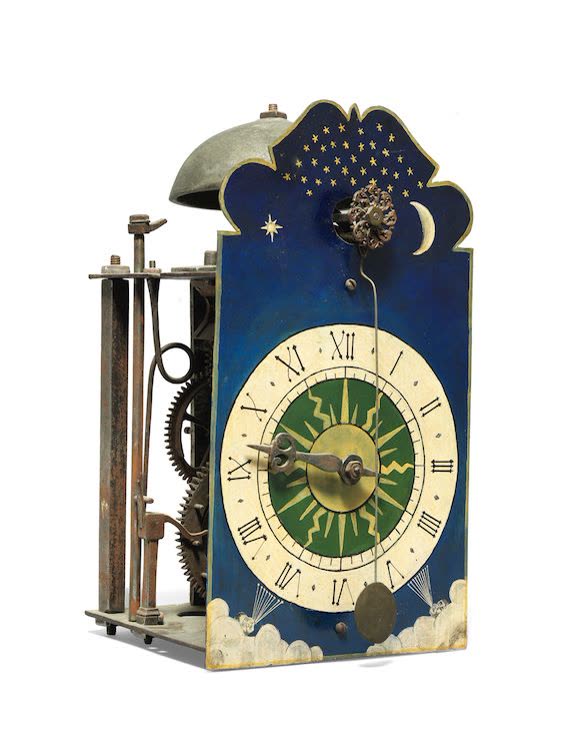
Catalogued as possibly German or Flemish, this weight-driven continental wall clock features an open posted iron movement with a verge escapement and a top-mounted bell. It utilizes a front-mounted 'cow tail' pendulum suspended from an arbor above the dial. The shaped, painted dial is described as replaced and has a single iron hour hand, Roman numeral chapter ring, sunburst center, and painted celestial elements. According to the source, the countwheel and striking hammer are lacking, but the bell is retained, and it is accompanied by a later wall bracket. Its height is 40 centimeters (16 inches).

Three-quarter view of the continental iron posted clock with front cow-tail pendulum and painted dial
Three-quarter view of the continental iron posted clock with front cow-tail pendulum and painted dial — Bonhams. Rights pending — permission not yet requested. Original source

Catalogue identity

Source
www.bonhams.com
Category
Clock · Wall clock
Maker / attribution
Not established
Reference
Not recorded
Catalogue / lot identifier
52
Source-reported date
Not established
Country
Germany or Belgium

Source-reported attribution and specifications are not independent authentication. A listing does not establish present ownership, current display, availability or permission to reproduce.

Object description

Dial and Escapement Configuration

The clock is fitted with a shaped painted dial plate decorated with celestial motifs, including a dark blue sky, golden stars, a crescent moon, clouds, and parachute-like descending figures. The chapter ring features Roman numerals I through XII with dot markers encircling a green and yellow sunburst center, indicated by a single pierced iron hour hand.

A front-mounted 'cow tail' pendulum descends down the face of the dial from a rosette collar. The auction cataloguing notes 'The replaced dial with single iron hand and shaped upper section supporting the pendulum arbor' and records that the clock features 'the posted movement with verge escapement'.

Evidence for this section
  • “Shaped painted dial plate with a dark blue sky, golden stars, a crescent moon, clouds, and parachute-like descending figures.”
  • “Circular chapter ring with Roman numerals I through XII and dot markers, centered around a green and yellow sunburst.”
  • “Single pierced iron hour hand mounted at the dial center.”
  • “Front-suspended pendulum ('cow tail') hangs down the face of the dial from a decorative rosette collar.”
  • “The replaced dial with single iron hand and shaped upper section supporting the pendulum arbor”
  • “the posted movement with verge escapement”

Movement Construction and Striking Train Deficiencies

The movement is constructed within an open posted iron frame exposing the internal wheelwork, detents, and uprights, surmounted by a dome bell.

According to the source, the striking train is missing components, noting 'the countwheel and hammer now lacking, but retaining the original bell'. The lot is accompanied by 'a later wall bracket' and measures '40cms (16ins) high'.

Evidence for this section
  • “Open posted iron frame revealing wheelwork, detents, uprights, and a dome bell atop the movement.”
  • “the countwheel and hammer now lacking, but retaining the original bell”
  • “together with a later wall bracket, 40cms (16ins) high.”

Attribution and Provenance Limitations

The geographical origin is catalogued tentatively by Bonhams as 'Possibly German or Flemish'. No maker signatures, marks, or dates of manufacture are recorded in the lot description.

The clock carries earlier auction history, documented in the footnotes as 'Sotheby's New Bond Street, 5th June 1997 lot 278.' The cataloguer describes the painted dial as replaced ('The replaced dial'), indicating that the present dial plate is not original to the movement.

Evidence for this section
  • “Possibly German or Flemish”
  • “The replaced dial with single iron hand and shaped upper section supporting the pendulum arbor”
  • “Sotheby's New Bond Street, 5th June 1997 lot 278.”

Open research questions

  • Does examination of the posted iron frame reveal surviving cut-outs, empty pivots, or brackets indicating whether the clock was originally governed by a foliot or balance before adaptation to the front cow-tail verge pendulum?
  • What period and regional origin can be established for the painted replaced dial through pigment and support analysis?
  • Were driving weights or lines recorded in the 1997 Sotheby's cataloguing for lot 278?

Source evidence

Recorded claims and source quotations for Continental weight-driven iron wall clock with cow-tail pendulum
FieldSource-reported valueSource quotation
EscapementVerge escapement“the posted movement with verge escapement”
Height40 cm (16 in)“40cms (16ins) high”
AttributionPossibly German or Flemish“Possibly German or Flemish”
Dial ConditionReplaced dial with single iron hand“The replaced dial with single iron hand and shaped upper section supporting the pendulum arbor”
Striking Train IncompletenessCountwheel and hammer lacking, original bell retained“the countwheel and hammer now lacking, but retaining the original bell”
ProvenanceSotheby's New Bond Street, 5 June 1997, lot 278“Sotheby's New Bond Street, 5th June 1997 lot 278.”
Associated HardwareAccompanied by a later wall bracket“together with a later wall bracket”
Dimensions40 cm (16 in) high“40cms (16ins) high.”

Visible details

  • Shaped painted dial plate with a dark blue sky, golden stars, a crescent moon, clouds, and parachute-like descending figures.
  • Circular chapter ring with Roman numerals I through XII and dot markers, centered around a green and yellow sunburst.
  • Single pierced iron hour hand mounted at the dial center.
  • Front-suspended pendulum ('cow tail') hangs down the face of the dial from a decorative rosette collar.
  • Open posted iron frame revealing wheelwork, detents, uprights, and a dome bell atop the movement.

Research qualifications

  • Origin attribution ('Possibly German or Flemish') is tentative.
  • Source notes the dial is replaced, the countwheel and hammer are lacking, and the wall bracket is later.
  • Weights and suspension cords are not illustrated.

Photograph identity and source facts were screened before import; rights clearance remains pending.

Terms in this record

Glossary explanations for terms named in this object’s record.