
Skip to content
The Encyclopedia of Horology

Wristwatch · Self-winding wristwatch

Vacheron Constantin Reference 43060 'Birds of America' Wristwatch

Partially verified

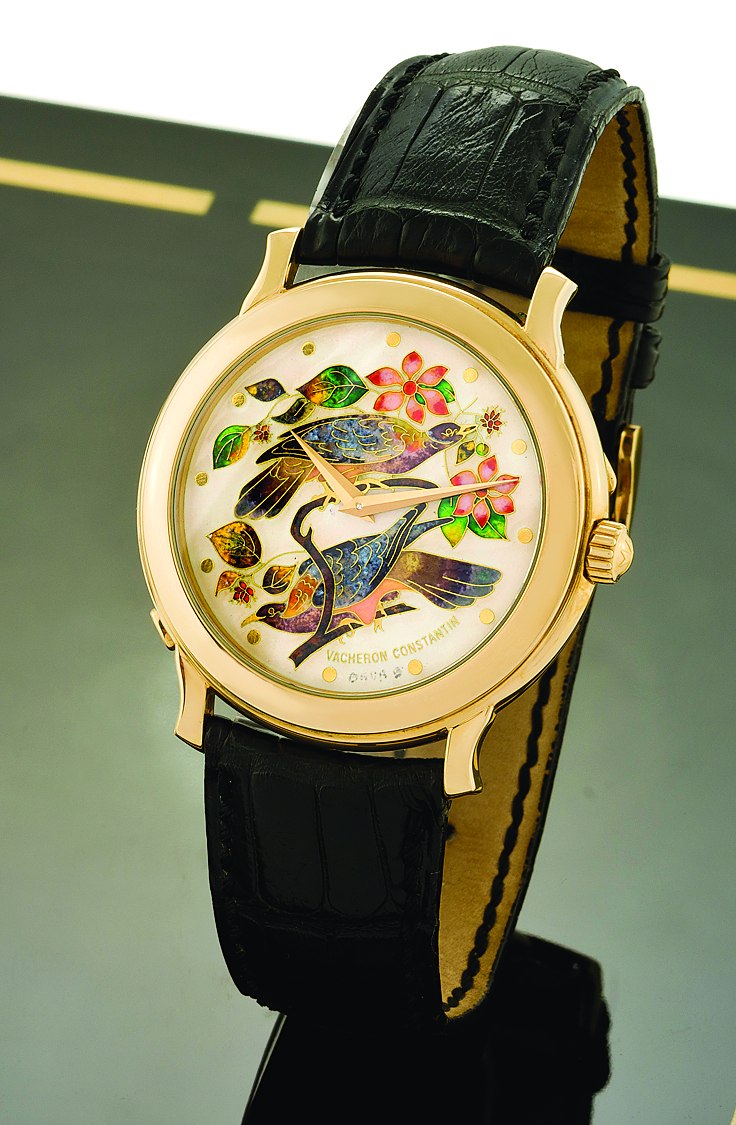
This 18K yellow gold self-winding wristwatch, reference 43060, is part of a limited edition launched by Vacheron & Constantin in 1997. Inspired by the ornithological illustrations of John J. Audubon, the watch features a polychrome cloisonné enamel dial executed by enamellist Muriel Sechaud, depicting two birds perched on a flowering bough against a cream enamel background. The timepiece is housed in a solid three-body case measuring 38.5 mm in diameter, featuring a wide bezel, concave lugs, and a hinged case back with a release button at the 8 o'clock position. The movement, caliber 1120/2, is a rhodium-plated mechanism with fausses-côtes decoration and a skeletonized rotor featuring a 21K gold segment. The watch is presented with its original wooden box, Certificate of Origin, and hang-tag, and includes an 18K yellow gold buckle.

Front view of the Vacheron Constantin reference 43060 watch featuring a cloisonné enamel dial depicting two birds on a flowering branch.
Front view of the Vacheron Constantin reference 43060 watch featuring a cloisonné enamel dial depicting two birds on a flowering branch. — Antiquorum. Rights pending — permission not yet requested. Original source

Catalogue identity

Source
catalog.antiquorum.swiss
Category
Wristwatch · Self-winding wristwatch
Maker / attribution
Vacheron & Constantin
Reference
43060
Catalogue / lot identifier
26
Source-reported date
1997
Source-reported place
Switzerland
Source-reported serial
682111

Source-reported attribution and specifications are not independent authentication. A listing does not establish present ownership, current display, availability or permission to reproduce.

Object description

Case and Dial Construction

The timepiece is constructed with an 18K yellow gold case described as a three-body, solid, polished and brushed design. The case features a wide bezel and concave lugs, with a hinged case back that includes a release button at the 8 o'clock position for opening. The movement is visible through a glazed cover secured by 6 screws.

The dial is a centerpiece of the watch, utilizing polychrome cloisonné enamel on a gold base. The design is set against a cream enamel background and features inlaid gold dot hour indexes, paired with yellow gold dauphine hands. Audubon.

Evidence for this section
  • “C. Three-body, solid, polished and brushed, hinged case back with release button at 8, rounded band and wide bezel, concave lugs, sapphire crystal, glazed cover over the movement with 6 screws.”
  • “D. Polychrome cloisonne enamel on gold, cream enamel background, decorated with two birds on a flowering bough, inlaid gold dot hour indexes.”
  • “The cloisonne enamel dials depicted different birds found in America and originally painted by the 19th Century naturalist John J. Audubon for his books on Birds of America.”
  • “the enamel by Muriel Sechaud.”

Movement and Mechanical Details

The watch is powered by the Vacheron & Constantin Caliber 1120/2, an automatic movement. The mechanics are finished with rhodium plating and feature fausses-côtes decoration across the bridges. The construction includes 36 jewels and a straight-line lever escapement.

The balance assembly features a monometallic balance with a shock-absorber and a self-compensating flat balance-spring. Winding is facilitated by a hand-engraved skeletonized rotor that incorporates a 21K gold segment for weighted performance.

Evidence for this section
  • “M. Cal. 1120/2, rhodium plated, fausses-côtes decoration, 36 jewels, straight line lever escapement, monometallic balance, shock-absorber, self-compensating flat balance-spring, hand-engraved skeletonized rotor with 21K gold segment.”

Provenance and Condition

The watch was launched in 1997 as part of a series inspired by Audubon's Birds of America. According to the auction notes, the series comprised 10 sets of 10 watches each. This specific piece is sold accompanied by its original wooden box, a Certificate of Origin, and the manufacturer's hang-tag.

Regarding condition, the auction documentation reports the dial and hands as 'as new', the movement as 'as new' (though suggesting an overhaul), and the case as 'very good'. All components—dial, case, and movement—are signed by the manufacturer.

Evidence for this section
  • “Launched in 1997, the Audubon Birds of America models were made in 10 sets of 10 watches each.”
  • “Accompanied by Vacheron Constantin wooden box, Certificate of Origin and hang-tag.”
  • “Dial, case and movement signed.”
  • “Case: 2 Very good Movement: 1* As new Overhaul recommended, at buyer's expense Dial: 1-01 As new”

Open research questions

  • What specific bird species from Audubon's Birds of America are illustrated on this specific dial?
  • Were there individual names given to the ten variants within the 100-piece production run?

Source evidence

Recorded claims and source quotations for Vacheron Constantin Reference 43060 'Birds of America' Wristwatch
FieldSource-reported valueSource quotation
MakerVacheron & Constantin, Genève“Vacheron & Constantin, Genève”
Model reference43060“Ref. 43060”
Case number682111“case No. 682111”
Movement number797963“movement No. 797963”
Enamel artistMuriel Sechaud“the enamel by Muriel Sechaud”
Caliber1120/2“Cal. 1120/2”
EditionLimited edition of 10 pieces“Made in a limited edition of 10 pieces”
Case diameter38.5 mm“DIAM. 38.5 mm.”

Visible details

  • Cloisonné enamel dial depicting birds on a branch
  • Concave lugs and wide bezel design
  • Hinged case back with release button at 8 o'clock
  • Skeletonized rotor visible through a glazed display cover

Research qualifications

  • The exact specific bird species represented on this particular dial are not identified in the source text
  • The auction description includes a note that an overhaul is recommended for the movement

Photograph identity and source facts were screened before import; rights clearance remains pending.

Terms in this record

Glossary explanations for terms named in this object’s record.