
Skip to content
The Encyclopedia of Horology

Pocket watch · Pocket watch with dead-beat centre-seconds

Unsigned Silver and Enamel Pocket Watch for the Chinese Market

Partially verified

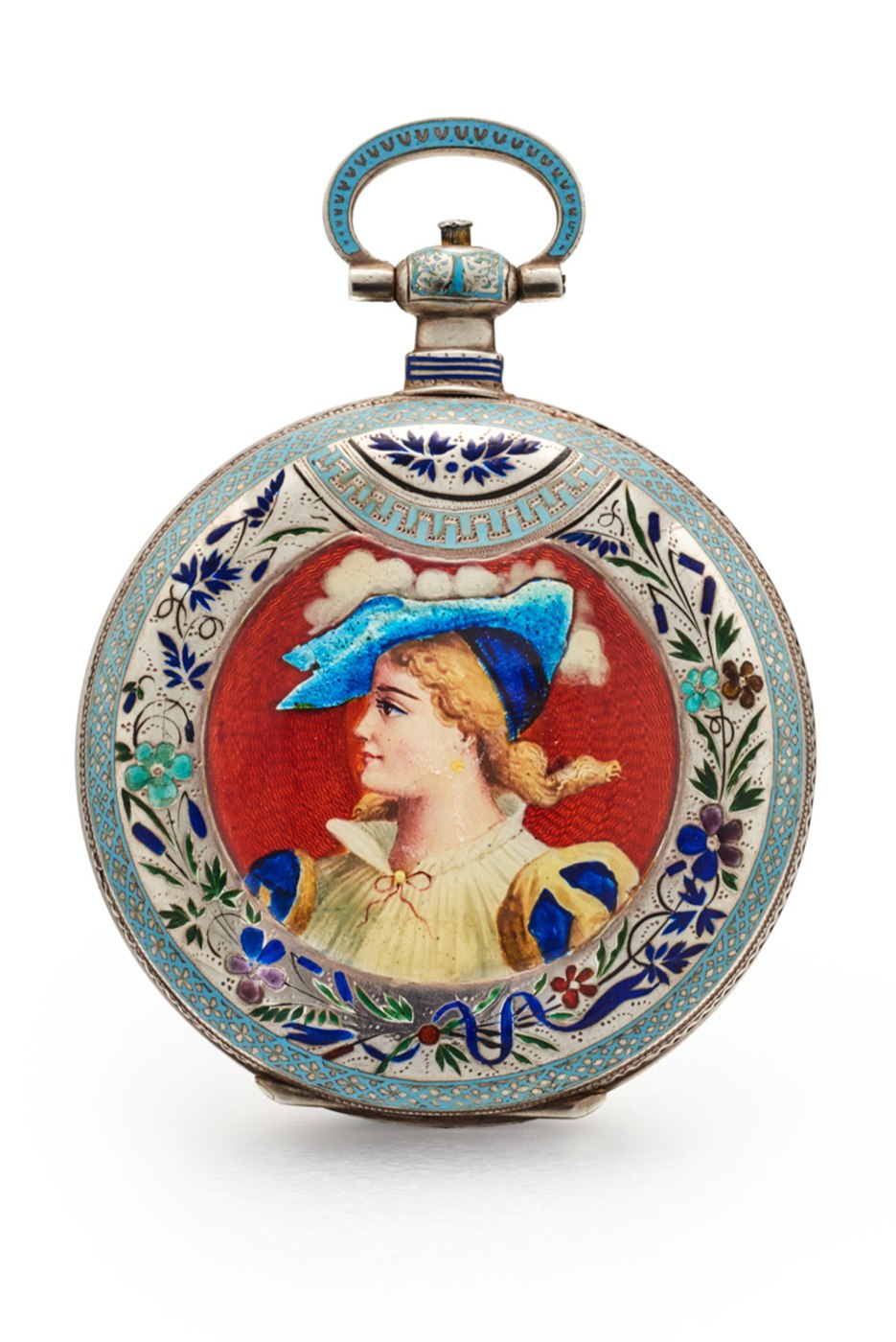
This silver, open-face, key-winding pocket watch was created for the Chinese market during the late 19th century. Measuring 60.5 mm in diameter, the watch features a duplex-Jacot escapement and a dead-beat centre-seconds complication. The exterior of the case is decorated with intricate champlevé enameling in light blue and polychrome, depicting various friezes and foliage. The center of the case back features a red flinqué enamel scene, presenting a portrait of a lady dressed in attire described as Renaissance-style. The movement, which has a caliber size of 22''', remains unsigned, though the auction house suggests an attribution to the Fleurier region of Val-de-Travers, Switzerland. The dial and case display wear consistent with their age, and the auction description notes specific condition issues including hairlines on the dial and restored enamel sections on the exterior case.

Exterior view of the silver and enamel open-face pocket watch featuring a central portrait and decorative champlevé enameling.
Exterior view of the silver and enamel open-face pocket watch featuring a central portrait and decorative champlevé enameling. — Antiquorum. Rights pending — permission not yet requested. Original source

Catalogue identity

Source
catalog.antiquorum.swiss
Category
Pocket watch · Pocket watch with dead-beat centre-seconds
Maker / attribution
Unsigned (probably Fleurier)
Reference
Not recorded
Catalogue / lot identifier
472
Source-reported date
Circa 1860-1880
Source-reported place
Switzerland
Source-reported serial
2 908

Source-reported attribution and specifications are not independent authentication. A listing does not establish present ownership, current display, availability or permission to reproduce.

Object description

Exterior Construction and Decoration

The pocket watch is housed in an open-face, round silver case characterized by complex decorative techniques. The bezel and the reverse side of the case are adorned with light blue and polychrome champlevé enameling, incorporating patterns of foliage and friezes. The primary visual element is a central, red flinqué enamel scene. This technique, defined by translucent enamel applied over guilloché engine-turning, captures a portrait of a lady wearing dress described as Renaissance-style.

The metallic components are complemented by the use of soft enamel, which has undergone restoration as noted by the auction house.

The watch includes a matching bow, which is similarly finished with enamel details consistent with the overall decorative scheme of the case.

Evidence for this section
  • “Case-back and bezel engraved and light blue and polychrome enamelled in champlevé with decoration of friezes and foliages”
  • “a red flinqué enamel (translucent enamel over guilloché engine-turning) scene showing the portrait of a lady in Renaissance-style dress.”
  • “Restored soft enamel”

Movement and Mechanical Specifications

The watch is powered by a 22''' caliber movement. It is equipped with a duplex-Jacot escapement, a mechanism identified for its specific role in this watch's timekeeping function. A notable complication included in the construction is the dead-beat centre-seconds, a feature that allows the seconds hand to advance in distinct intervals rather than a continuous sweep.

The movement remains unsigned, although it is attributed to the Fleurier region of Switzerland based on technical and stylistic assessments provided by the auction house.

Evidence for this section
  • “Calibre 22’’’, duplex-Jacot escapement”
  • “with dead-beat centre-seconds”
  • “Unsigned, probably Fleurier (Val-de-Travers)”

Condition and Market Attribution

The watch is cataloged as an unsigned object intended for the Chinese market. It carries the case number 2 908. In terms of condition, the auction description provides a grade of 'AA', indicating a very good overall state, though specific components carry individual assessments. The dial is reported to have hairlines, and the enamel decoration features areas of restoration.

While the auction documentation suggests an origin in Fleurier, Val-de-Travers, this is presented as a probability. The watch is classified as a key-winding model, consistent with mid-to-late 19th-century manufacturing practices for similar horological items destined for export.

Evidence for this section
  • “UNSIGNED POCKET WATCH WITH DEAD-BEAT CENTRE-SECONDS MADE FOR THE CHINESE MARKET”
  • “Case No. 2 908”
  • “Dial: 3-71-01 Good ENAMEL AND VARIOUS TYPES OF DECORATION Hairlines”

Open research questions

  • What is the definitive workshop or maker identity for watches with this specific caliber and enamel style from the Fleurier region?
  • Can the provenance of this watch be linked to specific Chinese merchant houses active during the 1860-1880 period?

Source evidence

Recorded claims and source quotations for Unsigned Silver and Enamel Pocket Watch for the Chinese Market
FieldSource-reported valueSource quotation
MakerUnsigned, probably Fleurier (Val-de-Travers)“Unsigned, probably Fleurier (Val-de-Travers)”
DateCirca 1860-1880“Circa 1860-1880”
Case Diameter60.5 mm“Diameter 60.5 mm.”
EscapementDuplex-Jacot“duplex-Jacot escapement”
MaterialSilver and enamel“Silver and enamel”
Serial Number2 908“Case No. 2 908”

Visible details

  • Case features a central portrait of a lady in red flinqué enamel.
  • Case back and bezel include polychrome champlevé enamel floral and geometric friezes.
  • The bow and winding area are finished with light blue enamel accents.
  • The portrait depicts a figure in Renaissance-style dress.

Research qualifications

  • The auction description indicates the watch is unsigned, attributing it to Fleurier as a probability rather than a certainty.
  • The presence of hairlines on the dial and restored enamel on the case are documented.

Photograph identity and source facts were screened before import; rights clearance remains pending.

Terms in this record

Glossary explanations for terms named in this object’s record.