
Skip to content
The Encyclopedia of Horology

Pocket watch · Split-seconds chronograph pocket watch

Ulysse Nardin Split-Seconds Doctor's Pocket Watch

Partially verified

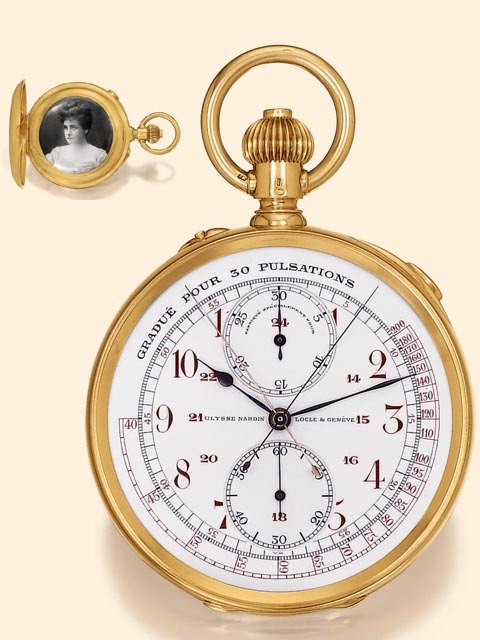
This 18K gold keyless split-seconds pocket watch, manufactured by Ulysse Nardin circa 1905, is designed as a medical or doctor's timepiece. The case is a four-body "bassine" type, characterized by polished gold surfaces adorned with translucent "basse-taille" enamel in red, green, and blue. A significant decorative element is the gold hinged cuvette, which contains a finely painted grisaille enamel portrait of a lady. The watch measures 56 mm in diameter and utilizes a 42 mm (18 1/2''') rhodium-plated movement. The movement is constructed with 25 jewels, a straight-line lever escapement, and a cut bimetallic compensation balance equipped with a blued steel Breguet balance spring and a "swan-neck" micrometric regulator for precision timing adjustments.

Ulysse Nardin split-seconds chronograph with pulsometer scale and grisaille enamel cuvette, circa 1905.
Ulysse Nardin split-seconds chronograph with pulsometer scale and grisaille enamel cuvette, circa 1905. — Antiquorum. Rights pending — permission not yet requested. Original source

Catalogue identity

Source
catalog.antiquorum.swiss
Category
Pocket watch · Split-seconds chronograph pocket watch
Maker / attribution
Ulysse Nardin
Reference
Not recorded
Catalogue / lot identifier
328
Source-reported date
circa 1905
Source-reported place
Switzerland
Source-reported serial
12165

Source-reported attribution and specifications are not independent authentication. A listing does not establish present ownership, current display, availability or permission to reproduce.

Object description

Case and Dial Design

The watch is housed in a four-body "bassine" case crafted from 18K gold. Inside, the watch features a hinged gold cuvette that serves as a protective cover for the movement. This cuvette is decorated with a grisaille enamel portrait, which is rendered with significant technical detail, depicting a lady.

The dial is finished in white enamel, providing a high-contrast backdrop for the red Arabic numerals that denote the hours. The perimeter of the dial features both a minute and seconds track, as well as an outermost pulsometer scale. This specific scale is calibrated to measure pulse rates based on 30 heartbeats, indicating the watch's specialized function for medical applications, commonly referred to as a doctor's watch.

Evidence for this section
  • “Four-body, "bassine", massive, polished, red, green and blue translucent "basse-taille" enamel initials”
  • “gold hinged cuvette with very finely painted on enamel grisaille portrait of a lady.”
  • “White enamel, red Arabic numerals, outer minute and seconds track, outermost red pulsometer scale calibrated for 30 heart beats.”

Movement and Complications

The movement is a 42 mm (18 1/2''') caliber, rhodium-plated to provide corrosion resistance and a clean aesthetic. The mechanism is a split-seconds chronograph, which allows for the timing of two simultaneous events or the recording of intermediate pulses, essential for medical diagnostics. The watch includes a 30-minute totalizer register to track elapsed time. The construction utilizes 25 jewels, which serve to reduce friction at critical points within the gear train and complications.

Technical regulation is managed by a cut bimetallic compensation balance, intended to counteract the effects of temperature fluctuations on the oscillation period of the balance wheel. To ensure isochronism, the watch is equipped with a blued steel Breguet balance spring. Fine adjustments are facilitated by a "swan-neck" micrometric regulator, which allows for precise regulation of the timekeeping rate, reflecting the precision-focused engineering associated with the Ulysse Nardin manufacture during this era.

Evidence for this section
  • “rhodium-plated, 25 jewels, straight line lever escapement, cut bimetallic compensation balance”
  • “blued steel Breguet balance spring, "swan-neck" micrometric regulator.”

Signatures and Condition

The watch is signed on both the dial and the case, confirming its origin from the Ulysse Nardin manufacture in Locle. The dial is given a grading of '2,' indicating a high level of preservation.

According to the accompanying notes provided in the source, Ulysse Nardin watches featuring painted enamel cases are considered rare. The combination of the specialized pulsometer complication and the decorative grisaille enamel work positions this piece as a distinctive example of early 20th-century horological production.

Evidence for this section
  • “Signed on dial and case.”
  • “Ulysse Nardin watches with painted on enamel cases are very rare. In addition, the present watch is in almost new condition.”
  • “Grading System Case: 3 Good Movement: 3* Good Overhaul recommended, at buyer's expense Dial: 2”

Open research questions

  • What is the specific technique used to create the 'basse-taille' enamel initials?
  • Are there archival records identifying the lady depicted on the cuvette?

Source evidence

Recorded claims and source quotations for Ulysse Nardin Split-Seconds Doctor's Pocket Watch
FieldSource-reported valueSource quotation
MakerUlysse Nardin“Ulysse Nardin, Locle, Suisse”
Serial Number12165“No. 12165”
Case Material18K gold“18K gold keyless split-seconds doctor's watch”
Movement Diameter42 mm“42 mm. (18 1/2''')”
Total Diameter56 mm“Diam. 56 mm.”
EscapementStraight line lever“straight line lever escapement”
RegulatorSwan-neck micrometric“swan-neck" micrometric regulator”

Visible details

  • Red Arabic numerals on the white enamel dial
  • Translucent basse-taille enamel initials on the case back
  • Grisaille portrait of a woman on the inner gold cuvette
  • Pulsometer scale calibrated for 30 beats

Research qualifications

  • Specific identity of the portrait subject is unverified
  • Provenance history prior to auction inclusion is not provided

Photograph identity and source facts were screened before import; rights clearance remains pending.