
Skip to content
The Encyclopedia of Horology

Pocket watch · Split-seconds chronograph pocket watch

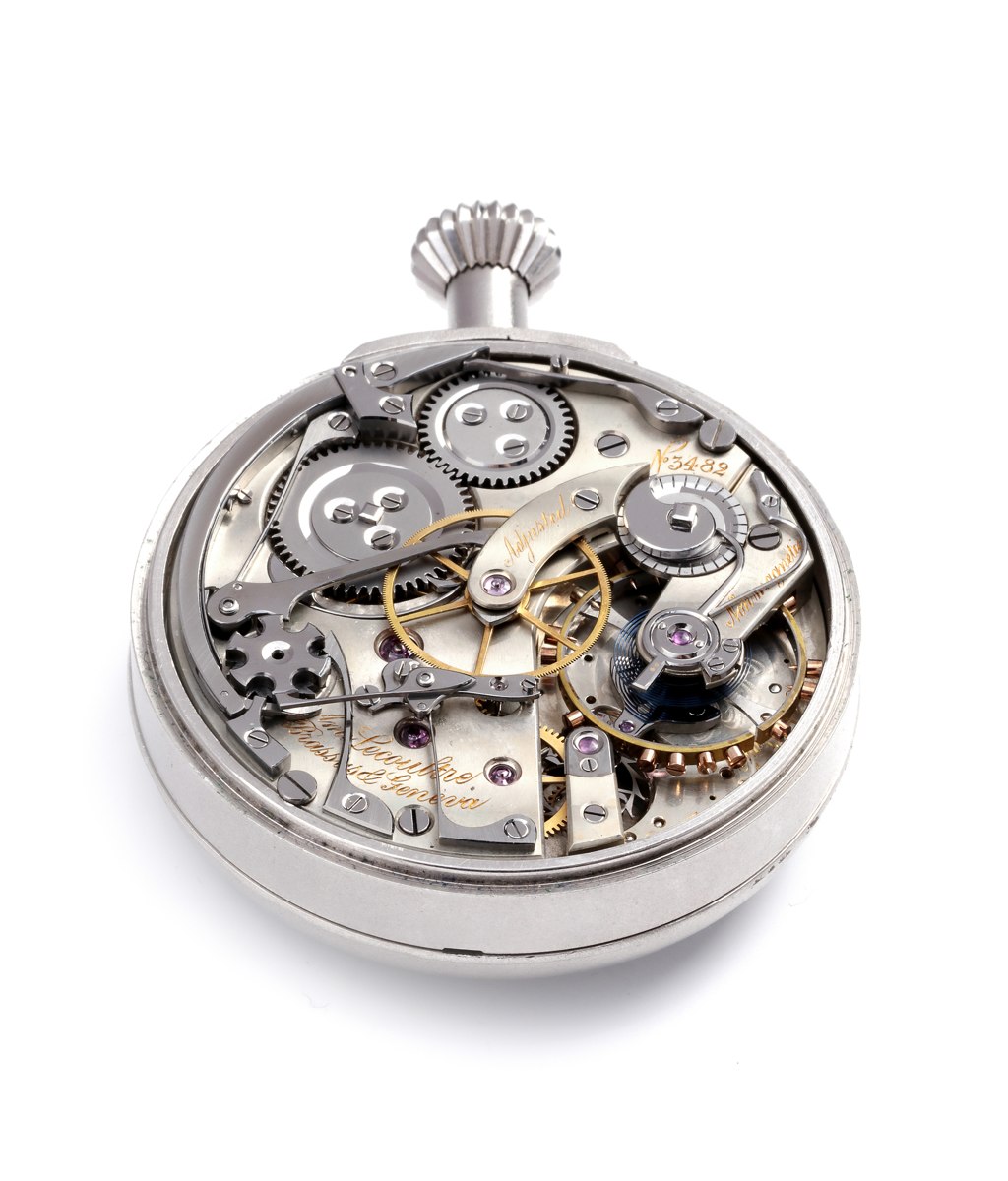
Ami Lecoultre split-seconds chronograph pocket watch movement in working-case

Partially verified

According to the auction catalog, this open-face pocket watch movement housed in a white metal working-case was manufactured circa 1888 by Ami Lecoultre of Le Brassus and Geneva. It features a 20-ligne rhodium-plated three-quarter plate movement with a straight-line lever escapement and a patented non-magnetic compensated balance. Horological complications reported by the source include a 1/4-second chronograph with an oscillating pinion device operated by a crown push-piece, a split-seconds function controlled at 11 o'clock, and a 1/4-second foudroyante subsidiary dial at 6 o'clock. The dial is white enamel with radial Roman numerals and blued steel pear hands.

Movement view of the Ami Lecoultre 20-ligne split-seconds chronograph with foudroyante in a working-case
Movement view of the Ami Lecoultre 20-ligne split-seconds chronograph with foudroyante in a working-case — Antiquorum. Rights pending — permission not yet requested. Original source

Catalogue identity

Source
catalog.antiquorum.swiss
Category
Pocket watch · Split-seconds chronograph pocket watch
Maker / attribution
Ami Lecoultre
Reference
Not recorded
Catalogue / lot identifier
1
Source-reported date
circa 1888
Country
Switzerland
Source-reported serial
3 482

Source-reported attribution and specifications are not independent authentication. A listing does not establish present ownership, current display, availability or permission to reproduce.

Object description

Identity and Horological Complications

This object consists of a 20-ligne open-face pocket watch movement housed in a white metal working-case, catalogued by the auctioneer as manufactured circa 1888 by Ami Lecoultre of Le Brassus & Geneva. It carries movement number 3 482 and measures 47.1 mm in diameter. The catalog notes that it is accompanied by copies of invention patents associated with its mechanisms.

The catalog lists three specific complications for the movement: a 1/4-second chronograph utilizing an oscillating pinion device operated through a push-piece in the winding crown, a split-seconds function controlled via a push-piece on the case band at 11 o'clock, and a 1/4-second foudroyante display situated on a subsidiary dial at 6 o'clock.

Evidence for this section
  • “White metal, open-face, keyless-winding, round-shaped, pocket watch movement in a working-case, with three horological complications:”
  • “1⁄4 second chronograph with oscillating pinion device (activated by the single push-piece located on the winding-crown) Split-seconds (activated by the push-piece located on the case- band at 11 o’clock) 1⁄4 of second, known as foudroyante seconds (subsidiary dial at 6 o’clock)”
  • “Movement No. 3 482”
  • “Accessories copies of the invention patents”

Visible Movement Construction and Finishes

Direct observation of the movement side reveals chronograph steel levers, intermediate wheels, a column wheel mechanism, and gold-filled cursive engravings. The plate engravings read 'No 3482', 'Adjusted', 'Non-magnetic', and 'Ami Lecoultre / Le Brassus & Geneva'. A fluted winding crown is visible atop the case pendant.

According to the auction catalog description, the movement is a 20-ligne, 3/4-plate caliber with rhodium plating, a going barrel, and a straight-line equilibrated lever escapement. The catalog also specifies an index regulator with a swan-neck spring and an eccentric snail precision-regulating mechanism for fast/slow adjustment, alongside a balance fitted with gold poising screws and a blued steel hairspring with terminal curve.

Evidence for this section
  • “Open movement side displaying chronograph steel levers, wheels, column wheel, and gold-filled cursive engravings.”
  • “Engravings legible on the movement plates include 'No 3482', 'Adjusted', 'Non-magnetic', and 'Ami Lecoultre / Le Brassus & Geneva'.”
  • “Fitted with a prominent fluted winding crown atop the case pendant.”
  • “Movement 20’’’, 3⁄4 plate, rhodium-plated, going barrel, straight-line equilibrated lever escapement, patented non-magnetic platinum alloy and brass compensated balance with gold poising screws and blued steel hairspring with terminal curve, index regulator with swan-neck spring and precision-regulating device for fast / slow by means of an eccentric snail, adjusted.”

Source Documentation and Unverified Elements

The catalog entry notes that the movement mechanism is based on American patent No. 355 403, granted on January 4, 1887, to Ami LeCoultre for a 'Stop Watch.' The balance is described as a patented non-magnetic platinum alloy and brass compensated balance linked in catalog notes to American patents issued in May and August 1888 to Heinrich Ostermann, Axel Prip, and Charles Lacroix.

Because the provided photograph only shows the movement side, elements on the reverse side are not visually verified. Descriptions of the white enamel dial with radial Roman numerals, the blued steel pear hands, and the foudroyante subsidiary dial at 6 o'clock rely entirely on the auction catalog text.

Evidence for this section
  • “Movement based on the American invention patent No. 355 403, delivered on January 4, 1887, to Ami LeCoultre, Le Brassus, for a “Stop Watch.”.”
  • “Metallic alloy of the balance based on the American invention patents No. 382 826 and No. 382 827, delivered on May 15, 1888, to Heinrich Ostermann, chemist, and Axel Prip, jeweller, Geneva, for a “Alloy.”, and also based on the American invention patents No. 388 145, No. 388 146 and No. 388 147, delivered on August 21, 1888, to Heinrich Ostermann, chemist, and Charles Lacroix, director of the Usine Genevoise de Dégrossissage d’or, Geneva, for a “Metallic Alloy.”.”
  • “White enamel dial with radial Roman numerals. Blued steel “Pear” hands.”

Open research questions

  • Does the dial or movement carry stamped numbers corresponding directly to the US patents cited in the catalog notes?
  • Was this white metal working-case intended purely as a manufacturer's casing for movement transport/patenting, or was it cased later?
  • What specific layout and markings appear on the 1/4 foudroyante subsidiary dial at 6 o'clock?

Source evidence

Recorded claims and source quotations for Ami Lecoultre split-seconds chronograph pocket watch movement in working-case
FieldSource-reported valueSource quotation
Movement Number3 482“Movement No. 3 482”
Caliber20’’’, lever escapement“Caliber 20’’’, lever escapement”
DimensionsØ 47.1 mm“Dimensions Ø 47.1 mm.”
HandsBlued steel “Pear” hands“Blued steel “Pear” hands.”
DialWhite enamel dial with radial Roman numerals“White enamel dial with radial Roman numerals.”
Case TypeWorking-case in white metal“White metal, open-face, keyless-winding, round-shaped, pocket watch movement in a working-case”
Patent ReferenceUS Patent No. 355 403 (Stop Watch)“Movement based on the American invention patent No. 355 403, delivered on January 4, 1887, to Ami LeCoultre, Le Brassus, for a “Stop Watch.”.”
SignaturesSigned on dial and movement“Signature dial and movement”

Visible details

  • Open movement side displaying chronograph steel levers, wheels, column wheel, and gold-filled cursive engravings.
  • Engravings legible on the movement plates include 'No 3482', 'Adjusted', 'Non-magnetic', and 'Ami Lecoultre / Le Brassus & Geneva'.
  • Fitted with a prominent fluted winding crown atop the case pendant.

Research qualifications

  • Catalogued specifically as a pocket watch movement housed in a working-case rather than a finished commercial case.
  • Details of the foudroyante dial, hands, and balance alloy composition are source-reported and not visible in this movement-side photograph.

Photograph identity and source facts were screened before import; rights clearance remains pending.

Terms in this record

Glossary explanations for terms named in this object’s record.