Skip to content
The Encyclopedia of Horology

Clock · Bracket clock

Thomas Windmills 18th Century Ebonized Table Clock

Partially verified

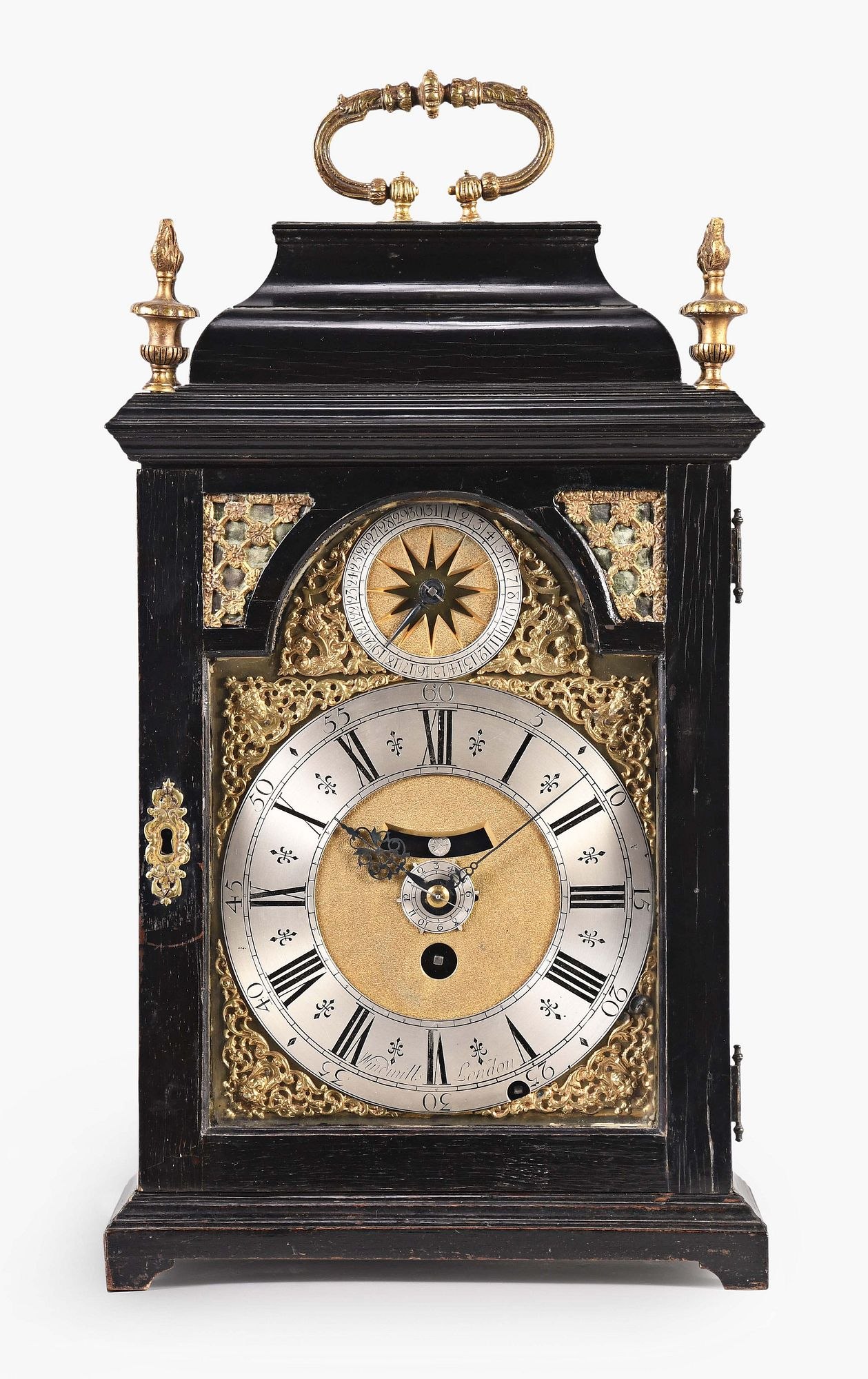
This 18th-century English table clock, attributed by source to Thomas Windmills of London, is housed in an ebonized caddy-top case adorned with gilded urn-and-flame finials, an ornate handle, and an escutcheon. Its arched composite dial displays a silvered chapter ring with Roman numerals and outer Arabic minute indicators, blued steel hands, pierced brass spandrels, a mock pendulum aperture, and an upper calendar arch featuring a sunburst mask. The auction description records an eight-day, three-train movement with fusee on the time train and cord winding for the alarm.

Front view of the ebonized Thomas Windmills table clock showing the arched composite dial, handle, and finials
Front view of the ebonized Thomas Windmills table clock showing the arched composite dial, handle, and finials — Schmitt Horan & Co. / Bidsquare. Rights pending — permission not yet requested. Original source

Catalogue identity

Source
www.bidsquare.com
Category
Clock · Bracket clock
Form
Table clock
Maker / attribution
Thomas Windmills
Reference
Not recorded
Catalogue / lot identifier
393
Source-reported date
circa 1750
Source-reported place
United Kingdom

Maker profile: Thomas Windmills — history, key models and current watchmaking.

Source-reported attribution and specifications are not independent authentication. A listing does not establish present ownership, current display, availability or permission to reproduce.

Object description

Case Form and Dial Features

The clock is housed in an ebonized case recorded with dimensions of 18 by 11 by 7 inches, fitted with glazed back and side apertures. The exterior ornamentation includes gilded and cast urn and flame finials at the top, decorative spandrels, a carrying handle, and an escutcheon. Visible observations note an ebonized bell-caddy surmounted by the handle and flanked by two visible urn-and-flame finials, along with an escutcheon plate on the left stile of the front door.

The composite dial features a silvered chapter ring with Roman hour numerals and pierced blued steel hands, surrounded by brass spandrels with foliate ornament and a central mask. In the arch, the dial includes a calendar display, a hollow sunburst mask, a silvered date chapter, and a silvered alarm dial positioned below an aperture for a mock pendulum.

Evidence for this section
  • “Dimensions: 18in x 11in x 7in”
  • “ebonized case with gilt, decorative spandrels, handle and escutcheon, the top with gilded and cast urn and flame finials, glazed back and sides, roman numeral composite dial with silvered chapter ring, pierced blued steel hands, brass spandrels with foliate ornament and central mask, the arch with calendar dial and a hollow sunburst mask with silvered date chapter and a silvered alarm dial below an aperture for the mock pendulum”
  • “Ebonized bell-caddy case surmounted by an ornate cast carrying handle and flanked by two visible urn-and-flame finials.”
  • “Gilt escutcheon plate mounted on the left stile of the front door.”
Movement and Attribution

The auction catalog describes the mechanism as an eight-day, three-train movement fitted with a bob pendulum, with a fusee present on the time train only. The alarm mechanism is described as cord-wound from the left side of the case. The back plate is decorated with engraving depicting acanthus, birds, and a central fruit basket, placed above an oval reserve containing the maker's name.

The catalog attributes the piece to Thomas Windmills, London, and lists an estimated date of circa 1750. The specific wording within the maker's reserve is not transcribed in the auction text.

Evidence for this section
  • “eight day, three train movement with bob pendulum and fusee on time train only, alarm is cord wound from the left side, back plate with engraved acanthus, birds and central fruit basket above an oval reserve with the maker's name”
  • “Thomas Windmills, London, an 18th century table clock”
  • “circa 1750”

Condition and Alterations

The catalog documents wear to the case, including cracked veneer, tarnished gilded components, replaced feet, and repairs to the front dial frame on the left side. Structural modifications include replaced base molding, a replaced back door, and modern hinges, though the back glass is noted as appearing original.

Both the front door glass and side panel glasses are noted as replacements. In the movement, the catalog notes that the mechanism is not attached to the case and mounting straps are missing. Furthermore, it lacks all strike train components and bells. The auctioneer reported the movement was ticking and the alarm appeared operational at cataloging.

Evidence for this section
  • “case is worn with cracks in the veneer, gilded pieces have tarnished, the feet are new; the front dial frame on the left side appears to have been repaired and the front door and side panel glasses have been replaced; back door has been replaced, some of the base molding has been replaced, modern hinges but back glass appears original”
  • “movement is not attached to case; mounting straps are missing, lacking all strike train components and bells, movement is ticking; alarm appears operational”

Open research questions

  • What specific signature text is inscribed in the oval reserve on the back plate?
  • Does examination of the movement pillar layout and train arbor holes indicate the original configuration of the missing strike train?
  • Are there matching mounting holes or witness marks on the case and movement plates confirming whether this movement and case are original to each other?

Source evidence

Recorded claims and source quotations for Thomas Windmills 18th Century Ebonized Table Clock
FieldSource-reported valueSource quotation
Maker attributionThomas Windmills, London“Thomas Windmills, London, an 18th century table clock”
Movement descriptionEight-day, three-train movement with fusee on time train“eight day, three train movement with bob pendulum and fusee on time train only”
Alarm windingCord wound from the left side“alarm is cord wound from the left side”
Dimensions18in x 11in x 7in“Dimensions: 18in x 11in x 7in”
Case condition notesWorn veneer with replacements to moldings and feet“case is worn with cracks in the veneer, gilded pieces have tarnished, the feet are new”
AccessoriesPendulum, four brass finials, and movement“ACCESSORIES: Pendulum, Four Brass Finials, Movement”
Estimated datecirca 1750“circa 1750”
Glazing statusReplaced front door and side panel glasses; original back glass on modern hinges“front door and side panel glasses have been replaced; back door has been replaced, some of the base molding has been replaced, modern hinges but back glass appears original”

Visible details

  • Ebonized bell-caddy case surmounted by an ornate cast carrying handle and flanked by two visible urn-and-flame finials.
  • Arched composite dial with a silvered chapter ring featuring Roman hour numerals and outer Arabic five-minute numerals.
  • Ornate pierced brass spandrels positioned in the dial corners, spandrel zones, and around the upper arch.
  • Upper arch displays a subsidiary ring surrounding a central radiating sunburst motif.
  • Aperture positioned in the upper portion of the dial center, revealing a mock pendulum.
  • Gilt escutcheon plate mounted on the left stile of the front door.

Research qualifications

  • The source reports the movement is not attached to the case and mounting straps are missing.
  • Lacking all strike train components and bells according to the auction description.
  • Condition notes indicate veneer cracks, replaced feet, replaced back door, and replaced glass panels on the front door and sides.

Photograph identity and source facts were screened before import; rights clearance remains pending.

Consulted source

Thomas Windmills table clock sold at auction on 28th April | Bidsquare

Reviewed 2026-10-21 · Record 8bea205fc9

Terms in this record

Glossary explanations for terms named in this object’s record.