
Skip to content
The Encyclopedia of Horology

Clock · Bracket clock

John Ellicott bracket clock

Partially verified

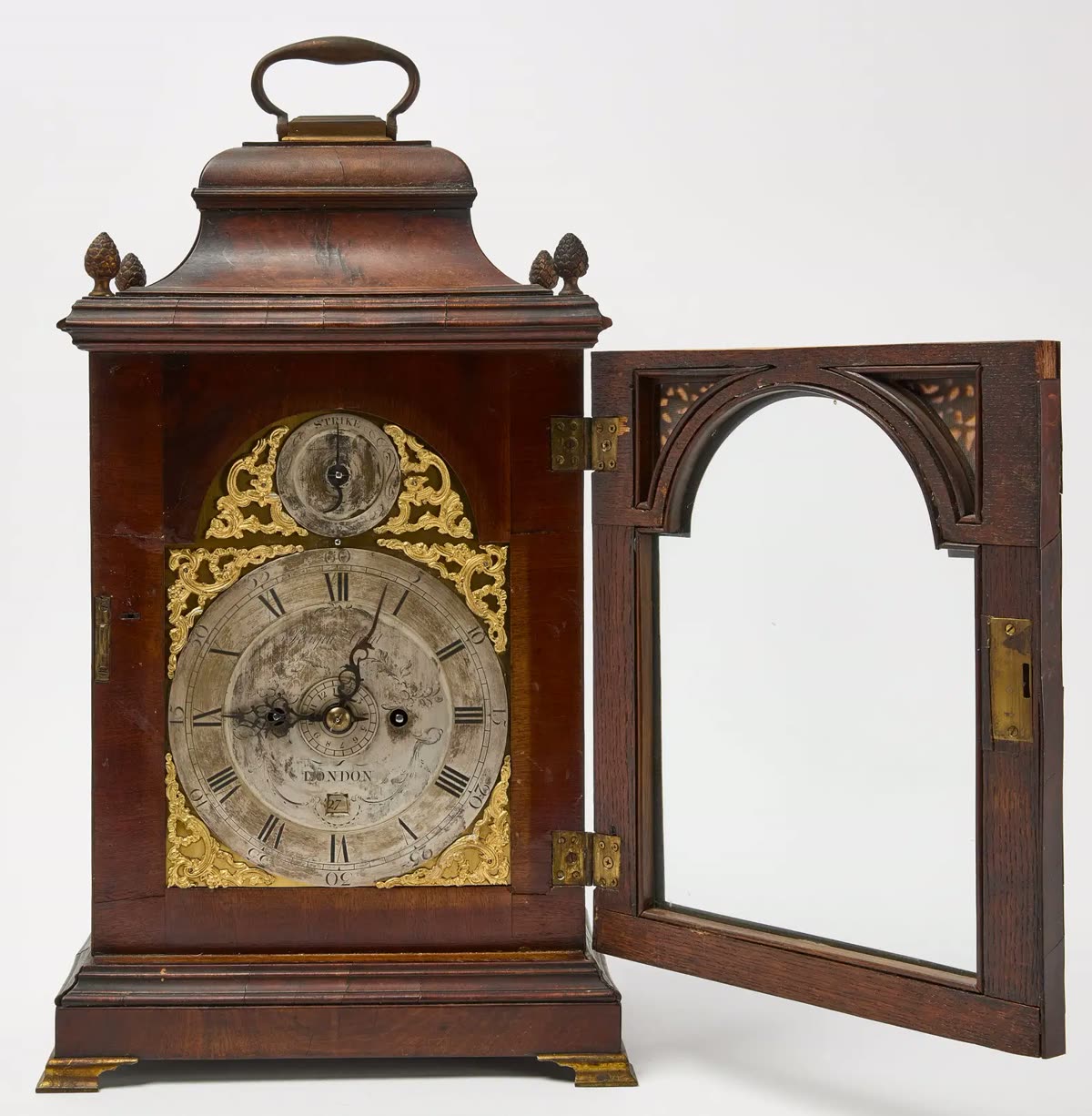
This eighteenth-century English bracket clock is housed in an inverted bell-shaped walnut case surmounted by a carrying handle and corner finials. Its arched brass dial features pierced gilt spandrels, a silvered chapter ring with Roman numerals and outer Arabic minute markings, a date aperture, and an upper subsidiary Strike/Silent dial. The dial center is inscribed 'LONDON'. According to the auction description, the movement is fitted with a verge escapement and the case measures 16-1/2 inches high.

Front view of the walnut bracket clock with open front door showing the arched brass and silvered dial
Front view of the walnut bracket clock with open front door showing the arched brass and silvered dial — New England Auctions - Fred Giampietro. Rights pending — permission not yet requested. Original source

Catalogue identity

Source
www.liveauctioneers.com
Category
Clock · Bracket clock
Maker / attribution
John Ellicott
Reference
Not recorded
Catalogue / lot identifier
0242
Source-reported date
18th century
Country
United Kingdom

Source-reported attribution and specifications are not independent authentication. A listing does not establish present ownership, current display, availability or permission to reproduce.

Object description

Case Form and Construction

According to the auction listing, the clock is housed in an inverted bell-shaped walnut case with stated measurements of 16-1/2 inches in height, 9-1/4 inches in width, and 6-1/4 inches in depth.

Visual observation of the cataloguing photograph shows that the front door is hinged and depicted open, revealing brass hinges and a keyhole lock plate on the case frame. The seller notes condition as including "Some restorations as expected," though specific restoration details are not documented in the listing.

Evidence for this section
  • “Inverted bell shaped walnut case.”
  • “H 16-1/2" W 9-1/4" D 6-1/4".”
  • “Front hinged door is open, showing brass hinges and a keyhole lock plate”
  • “Condition: Some restorations as expected.”

Dial Features and Visual Layout

The cataloguer records the clock as having a "Dial with silvered chapter ring." Visible inspection reveals an arched dial plate featuring gilded scrolling spandrels in the corners and arch surrounding the silvered ring.

In the upper arch, a smaller subsidiary dial is marked for strike regulation. The dial center exhibits visible tarnishing and wear, and it is marked with "LONDON" positioned above a square calendar aperture.

Evidence for this section
  • “Dial with silvered chapter ring.”
  • “Arched dial plate with gilded scrolling corner and arch spandrels surrounding a silvered chapter ring”
  • “Upper arch houses a smaller subsidiary dial marked for strike regulation”
  • “Dial center displays visible tarnishing/wear and is marked 'LONDON' above a square calendar aperture”

Reported Movement and Attribution Details

The auction entry identifies the piece under the heading "John Ellicott (1706–1772)" with origin given as "London, 18th century." However, visible inspection of the dial face shows only the city mark "LONDON" rather than a full signature of the maker.

Mechanically, the cataloguer describes the clock as having a "Movement with verge escapement" and notes it as "Working." Because the internal movement and back plate are not depicted in the listing image, movement markings, backplate engraving, and mechanical originality are not documented in this source.

Evidence for this section
  • “John Ellicott (1706–1772).”
  • “London, 18th century.”
  • “Dial center displays visible tarnishing/wear and is marked 'LONDON' above a square calendar aperture”
  • “Movement with verge escapement.”
  • “Working.”

Open research questions

  • Is the back plate of the movement engraved or signed with John Ellicott's name to support the cataloguer's attribution, given that only 'LONDON' appears on the dial center?
  • What specific components of the walnut case, dial, or movement underwent the 'restorations as expected' mentioned in the auction condition report?
  • Does the verge escapement show physical evidence of being original or reconverted from an earlier alteration?

Source evidence

Recorded claims and source quotations for John Ellicott bracket clock
FieldSource-reported valueSource quotation
Case designInverted bell shaped walnut case“Inverted bell shaped walnut case.”
Dial descriptionDial with silvered chapter ring“Dial with silvered chapter ring.”
EscapementVerge escapement“Movement with verge escapement.”
DimensionsH 16-1/2" W 9-1/4" D 6-1/4"“H 16-1/2" W 9-1/4" D 6-1/4".”
OriginLondon, 18th century“London, 18th century.”
Maker dates1706–1772“John Ellicott (1706–1772).”
Reported condition noteSome restorations as expected; working“Condition: Some restorations as expected. Working.”

Visible details

  • Arched dial plate with gilded scrolling corner and arch spandrels surrounding a silvered chapter ring
  • Upper arch houses a smaller subsidiary dial marked for strike regulation
  • Dial center displays visible tarnishing/wear and is marked 'LONDON' above a square calendar aperture
  • Front hinged door is open, showing brass hinges and a keyhole lock plate

Research qualifications

  • Internal movement and back plate are not visible in the provided image
  • The maker attribution to John Ellicott is sourced from the cataloguer, but the visible dial face shows 'LONDON' rather than the full maker's signature

Photograph identity and source facts were screened before import; rights clearance remains pending.

Terms in this record

Glossary explanations for terms named in this object’s record.