
Skip to content
The Encyclopedia of Horology

Clock · Bracket clock

An 18th century mahogany bracket clock with pull repeat and calendar function, Crane, Bromsgrove

Partially verified

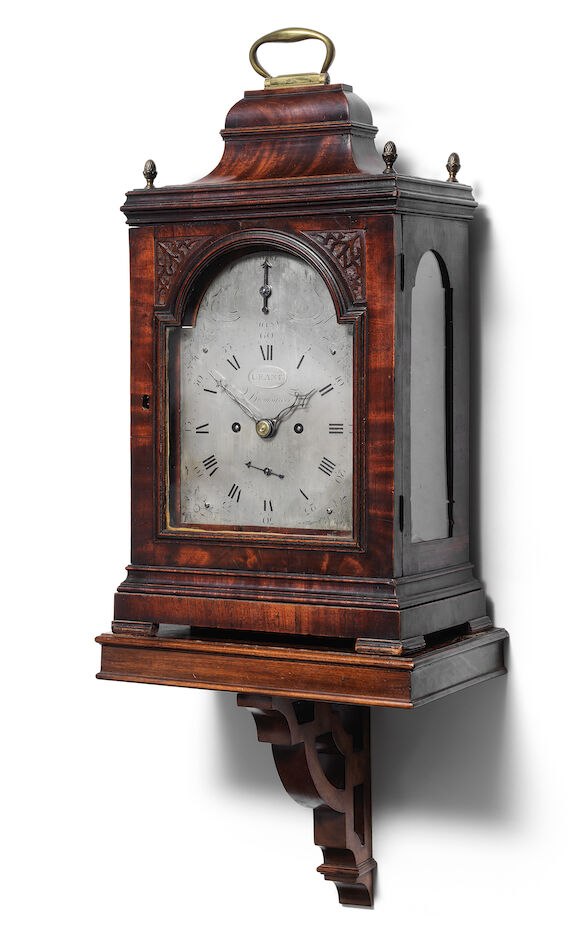
According to the auction catalogue, this 18th-century mahogany bracket clock was made by Crane of Bromsgrove. The concave bell-top case is fitted with a cast brass carrying handle and four pineapple finials, glazed side panels, and moulded block feet, mounted on a matching pierced wall bracket. The fully silvered arched dial displays Roman and Arabic numerals, pierced steel hands, a calendar aperture above VI, an engraved maker's cartouche below XII, and a strike/silent dial in the arch. Bonhams notes that the movement features twin gut fusees, five knopped pillars, a knife-edge verge escapement, and an engraved floral backplate.

Three-quarter perspective of the 18th-century mahogany bracket clock on its pierced bracket, signed Crane, Bromsgrove
Three-quarter perspective of the 18th-century mahogany bracket clock on its pierced bracket, signed Crane, Bromsgrove — Bonhams. Rights pending — permission not yet requested. Original source

Catalogue identity

Source
www.bonhams.com
Category
Clock · Bracket clock
Maker / attribution
Crane, Bromsgrove
Reference
Not recorded
Catalogue / lot identifier
127A
Source-reported date
18th century
Country
United Kingdom

Source-reported attribution and specifications are not independent authentication. A listing does not establish present ownership, current display, availability or permission to reproduce.

Object description

Case Architecture and Mounting

The clock is presented in an 18th-century mahogany case featuring a severely concave bell top surmounted by a cast brass handle and four small pineapple finials. The case is fitted with glazed sides as well as front and back doors, with upper quarter frets detailing the front door. It is supported by a moulded base resting on moulded block feet.

The lot includes a pierced wall bracket. Total height is catalogued as 79 cm (31 inches) when mounted on the bracket, compared to 53 cm (20.5 inches) for the clock case alone.

Evidence for this section
  • “The case surmounted by a cast brass handle atop the severely concave bell top with four small pineapple finials above the glazed sides, front and back doors, with upper quarter frets to the front door, supported by a moulded base, on moulded block feet.”
  • “79cms (31ins) high with bracket, 53cms (20.5ins) without”

Dial Configuration and Inscription

The arched dial plate is fully silvered, displaying Roman and Arabic numerals, engraved floral spandrels, and a subsidiary calendar ring positioned above the VI numeral. Time is indicated by skeletonised blued steel hands.

Beneath the XII marker, a raised oval cartouche is engraved 'Crane' above an elaborately engraved 'Bromsgrove'. The upper arch contains a large strike/silent dial with a blued steel pointer.

Evidence for this section
  • “The fully silvered arched Roman and Arabic dial with engraved floral spandrels and a subsidiary calendar ring above VI and raised oval cartouche under XII, engraved Crane above an elaborately engraved Bromsgrove , all under skeletonised blued steel hands with a large strike silent dial in the arch and a blued steel pointer.”

Movement and Reported Mechanics

According to the auction catalogue, the movement features twin gut fusees, five knopped pillars, and a knife-edge verge escapement. The backplate is documented as having floral and urn engraving.

The lot description notes pull repeat and calendar functions, two case keys, and that the clock was 'ticking' at cataloguing. Because internal movement details are not visible in the exterior photograph, their mechanical condition and assembly cannot be verified independently from this record.

Evidence for this section
  • “An 18th century mahogany bracket clock with pull repeat and calendar function Crane, Bromsgrove”
  • “The twin gut fusee movement with five knopped pillars and knife-edge verge escapement, the backplate with floral and urn engraving.”
  • “Ticking with two case keys and a pierced bracket.”

Open research questions

  • Does inspection of the backplate and movement confirm whether the knife-edge verge escapement is original or an alteration?
  • Can horological records identify the active working dates of the maker Crane in Bromsgrove?
  • Does examination of the pierced wall bracket indicate original co-manufacture with the mahogany clock case or a later association?

Source evidence

Recorded claims and source quotations for An 18th century mahogany bracket clock with pull repeat and calendar function, Crane, Bromsgrove
FieldSource-reported valueSource quotation
Case MaterialMahogany“An 18th century mahogany bracket clock”
MakerCrane, Bromsgrove“Crane, Bromsgrove”
EscapementKnife-edge verge escapement“knife-edge verge escapement”
Movement MechanismTwin gut fusee movement with five knopped pillars“twin gut fusee movement with five knopped pillars”
Dial DescriptionFully silvered arched Roman and Arabic dial with strike silent in the arch“fully silvered arched Roman and Arabic dial with engraved floral spandrels and a subsidiary calendar ring above VI and raised oval cartouche under XII, engraved Crane above an elaborately engraved Bromsgrove , all under skeletonised blued steel hands with a large strike silent dial in the arch”
Dimensions79 cm high with bracket, 53 cm without“79cms (31ins) high with bracket, 53cms (20.5ins) without”
Backplate DecorationFloral and urn engraving“the backplate with floral and urn engraving”
Accompanying AccessoriesTwo case keys and a pierced bracket“Ticking with two case keys and a pierced bracket.”

Visible details

  • Arched mahogany case mounted on a matching pierced wooden wall bracket.
  • Concave bell top surmounted by a brass bail carrying handle.
  • Four small metal pineapple finials positioned on the corners of the upper moulding.
  • Silvered arched dial plate featuring Roman hours, an outer Arabic minute track, a calendar dial above VI, and a strike/silent ring in the arch.
  • Glazed arched side window providing a view into the movement chamber.

Research qualifications

  • Internal mechanisms, gut fusees, knopped pillars, and the engraved backplate are not visible in the provided exterior photograph.
  • Mechanical functioning is reported by the auctioneer ('ticking') but cannot be independently verified.

Photograph identity and source facts were screened before import; rights clearance remains pending.

Terms in this record

Glossary explanations for terms named in this object’s record.