
Skip to content
The Encyclopedia of Horology

Marine chronometer · One-day marine chronometer

Thomas Earnshaw marine chronometer no. 509

Partially verified

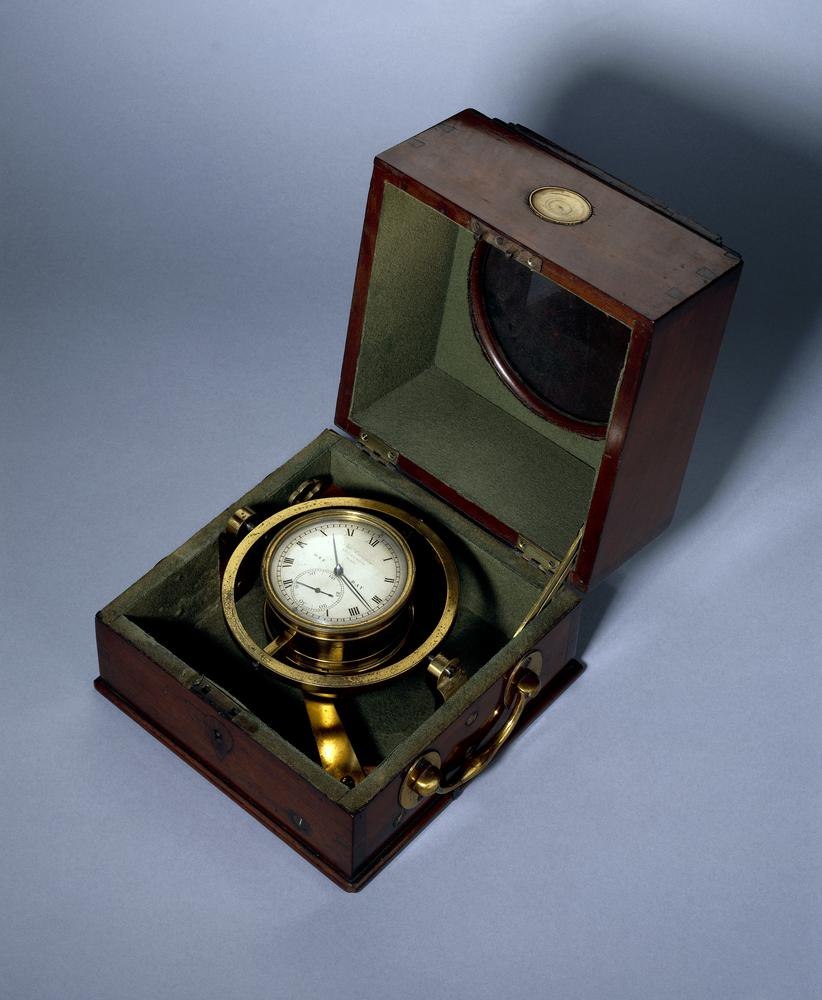
This one-day marine chronometer was made around 1795 to 1805 by Thomas Earnshaw in London. Housed in a brass bowl mounted within a brass gimbal system, it sits inside a rectangular mahogany box lined with green baize. The movement features Earnshaw's spring-detent escapement, a split-bimetallic balance, a helical blued-steel balance spring, fusee, and maintaining power. The silvered brass dial displays Roman hour numerals, an outer minute ring, and a subsidiary seconds track above the VI numeral, bearing the signature 'Thos Earnshaw INVT ET FECIT NO 509 ONE DAY'. Historically, it saw service across several Royal Navy vessels, notably including HMS Beagle under Captain Robert FitzRoy.

Three-quarter view of the Thomas Earnshaw marine chronometer in its gimballed brass bowl within the opened mahogany box
Three-quarter view of the Thomas Earnshaw marine chronometer in its gimballed brass bowl within the opened mahogany box — British Museum. Rights pending — permission not yet requested. Original source

Catalogue identity

Source
www.britishmuseum.org
Category
Marine chronometer · One-day marine chronometer
Maker / attribution
Thomas Earnshaw (Senior)
Reference
Not recorded
Catalogue / lot identifier
Source URL identifies the listing
Source-reported date
1795-1805
Country
United Kingdom
Source-reported serial
509

Source-reported attribution and specifications are not independent authentication. A listing does not establish present ownership, current display, availability or permission to reproduce.

Object description

Construction and Housing

The chronometer is housed in a rectangular mahogany box with dovetailed base corners and brass carrying handles. The lid, which features a round glazed aperture and a mahogany sliding cover, includes an internal brass slide to limit its opening. The box is lined with green baize, excluding two triangular wooden inserts at the corners that contain brass spring locking pieces.

The exterior of the case features a small empty hole in the front of the lower section. An ivory disc recess is present in the front of the top lid, though the disc itself is missing. The underside of the sliding cover is lined with dark purple leather.

Evidence for this section
  • “Rectangular mahogany box with two brass carrying handles, locking lid with round glazed aperture in the top and mahogany sliding cover.”
  • “The inside of the box lined with green baize, except for two triangular wooden (oak?) inserts to front right and rear left corners which have brass spring locking pieces screwed to them.”
  • “One small empty hole in the front of the lower case. Ivory disc recess in the front of the top but with the engraved(?) disc now missing.”
  • “The underside of this cover is lined with dark purple leather.”

Dial and Mechanism

The silvered brass dial bears the signature 'Thos Earnshaw INVT ET FECIT NO 509 ONE DAY'. It features Roman numerals I-XII and a subsidiary seconds dial located above the VI numeral. The dial is attached to the movement via two screws, one of which is currently missing.

The one-day spring-driven movement includes a fusee, Harrison's maintaining power, and an Earnshaw spring-detent escapement. It utilizes a split-bimetallic balance and a helical blued-steel balance spring, which is noted as a later replacement. The brass escape wheel contains thirteen teeth.

Evidence for this section
  • “On the dial 'Thos Earnshaw INVT ET FECIT NO 509 ONE DAY'.”
  • “Dial attached to movement by two screws which pass through the front plate and screw into the back of the dial. One screw now missing.”
  • “Later closely coiled blued steel helical spring of 11 turns”
  • “Earnshaw spring-detent escapement with Earshaw split-bimetallic temperature compensation balance”
  • “brass escape wheel of thirteen teeth”

Service and Provenance

The chronometer served on various Royal Navy ships, including HMS Hecla, before being sent to Robert Molyneux for overhaul in July 1830. In December 1831, it was placed into service on HMS Beagle for the voyage involving Captain Robert Fitzroy and Charles Darwin.

The object was part of the Ilbert Collection, purchased in 1931 from Lilley & Son, and was subsequently presented to the British Museum by Gilbert Edgar in 1958.

Evidence for this section
  • “In July 1830 it went to Robert Molyneux for cleaning and overhaul”
  • “In December ofthat year it went into service, along with a number of other chronometers, on HMS 'Beagle's' momentous voyage with Captain Robert Fitzroy and Charles Darwin.”
  • “Provenance: Ilbert Collection; in his inventory notebook Ilbert records the purchase of this chronometer in 1931 from Lilley & Son. Presented by Mr Gilbert Edgar C.B.E. in 1958.”

Open research questions

  • What is the significance of the 'JB 2/6/86' scratch found on the back of the dial?
  • Could the missing ivory disc be confirmed as 'plain' (as stated in the description) or 'engraved' (as suggested by the curator's notes)?

Source evidence

Recorded claims and source quotations for Thomas Earnshaw marine chronometer no. 509
FieldSource-reported valueSource quotation
Museum Number1958,1006.1957“Museum number 1958,1006.1957”
MakerThomas Earnshaw (Senior)“Made by: Thomas Earnshaw (Senior)”
EscapementEarnshaw spring-detent escapement“Earnshaw spring-detent escapement with Earshaw split-bimetallic temperature compensation balance”
Dial InscriptionThos Earnshaw INVT ET FECIT NO 509 ONE DAY“On the dial 'Thos Earnshaw INVT ET FECIT NO 509 ONE DAY'.”
DurationOne-day“One-day spring-driven movement, with fusee and Harrison's maintaining power.”
Ship ServiceHMS Beagle“it went into service, along with a number of other chronometers, on HMS 'Beagle's' momentous voyage with Captain Robert Fitzroy and Charles Darwin.”
Museum Number1958,1006.1957“Museum number 1958,1006.1957”
Barrel Bridge InscriptionLondon No 2853“On the barrel bridge 'London No 2853'.”
Dial Reverse Markings509 and JB 2/6/86“Scratched on the back ' 509 ' and 'JB 2/6/86'.”

Visible details

  • Silvered dial with Roman numerals I through XII and a subsidiary seconds dial located above the six o'clock position.
  • Blued steel hour, minute, and seconds hands.
  • Gimballed brass mounting ring holding the cylindrical chronometer bowl inside a hinged mahogany box.
  • Mahogany box lid with glazed aperture and circular ivory inlay on the exterior.

Research qualifications

  • Source notes conflicting details regarding the ivory disc: described as an 'inserted plain ivory disc' in one section, but later noted as 'Ivory disc recess in the front of the top but with the engraved(?) disc now missing'.
  • Movement interior, balance spring, and back plate inscriptions are not visible in the provided exterior photographs.

Photograph identity and source facts were screened before import; rights clearance remains pending.

Consulted source

marine chronometer | British Museum

Reviewed 2026-10-25 · Record bc50562a0b

Terms in this record

Glossary explanations for terms named in this object’s record.