
Skip to content
The Encyclopedia of Horology

Marine chronometer · One-day marine chronometer

Thomas Earnshaw Marine Chronometer No. 245

Partially verified

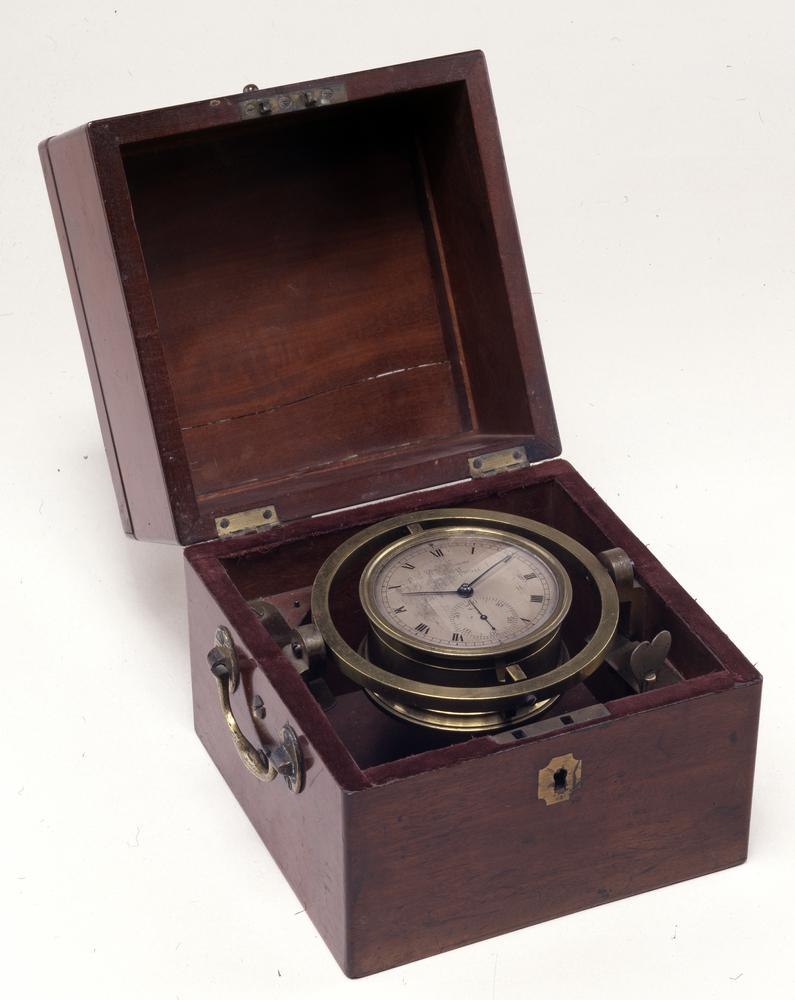
This one-day marine chronometer by Thomas Earnshaw, dated by the British Museum to between 1790 and 1800 (and circa 1795 in catalogue comments), is built with an Earnshaw spring detent escapement. The movement is cased in a brass canister with a solid gimbal ring, set within a later mahogany outer box edged with red velvet. Its silvered dial plate is directly engraved and filled with black wax, featuring Roman numerals, blued steel hands, and a subsidiary seconds dial. Research cited in the museum record identifies its use by Captain Henry Meriton aboard the HEICS Exeter during early 19th-century voyages to China.

Oblique view of Thomas Earnshaw marine chronometer No. 245 gimballed inside its open mahogany box
Oblique view of Thomas Earnshaw marine chronometer No. 245 gimballed inside its open mahogany box — British Museum. Rights pending — permission not yet requested. Original source

Catalogue identity

Source
www.britishmuseum.org
Category
Marine chronometer · One-day marine chronometer
Maker / attribution
Thomas Earnshaw
Reference
Not recorded
Catalogue / lot identifier
Source URL identifies the listing
Source-reported date
1790-1800
Country
United Kingdom
Source-reported serial
No 245

Source-reported attribution and specifications are not independent authentication. A listing does not establish present ownership, current display, availability or permission to reproduce.

Object description

Construction and Movement

This one-day marine chronometer employs a full-plate movement construction typical of large watches, secured by five turned pillars. The brass elements are finished with a dull grain.

The escapement is an Earnshaw spring detent type. It features a brass escape wheel with arms recessed below the level of the teeth and rims, a large diameter discharge roller, and a straight detent with a triangular locking stone.

Evidence for this section
  • “one-day Earnshaw movement”
  • “Earnshaw spring detent escapement with typical brass escape wheel”
  • “Remarkably large diameter discharge roller with the tip of the jewel almost at the same radius as the impulse roller”

Dial and Housing

The dial lacks a separate plate; signature details, Roman numerals, and subsidiary seconds are engraved directly into the metal dial plate and filled with black wax. The hands are blued steel.

The movement is contained within a brass canister and supported by a gimbal system. This canister is housed in a mahogany box, noted as a later replacement, which features a glazed top panel and internal red velvet dust seals.

Evidence for this section
  • “The engraving is directly on the dial plate, and is filled with black wax”
  • “The movement contained in a brass canister, gimballed in a later mahogany box.”
  • “The box has a glazed panel in the top”
  • “strip of red velvet as a dust seal”

Historical Context and Provenance

Log entries for the HEICS Exeter demonstrate that Captain Henry Meriton used this chronometer, identified as No. 245, for longitude observations during voyages between 1800 and 1808.

The chronometer was formerly part of the Ilbert Collection and was acquired by the British Museum in 1958 via a donation from Mr. Gilbert Edgar. A mainspring replacement recorded to George Cotton and Sons occurred in January 1937.

Evidence for this section
  • “he mentions chronometer No. 245 in the longitude observation”
  • “Presented by Mr Gilbert Edgar C.B.E. in 1958”
  • “The later mainspring signed 'George Cotton and Sons Jan 1937'”

Open research questions

  • What is the significance of the inscription 'London No 2264' on the barrel bridge?
  • Are there other records of chronometers used by Captain Meriton that correlate with the unnamed 'No. 56' mentioned in the ship's logs?

Source evidence

Recorded claims and source quotations for Thomas Earnshaw Marine Chronometer No. 245
FieldSource-reported valueSource quotation
EscapementEarnshaw spring detent“Earnshaw spring detent escapement with typical brass escape wheel”
Dial SignatureTHOs EARNSHAW LONDON INVT et FECIT No 245“On the dial 'THOs EARNSHAW LONDON INVT et FECIT No 245'.”
Museum Registration Number1958,1006.1960“Museum number 1958,1006.1960”
Replacement MainspringGeorge Cotton and Sons Jan 1937“The later mainspring signed 'George Cotton and Sons Jan 1937'”
EscapementEarnshaw spring detent“Earnshaw spring detent escapement”
Museum Registration Number1958,1006.1960“Museum number 1958,1006.1960”
Dial SignatureTHOs EARNSHAW LONDON INVT et FECIT No 245“On the dial 'THOs EARNSHAW LONDON INVT et FECIT No 245'.”

Visible details

  • Square mahogany case with an open hinged lid and inlaid brass keyhole escutcheon
  • Gimballed brass canister holding the marine chronometer movement
  • Brass side drop handle attached to the outer wooden box
  • Silvered dial with Roman hour numerals and subsidiary seconds track
  • Red velvet dust seal running along the upper rim of the lower box section

Research qualifications

  • Museum curators note the mahogany box is a later replacement
  • Mainspring is not original, signed by George Cotton and Sons and dated January 1937

Photograph identity and source facts were screened before import; rights clearance remains pending.

Consulted source

marine chronometer; clock-case | British Museum

Reviewed 2026-10-25 · Record 6cfb560f5e

Terms in this record

Glossary explanations for terms named in this object’s record.