
Skip to content
The Encyclopedia of Horology

Clock · Table clock

Table clock with calendar by Joseph Antram

Partially verified

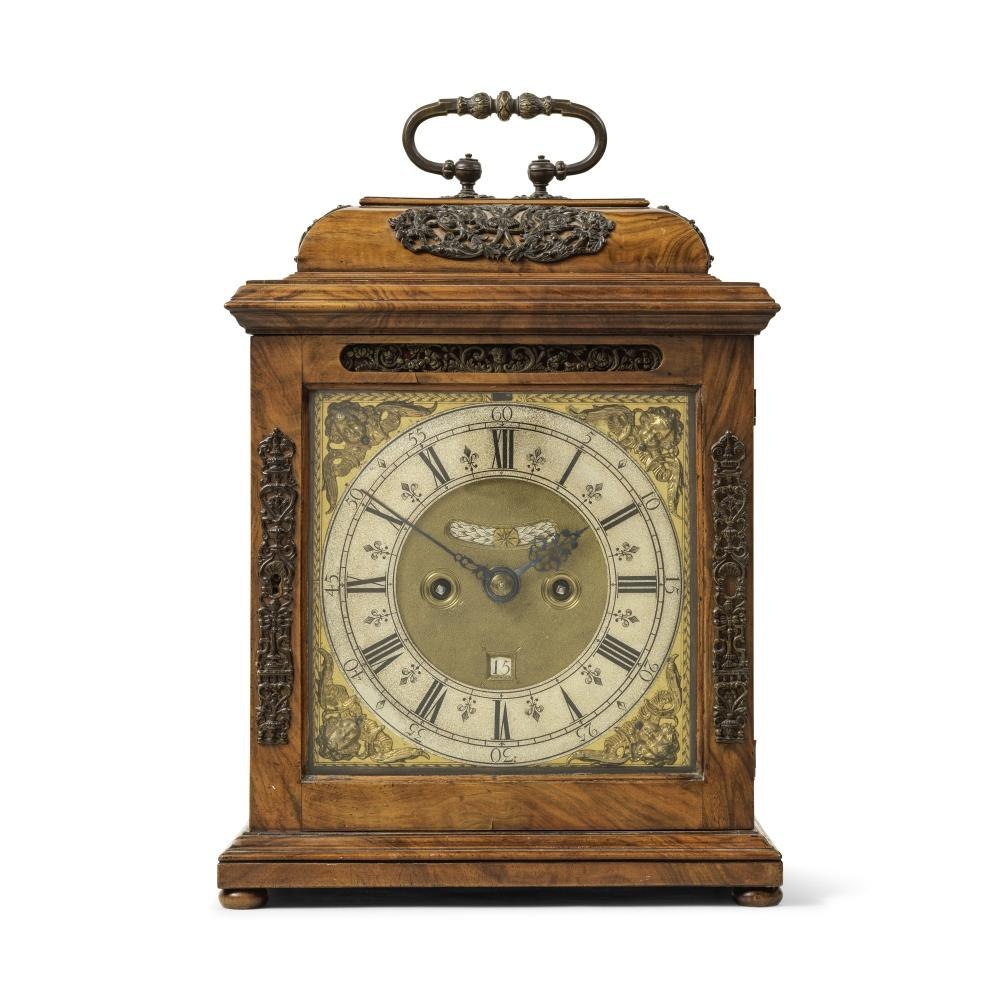
The clock features a twin fusee movement, originally constructed with a verge escapement and since converted to an anchor escapement. The movement includes five knopped pillars and a rack and snail striking mechanism for the hours on a bell. The 5-inch brass dial displays a silvered Roman chapter ring with Arabic five-minute intervals and fleur-de-lys half-hour markers. It is centered by a matted finish with a mock pendulum aperture and a calendar indicator. The dial is framed by winged cherub spandrels and a strike/silent dial within the break arch. The walnut case incorporates a caddy top with tulip and foliage mounts, and stands on four brass bun feet.

The clock featuring a brass dial with calendar and mock pendulum apertures, housed in a walnut case with a caddy top and brass carrying handle.
The clock featuring a brass dial with calendar and mock pendulum apertures, housed in a walnut case with a caddy top and brass carrying handle. — Bonhams (via Invaluable). Rights pending — permission not yet requested. Original source

Catalogue identity

Source
www.invaluable.com
Category
Clock · Table clock
Maker / attribution
Joseph Antram
Reference
Not recorded
Catalogue / lot identifier
285
Source-reported date
early 18th century
Source-reported place
England

Source-reported attribution and specifications are not independent authentication. A listing does not establish present ownership, current display, availability or permission to reproduce.

Object description

Dial and Case Description

The clock utilizes a 5-inch brass dial featuring a silvered chapter ring with Roman numerals and Arabic five-minute markers. The design incorporates fleur-de-lys half-hour indicators and a matted central panel which includes a mock pendulum aperture and a calendar window located at the base. Cast winged cherub spandrels flank the dial, which is further decorated by a wheatear-engraved border and a strike/silent dial situated in the break arch.

The case includes a caddy top decorated with applied tulip and foliage mounts, surmounted by a brass carrying handle. The exterior features glazed observation windows on the sides and a rear aperture, with the structure raised on a moulded base and four brass bun feet.

Evidence for this section
  • “The 5 inch brass dial with silvered Roman chapter ring and Arabic five-minute markers”
  • “The case, which is probably of 20th-century manufacture”

Movement and Escapement

The clock is powered by a twin fusee movement supported by five robust knopped pillars. The mechanism is designed to strike the hours on a bell, managed through a rack and snail system. The backplate shows ornamental engraving depicting flowing scrolls, acanthus leaves, and other foliate patterns, accompanied by a signature cartouche for Joseph Antram of London.

Significant technical modifications are present in the movement. While it was built originally with a verge escapement, it has subsequently been converted to an anchor escapement. This change included the introduction of a replacement pendulum and a new back cock. The current state of the movement is incomplete, with reports indicating that the fusees have lost their setup and the lines are presently detached.

Evidence for this section
  • “The twin fusee movement, originally with verge escapement and now converted to anchor”
  • “five robust knopped pillars, striking the hours on a bell mounted above the backplate via rack and snail”
  • “both fusees have lost their setup and the lines are detached”

Condition and Attribution

The condition report notes that the case is well-executed, with all brass mounts securely attached, although they exhibit tarnish. The veneers remain largely intact with minimal lifting. The dial is reported to be in an unrestored state, with the silvered chapter ring showing an unusual tone and minor markings observed near the winding squares.

The clock is attributed to the early 18th century, though it is now married to a more contemporary case. The auction description cautions that the movement is in need of a full overhaul for reliable operation, citing spare holes in the backplate and the non-original status of the pendulum and back cock assembly as part of the conversion process.

Evidence for this section
  • “The dial is in unrestored condition.”
  • “the clock has been converted from verge escapement to anchor, with a replacement pendulum and back cock.”
  • “We would recommend a full overhaul for reliable use.”

Open research questions

  • What is the specific provenance history prior to the current distinguished private collection?
  • At what point in the clock's history was the original verge escapement replaced with an anchor escapement?

Source evidence

Recorded claims and source quotations for Table clock with calendar by Joseph Antram
FieldSource-reported valueSource quotation
MakerJoseph Antram“Joseph Antram, London”
Dateearly 18th century“An early 18th century table clock movement and dial”
EscapementAnchor“originally with verge escapement and now converted to anchor”
Dial Size5 inches“The 5 inch brass dial”
Case materialWalnut“in a later walnut case”
Height42cm“42cm (16.5ins) high.”
Striking mechanismRack and snail“striking the hours on a bell mounted above the backplate via rack and snail”

Visible details

  • The dial contains a calendar aperture positioned at the lower section.
  • The case includes a foliate-tied brass carrying handle on the caddy top.
  • The backplate features detailed engraving of acanthus leaves and scrolls.
  • The clock has been modified from its original verge escapement to an anchor escapement.

Research qualifications

  • The auction description states the walnut case is likely a 20th-century manufacture.
  • The current condition of the movement includes detached fusee lines and lost setup.
  • The authenticity of the back door access is currently restricted as the lock is engaged.

Photograph identity and source facts were screened before import; rights clearance remains pending.

Terms in this record

Glossary explanations for terms named in this object’s record.