
Skip to content
The Encyclopedia of Horology

Clock · Table clock

Table clock by Bartholomew Newsam

Partially verified

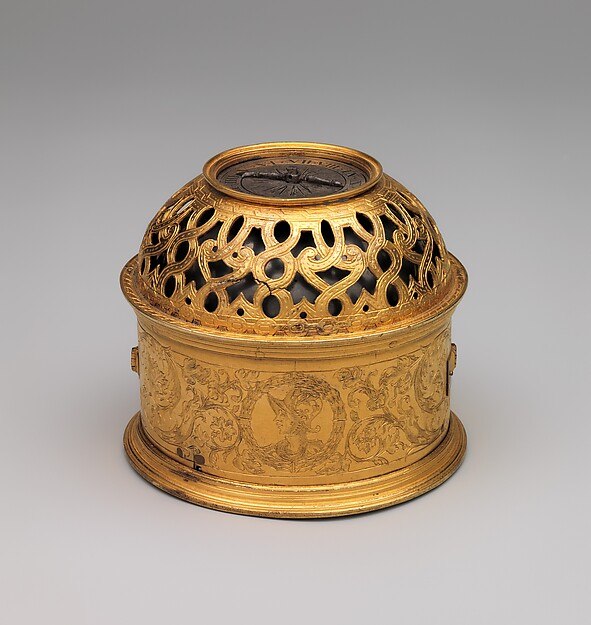
This sixteenth-century table clock is attributed to Bartholomew Newsam, a maker recorded in London between 1565 and 1587. The cylindrical timepiece features an engraved, chased, and gilded brass case with a pierced, domed top and profile moldings. It is designed with two hinged doors for accessing the gut-driven fusees of both the going and striking trains. The movement comprises two brass plates supported by four turned pillars, utilizing a verge escapement regulated by a balance. Originally intended for travel, the clock is accompanied by a boiled and molded leather (cuir-bouilli) case. The object is signed "BARTHOLMEW NVSAM" within an ornate frame on the exterior.

Cylindrical table clock by Bartholomew Newsam, showing the pierced dome and engraved brass case.
Cylindrical table clock by Bartholomew Newsam, showing the pierced dome and engraved brass case. — The Metropolitan Museum of Art. Rights pending — permission not yet requested. Original source

Catalogue identity

Source
www.metmuseum.org
Category
Clock · Table clock
Maker / attribution
Bartholomew Newsam
Reference
Not recorded
Catalogue / lot identifier
17.190.1514a
Source-reported date
1580–85
Source-reported place
Britain

Source-reported attribution and specifications are not independent authentication. A listing does not establish present ownership, current display, availability or permission to reproduce.

Object description

Case and External Features

The clock is housed in a cylindrical case crafted from engraved, chased, and gilded brass. The design includes a profile molding supporting a gilded, pierced, and chased strapwork dome, which houses the silver dial. The dial is calibrated for twelve hours and features a single iron hand, both of which are documented as later replacements.

Hinged doors on opposite sides of the case allow access to the gut-driven fusees for the going and striking trains. The sides are decorated with roundels featuring a helmeted warrior and a female figure, encircled by laurel wreaths and foliate scrolls. The base plate is friction-fitted, features S and M markings for maintenance, and bears the signature of Bartholomew Newsam within a strapwork frame.

Evidence for this section
  • “The cylindrical case of the Metropolitan Museum’s table clock is made from engraved, chased and gilded brass with a profile molding that supports a gilded, pierced, and chased strapwork dome.”
  • “It is signed on the exterior side, “BARTHOLMEW NVSAM,” within a stylish strapwork-ornamented frame that hangs from a ribbon with tasseled ends.”

Movement and Mechanism

The spring-driven movement consists of two circular brass plates separated by four turned brass pillars that end in ball feet. The going train includes three wheels, while the striking train consists of four wheels ending in a fly. Power is provided by fusees cut for gut, with the going train providing a duration of slightly more than twenty-four hours and the striking train nearly twenty-four hours.

Historical repairs have resulted in the replacement of several components. The arbors, steel verge, balance, and balance cock are replacements. The mainspring in the going train is an old component considered oversized for its barrel. A previous, abandoned method of attachment involved screws, the evidence of which remains as plugged holes in the case sides, whereas the clock now uses steel latches.

Evidence for this section
  • “The spring-driven movement, with fusees cut to accommodate gut, consists of two circular-brass plates held apart by four turned-brass pillars pinned to the top plate”
  • “At one point the movement was attached to the case by two screws instead of the steel latches secured by S-shaped springs that are now employed to create a very French-like construction.”

Provenance and Associated Objects

The clock includes a cylindrical case of boiled and molded leather (cuir-bouilli), believed to be original to the timepiece and indicative of its function as a travel clock. This case features a shield-shaped brass escutcheon and a hook-and-eye closure. A printed label on the bottom of the leather case links the object to the collection of the British banker Frederick George Hilton Price.

The item was later acquired by J. Pierpont Morgan, who eventually gifted the piece to the Metropolitan Museum of Art in 1917. Before its tenure in the Hilton Price collection, the clock and its leather case were associated with W. Jerdone Braikenridge of Somerset, England.

Evidence for this section
  • “The cylindrical case of boiled and molded leather (cuir-bouilli) with stamped ornament is most likely original to the clock and suggests that the timepiece was intended from the beginning to be used for traveling.”
  • “A printed label on the underside of the leather case identifies the object as number 141 in the Hilton Price Collection.”

Open research questions

  • What is the origin of the non-original silver dial and hour-wheel assembly?
  • Is there further evidence linking the engraving style to specific South German models beyond Virgil Solis prints?

Source evidence

Recorded claims and source quotations for Table clock by Bartholomew Newsam
FieldSource-reported valueSource quotation
MakerBartholomew Newsam“Bartholomew Newsam, Maker”
Date1580–85“1580–85”
MediumGilded brass case, silver dial“Case: engraved, chased, and gilded brass; dial: silver; movement: brass and steel”
Accession Number17.190.1514a“17.190.1514a”
SignedBARTHOLMEW NVSAM“It is signed on the exterior side, “BARTHOLMEW NVSAM,” within a stylish strapwork-ornamented frame”
ProvenanceHilton Price Collection, J. Pierpont Morgan“A printed label on the underside of the leather case identifies the object as number 141 in the Hilton Price Collection.”

Visible details

  • Case decorated with roundels depicting a helmeted warrior and a female figure
  • Signature "BARTHOLMEW NVSAM" within a ribboned frame on the base plate
  • Movement includes going train with fusee and verge escapement
  • Base plate marked with S and M for striking and movement

Research qualifications

  • The silver dial and sculptured iron hand are not original to the clock
  • The steel arbors, verge, balance, and balance cock are noted as replacements
  • The bell has been broken and repaired

Photograph identity and source facts were screened before import; rights clearance remains pending.

Consulted source

Table clock

Reviewed 2026-10-26 · Record 8cef9b3601

Terms in this record

Glossary explanations for terms named in this object’s record.