
Skip to content
The Encyclopedia of Horology

Pocket watch · Oval pendant watch

Robert Grinkin Oval Pendant Watch

Partially verified

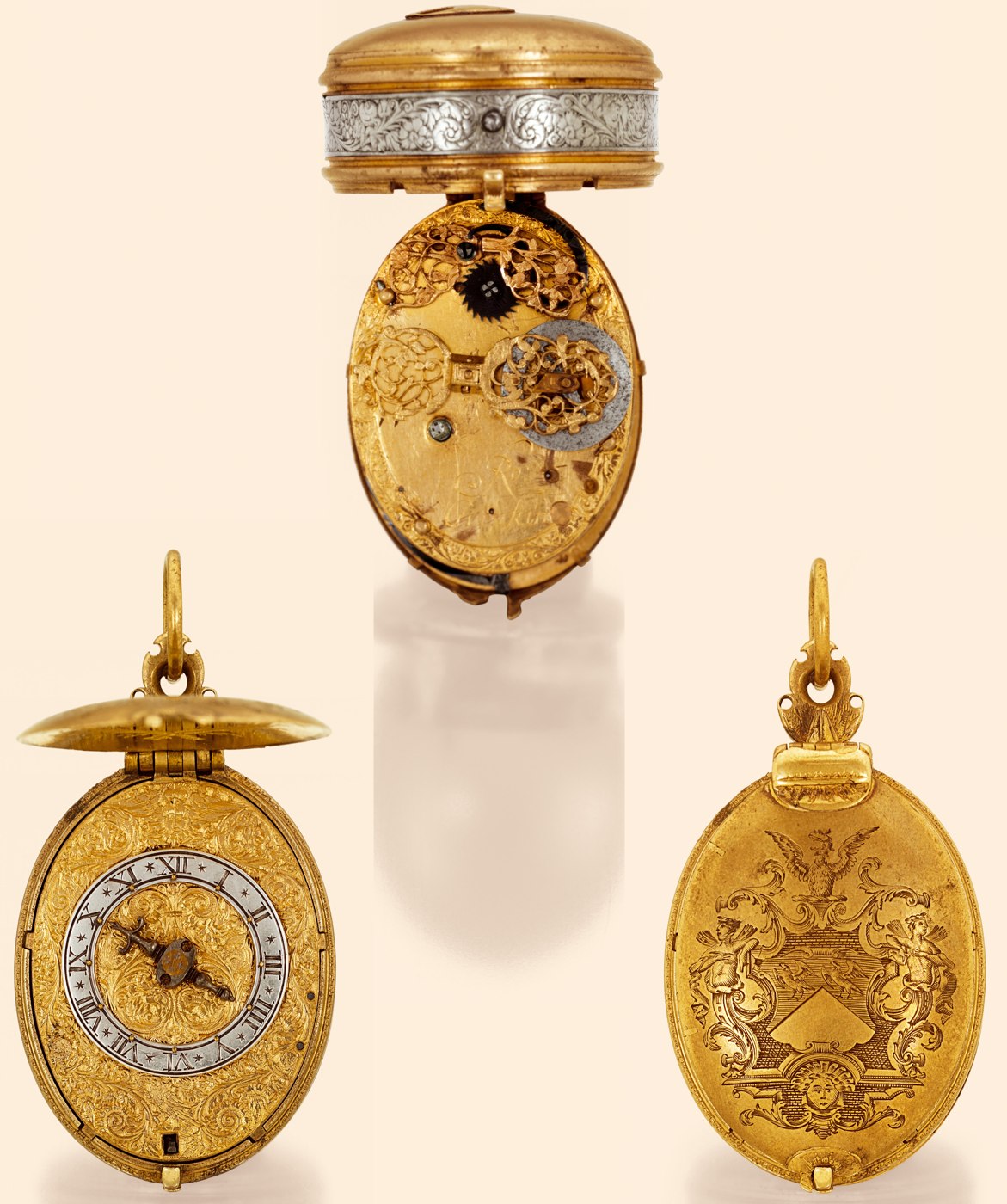
This early 17th-century pendant watch is attributed to the London maker Robert Grinkin and dates to approximately 1625. It features an oval case construction with a silver band chased in foliage and an outer cover bearing engraved arms associated with John Stephens, Attorney General to Henry, Prince of Wales and Charles I, added around 1700. The dial is chased and engraved with inhabited foliage and includes an applied silver chapter ring with radial Roman numerals and star half-hour markers. Internally, the watch is powered by a hinged gilt brass full-plate movement. It utilizes round baluster pillars, a fusee with gut line, and a verge escapement with a plain steel two-arm balance lacking a spring. The watch is signed on the backplate and includes an irregular florally pierced gilt brass cock and a ratchet wheel setup. This piece is documented in several horological publications.

The oval pendant watch shown with the dial exposed (left), the movement exposed (center), and the engraved cover exterior (right).
The oval pendant watch shown with the dial exposed (left), the movement exposed (center), and the engraved cover exterior (right). — Antiquorum. Rights pending — permission not yet requested. Original source

Catalogue identity

Source
catalog.antiquorum.swiss
Category
Pocket watch · Oval pendant watch
Maker / attribution
Robert Grinkin
Reference
Not recorded
Catalogue / lot identifier
104
Source-reported date
circa 1625
Source-reported place
London, England

Source-reported attribution and specifications are not independent authentication. A listing does not establish present ownership, current display, availability or permission to reproduce.

Object description

Case and Dial

The watch is housed in an oval, two-body case featuring a silver band decorated with chased foliage. An outer hinged cover carries the engraved arms of John Stephens, who served as Attorney General to Henry, Prince of Wales, and Charles I. The inner surface of this cover is engraved with a laurel wreath. It is noted that these armorial engravings date to approximately 1700, reflecting later historical provenance.

The dial plate is finished with detailed chasing and engraving featuring inhabited foliage. An applied silver chapter ring is mounted to the dial, displaying radial Roman numerals alongside star-shaped half-hour markers. Time is indicated by an elaborate blued steel single hand, which sits centrally over the decorated dial plate. The watch remains in a pendant format, consistent with its design for portable use during the early 17th century.

Evidence for this section
  • “C. Two-body, silver band chased with foliage, outer hinged cover engraved with the arms of John Stephens”
  • “the inner surface engraved with a laurel wreath”
  • “D. Oval dial plate finely chased and engraved with inhabited foliage, applied silver chapter ring with radial Romannumerals and star half-hour markers.”

Movement and Escapement

The movement is constructed as a hinged gilt brass oval full-plate. It is supported by round baluster pillars, which provide the structural framework for the gear train. Energy is transmitted through a fusee system utilizing a gut line, which was a common feature for watches of this period. The escapement is of the verge type, controlling a plain steel two-arm balance that operates without a balance spring.

Additional mechanical features include an irregular, florally pierced gilt brass cock, which is secured by a pin. A ratchet wheel setup with a matching cock is also incorporated into the design. The backplate features an engraved foliate band along its border and bears the signature of the maker.

Evidence for this section
  • “M. Hinged gilt brass oval full-plate withround baluster pillars, the backplate with engraved foliate band on the border”
  • “fusee with gut line, verge escape-ment,plain steel two-arm balance without spring”
  • “irregular florally pierced gilt brass cock secured by a pin, ratchetwheel set-up with matching cock.”

Provenance and Documentation

This watch has been the subject of multiple historical references and horological studies. It was previously sold by Antiquorum in Geneva during the 1995 auction titled "The Art of British Horology." Documentation also suggests it is almost identical to a watch illustrated in T.P. Camerer Cuss's 1976 work, "The Camerer Cuss Book of Antique Watches." Further academic analysis regarding the maker and the watch appears in publications such as "Antiquarian Horology" and the "Notes and Records of the Royal Society of London."

Robert Grinkin was a significant figure in 17th-century London clockmaking. He was a member of the Clockmakers' Company from its founding in 1632, eventually serving as master on two separate occasions during the mid-17th century.

Evidence for this section
  • “This watch was previously sold by Antiquorum, Geneva, in "The Art of British Horology", 21 October 1995, lot 3.”
  • “An almost identical watch by the same maker is described and illustrated in T.P. Camerer Cuss”
  • “was a member of the Clockmakers' Company from the year of its foundation in 1632.”

Open research questions

  • What specific archival evidence links the engraved arms to the personal collection of John Stephens?
  • Are there identifiable variations in the movement architecture between this example and the piece illustrated in the Camerer Cuss book?

Source evidence

Recorded claims and source quotations for Robert Grinkin Oval Pendant Watch
FieldSource-reported valueSource quotation
MakerRobert Grinkin“Robert Grinkin, London”
Date of productioncirca 1625“Made circa 1625”
Arms engraving datecirca 1700“arms engraved circa 1700”
Case dimensions58 x 35 mm“Dim. 58 x 35 mm”
EscapementVerge“verge escape-ment”
BalancePlain steel two-arm without spring“plain steel two-arm balance without spring”
Case constructionSilver band and gilt brass“C. Two-body, silver band chased with foliage”
Signature locationBackplate“Signed on the backplate.”

Visible details

  • Oval gilt brass and silver two-body case
  • Applied silver chapter ring with radial Roman numerals
  • Movement with round baluster pillars and gut line fusee
  • Irregular florally pierced gilt brass cock

Research qualifications

  • Arms were engraved circa 1700, potentially well after the original production date of the watch
  • Attribution of the specific maker within the Grinkin family remains historically contextual rather than definitively verified by a specific workshop mark

Photograph identity and source facts were screened before import; rights clearance remains pending.

Terms in this record

Glossary explanations for terms named in this object’s record.